Spring, the season of hope, emerges as the most uplifting of the four seasons. The very word “spring” signifies “coming forth”, likely inspired by dormant seeds, patiently awaiting through fall and winter, now germinating and thrusting green shoots into the air. It’s a riot out there!
Our ancestors must have been challenged to comprehend nature’s workings. They had to accept its rhythmic repetitions like clockwork. Today, of course, science illuminates the tilt of the earth that orchestrates the seasons, somewhat diminishing the romantic allure.
I recall the incredulity of my youth upon learning that while it was spring here, it was fall elsewhere, seeming as if I stood upright while others were upside down.
Reflecting on our ancestors’ perspectives on spring, Greek mythology offers insights into the complex Pantheon of Gods. Zeus, the chief, alongside his formidable brothers Poseidon and Hades, and their three sisters—Hestia, Demeter, and Hera—spawned from Rhea. It’s a convoluted family, replete with peculiar dynamics.
Cronus, having usurped his father Uranus to rule the Heavens, harbored the same apprehension. Upon Rhea’s childbirth, Cronus swiftly swallowed each infant, one by one. Yet, Zeus, the youngest, was spared when Rhea concealed a stone within swaddling clothes, tricking Cronus.
Zeus matured and eventually overthrew Cronus, liberating his siblings and marrying his sister Hera. Truly, a turbulent family affair.
Meanwhile, Hades, unmarried, set his sights on his niece, Persephone, daughter of Demeter. Despite Persephone’s disinterest, being deeply connected to the Earth like her mother, she was ensnared by Hades’ relentless pursuit. His black chariot, drawn by four steeds with fiery eyes, whisked Persephone to the Underworld to reign as its queen.
Consequently, Earth lost its idyllic perfection, descending into a singular, melancholic season. Demeter, devastated by her daughter’s abduction, plunged Earth into desolate winter, lamenting her loss. Eventually, Hera intervened, securing a compromise. Persephone would cyclically descend to Hades, marking the onset of fall, then ascend to reunite with Demeter, heralding spring’s return. Summers, meanwhile, were a time of revelry.
Thus, the year’s cycle was dictated by a dysfunctional family saga, transcending the mundane tilt of the Earth. Oh, and did I mention Persephone’s father was Zeus, the younger brother who reigned over all?
Martha Wainwright’s poignant song “Proserpina” (Persephone) on YouTube.com adds a musical dimension to this tale.
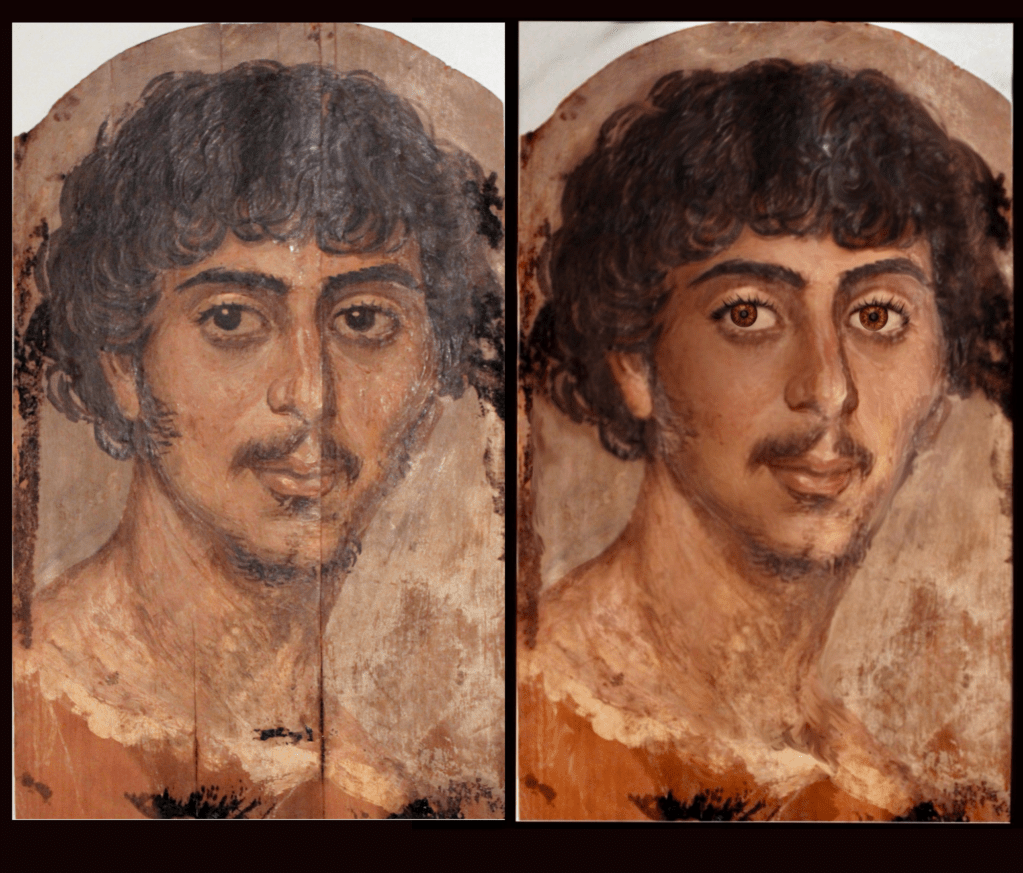
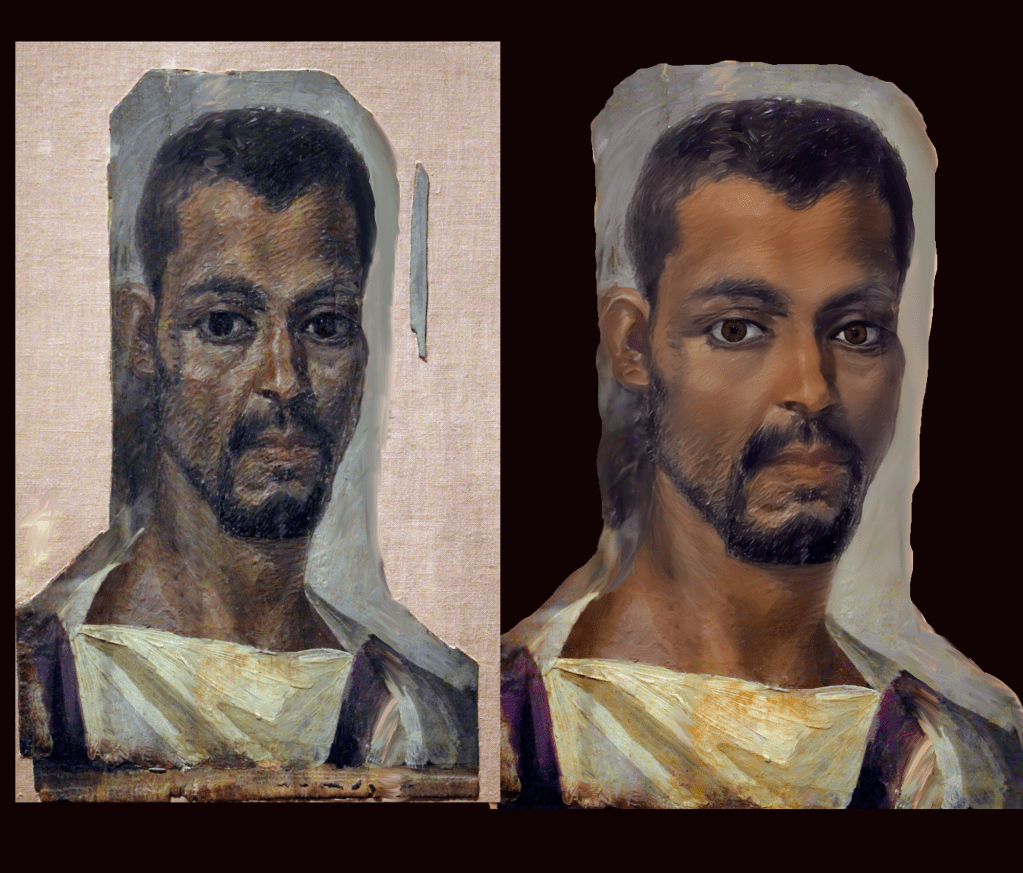
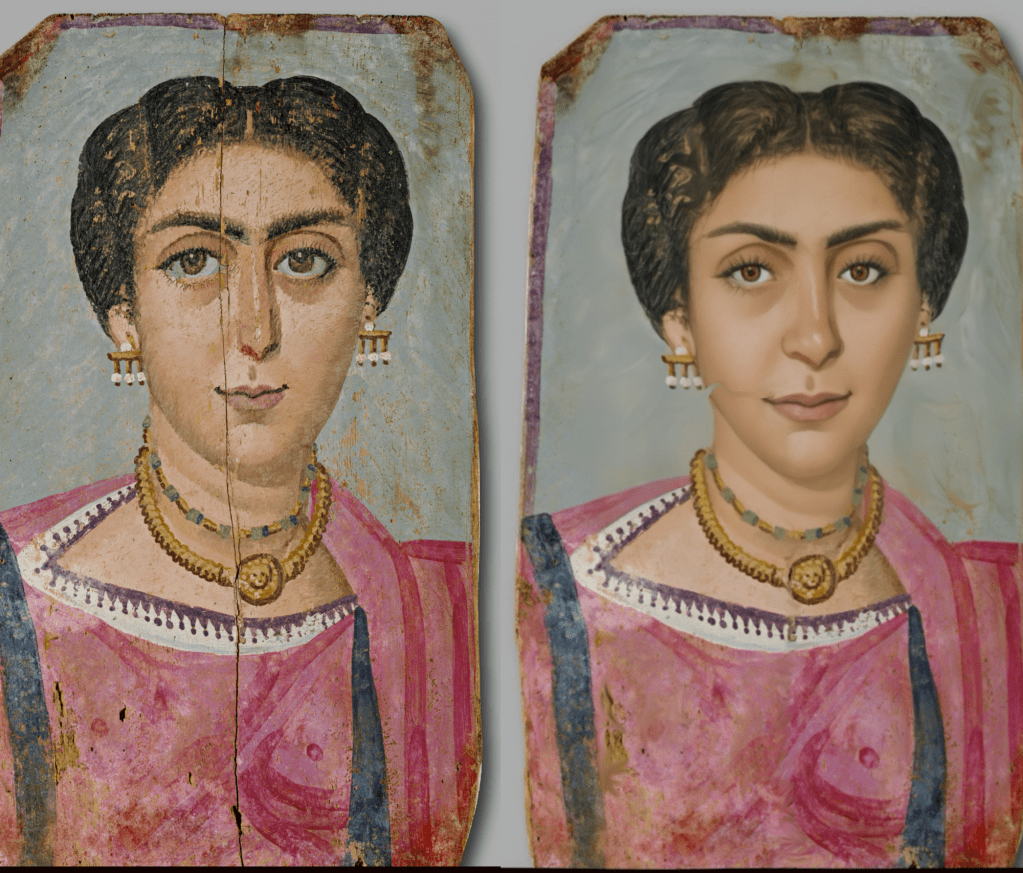
I’ve collected a number of Fayum Mummy Portraits from archeological digs. There was a short period where this art was popular, running from 1st century to the middle of the 3rd century, primary in the Fayum Basin in Egypt.
They were primarily full color portraits, painted on boards, that were placed on the face,and attached, to wrapped mummies.
It’s clear that many of the mummies were of individuals who had died young.
I scanned the images, then spent some time repairing cracks, and giving a little modern makeover.
It’s tax time. Every year about this time, it’s tax time. Time to pay the piper. Time to fund the government that makes choices for where my money goes. Time to assess if those choices are in agreement with my choices. Yech!
It’s also one of those big years, one of those presidential choice years, it’s such a very very sad year, at least until this morning.
This morning, as a complete surprise, I found a candidate, one that edged out the others in the significant category of who I would want stuck in an elevator with, or trapped in snow lodge with lots of coffee. Actually it even extends to personally having a dinner in my own home.
No one has met that standard on the national stage for decades, and that’s okay because national issues are really platform issues, and I always support the platform that mostly coincides with my own personal standards. It’s never perfect, but I know I’m doing the best I can.
But this year, I believe I have found a candidate that meets both standards and that hasn’t happened for decades upon decades.
My vote is secret, I will not participate in polls, I’m stubborn that way, but I do occasionally announce candidates that I support…
Bags and bags of springs, their ends straight, with the springy part in the middle. My pay depended on the pound of completed bent springs.
It was a monotonous task, but one I could manage from home, offering flexibility in my hours. There seemed to be an insatiable demand for precisely bent springs. For months, it was the same routine, until one day, a new jig arrived with slightly heavier springs, ushering in a change.
A “jig” was the machine responsible for bending and clipping the ends of the raw springs. I merely had to insert the spring and press the pedal on the floor. Arms would swing into action, bending and clipping the wire. All I had to do was drop it into the completed bucket and insert another spring. It was repetitive, hypnotic, and surprisingly profitable.
In the 60s, there weren’t many job opportunities for teenagers with long hair. Businesses were wary of hiring “hippies” or radicals. But for me, it worked out just fine.
I landed this gig through my sister-in-law, who outsourced her spring making. She obtained her springs from a weathered old man she had “adopted”. He was likely in his eighties, with gnarled fingers, stooped shoulders, and a shuffling gait, speaking broken English with an Italian accent.
Amadeo, the middleman, supplied the portable electric jigs and the specified weight of the springs. I assumed he shipped the final products to factories or warehouses.
But Amadeo was more than just a supplier. He was a genuine spiritualist, specifically a Faithist, believing in the “New Bible”, a text published in 1882 by a dentist in New York City.
The book, titled “Oahspe”, was said to have been “automatically” typed over several years, guided by spiritual forces. With the typewriter being a recent invention, the spiritual forces must have been thrilled.
Amadeo often lingered for a few hours when delivering supplies or picking up springs. It was his opportunity to share about Oahspe and its impact on his life.
As a subcontractor, I felt it was polite to excuse myself and return to bending springs. Although I did receive a broken English translation of Oahspe, I needed to focus on earning money, so I politely declined further discussions.
Amadeo left a copy of his “New Bible”, a thick tome of around 1500 pages, filled with cosmic charts and color portraits of saints in turbans, giving it a distinctly Persian feel.
Years later, with Amadeo gone and my spring-bending days behind me, “Oahspe” remained on my bookshelf. During a visit, a friend noticed the book, she abruptly turned around, and left, another date gone awry.
Yesterday afternoon I saw the musical ‘The Divine Sarah” by June Richards and Elaine Lang. Something both of them started over forty years ago, and shelved more then 39 years ago. Most things on the shelf for more than five years are simply lost in time.
In this case, good friends asked them, “What happened to that script?” Then someone found the .pdf of the typed pages. Another found some VHS tapes that were made of readings, and the songs were found on tape.
Old friends were called upon, rewrites were made, COVID forced readings on Zoom. Endless edits, a completely new second act, lots more current research, and nearly a thousand images downloaded from around the world. When the resolution was so poor, the images were redrawn, reimagined.
In a world of takers, there was a subset of “makers”.
Months of wondering what to do, now that it was nearly finished. Submit the musical to producers, and a magically a local playhouse dedicated to new works agreed to produce the musical. I began helping nearly 4 years ago. It’s been on stage for a week with three more weeks to go. The production is wonderful, the music sublime, Sarah is perfect, and the Ensemble could not be better.
So amazing to see something that existed only in text and images in your head, become alive on stage with an audience enthralled.
So, I sit thinking about the things we see, and what we do about them. A painting on the wall, not yours, in a different place, different town. Who is it by? What do you think?
I think it is a blend of MC Escher and Salvador Dali. Oddly disturbing, mysterious, and beautiful.
That has an impact on how I feel, and the emotions that are just under the surface. Whatever happens next, whatever words are said, have to go first through this protective filter. Sight is powerful.
If we see something out of normal, a flaky patch of skin, a change in color, a lump of tissue. Between sight and touch, the experience can send you down path, close to the future abyss. Which is probably more like leaving the room than falling in a crevasse.
My thoughts turn to various moments of the totally natural event that didn’t happen, but should have. A truck crashing through a barricade on the road above me, 8×8 timbers exploding in either direction, so close as to sweep behind, and in front of me, leaving me standing safely, while the truck lands inches in front, bouncing from a 12 foot drop. Whew!
Or some years later, I’m on a small 20 foot sailboat, sailing alone, trying to let down the jib. I decide to go downwind, let the mainsail out fully, tie off the rudder, release the jib sheets, walk forward carefully to manually pull down the jib.
I was successful, I walk back safely, jump into the cockpit, bend forward a little, and my tight fitting beret fell off my head, I bend forward at my knees to pick the hat up, and suddenly the wind shifts and there is a hard gybe. The boom sweeps the boat moving from starboard to port with such violence as to nearly snap the mast.
Needless to say I should have been standing, I should have been hit in the chest, or beheaded. I should have been launched breathless into Richardson’s Bay, taking my first breath six feet under water.
For the non-sailor readers, a soft gybe is harmless in windless conditions. A hard gybe is still safe in steady winds from aft, but you have to bring the boom nearly to the center line of the boat, lock the sheet, and do not over steer the rudder, or you will knock the boat down.
Having the boom way out to the side, is like a professional baseball batter swinging for the bleachers. It gets real tricky when the wind shifts and your rudder is tied down. Somehow the boom didn’t hit me, and I got control of the rudder.
Accidents happen, sometimes we survive, sometimes we don’t. The curiosity is when synchronicity is taking place at the same time.
And here is the issue I am thinking today. If I have even the slightest issue of not understanding the meanings of past synchronicities, when they were monumentally obvious… what chance do I have in seeing and understanding the subtle future events?
Watching for them diligently is probably the first step, denying the possibility of coincidence is the second step, and maybe just asking for guidance is the third step.
I’ve often pondered whether synchronicities are merely coincidences. While Google may suggest they’re related, synchronicities carry a weight of “meaning” that’s both perplexing and disconcerting.
I find it unsettling when seemingly disparate events align to convey significance, especially when they could easily be dismissed as random or even “cartoonish.”
With my daughter and her husband visiting during a layover from New Zealand to NYC, and my wife away assisting our other daughter, I’m left alone, perhaps more susceptible to flights of fancy—or at the very least, awkwardly stable.
Driving with my departing daughter to Alameda, where they plan to catch an early morning flight, dinner plans were thwarted by a combination of rain and nighttime driving—two elements I’m not keen on facing simultaneously.
Opting to depart between storms while daylight lingered, I found myself amidst the peak of commute traffic, a scenario I’m accustomed to handling, so long as it moves at a steady pace.
Navigating through Alameda’s maze of commuter traffic and underwater tubes, I found myself queued up for the Webster Street tube. As traffic slowed, I seized the opportunity to cue up some music on my phone, settling on a blast from the past—“Alley Oop” from 1960.
Though it had been decades since I last heard it, I called upon Siri to play the tune. Yet, as seconds ticked by, it became evident Siri was struggling to connect. Did she need the artist’s name? The dilemma was real—I couldn’t recall. Was it “Sam the Sham, and the Pharaohs”? My memory was foggy, clouded by the dozens of one-hit wonders from that era.
As I attempted to clarify, the unexpected unfolded. Just as I uttered “Sam the Sham and the Pharaohs,” a towering figure emerged in the tunnel ahead of me. His outstretched arms and striped robe gave him an uncanny resemblance to Moses, especially with the cars parting to the left and right. But wait, he had a headdress and kohl eye makeup. Not Moses, but Pharaoh!
There was no logical explanation for his sudden appearance, no empty vehicle he emerged from. Was he one of the Pharaohs from my half-remembered band? The mind plays tricks in the murky depths of exhaust fumes, beneath forty feet of water.
As he knelt before a passing Tesla, motioning as if in supplication, chaos ensued. Swerving to avoid him, the Tesla nearly collided with the tunnel wall, providing me with a narrow window to slip past on the right. The cramped confines of the tunnel, coupled with the unexpected presence of a Pharaoh, made for a surreal experience.
Glancing in my mirror, I verified he was still there, and ahead I saw the tunnel’s end approaching. And just as abruptly as the Pharaoh appeared, the unmistakable strains of “Alley Oop” filled the car—not by the expected artists, but by the Hollywood Argyles.
Coincidence may no longer have a place in my vocabulary, but synchronicity lingers—a reminder of the inexplicable connections that weave through the tapestry of life.
In my world there are no coincidences, only undiscovered meanings. If synchronicity embraces that then I’m left with the “cartoonish” puzzle of my thoughts and the timing.
It’s almost like a test flight, “I can do this, and other things, prepare to believe.”
I’ve been here before, or so it feels. Maybe it’s the flickering neon sign of “Pizza Palace” casting a familiar red glow on my beatle-length hair. I rock the “early days” look, paired with year-round sandals and a perpetually shoulder-draped jacket. Not exactly bar-worthy, which sucks at nineteen.
No car, no license. My “haunt” is this late-night pizza joint, a haven for weary souls and my trusty notebooks. Two of them, because you never know when inspiration strikes. One night, it took the form of a giant Finn named Don, and his “girlfriend” – twice his size and three times the ambition. He spent nights here drowning his existential dread in cheap beer, while she built her own life, brick by brick, degree in hand.
Don offered me a job at the cannery – peaches, pears, and the dubious glory of fruit cocktail. From head to toe, I donned a rubber hazmat suit (before Hazmat suits were a thing). My baptism by fire was the graveyard shift, pushing a squeegee and sending fallen fruit on a one-way trip to the bay.
Then came the steam. Hours spent hosing down machinery, the air thick with the metallic tang of fear. The real terror? Zeke and the sewers. The guy who knew the labyrinthine network of tubes carrying deceased peaches to their watery grave. Every so often, a tube clogged, and Zeke asked for a volunteer from the cleanup crew. I was volunteered. He’d return alone, the disposable guy long gone, quitting after the shift.
I quit before my shift came. The money was good, but the thought of Zeke’s expeditions under the cannery sent shivers down my spine.
Yet, next summer, a postcard arrived: “Come back, the second year is easier!” Apparently, seniority had its perks. This time, I landed a swing shift, working my way up the cannery ladder. My station? Lid-placing. Easy, right? Except, I mostly fed the machine, occasionally causing a five-minute “distraction” with an upside-down lid. Hey, a little chaos never hurt anyone.
Third season. Savings account growing. I was assigned to the fruit cocktail line. Here, the rejects found redemption – diced, de-rotted, and swimming with a few grapes and maraschino cherries. Speaking of cherries, I confess, I pilfered a few during breaks. Mistake. Absolutely tasteless, dyed imposters. Turns out, the “pop-pop-pop” of the cherry dispenser wasn’t the sound of juicy delight, but of culinary deception.
My season ended with a rogue barrel, a misplaced hand truck handle, and a near-burst appendix, the “largest inflamed” one the hospital had ever seen. They kept it in a jar, a morbid souvenir of my summer spent whispering secrets to fruit.
Sure, the job wasn’t perfect. But hey, it was an adventure, and who knows? Maybe that jarred appendix still resides in the hospital basement, a silent testament to the summer I became the Fruit Whisperer.
It was probably June of 1959. We rarely stayed home during the summer. We had discovered “car camping”. We started off loading the sedan with boxes and paper bags full of food and cooking gear, some blankets and one Montgomery Ward’s checked inner/forest green shell official sleeping bag that zipped open to be a blanket.
My parents slept under a pitched tarp in reclined lawn chairs, and I had the pulled out back seat of the four door Plymouth sedan. The seat had to be propped up to be level. It was only for Saturday night, and it was an adventure.
My father had a few forest maps with the logging roads highlighted. We were somewhere in California, four hours from home, on a yellow dust caked road, looking for a river that might have fish, specifically trout!
We found several that weekend and we began making a list of the several choices we didn’t make, looking for the best camp spots. There were no developed campsites at this time, no piped water, no flushing toilets, no electric outlets. It was just a wide dirt path, veered off the dirt road, with perhaps a rock pile of a fire pit to cook over. By today’s standards it was pretty rugged.
By June of 1959 we had traded in the Plymouth for a slightly used 1957 Chevrolet Station wagon, blue and white. It had lots more room, we kept the back seats folded down and packed all of our gear in the back. We had improved on much of the gear, little by little. We all had sleeping bags, we all had lawn chairs, we even had a tent with a screen door and back window. Very heavy coated canvas tent, backpacking didn’t exist, and this tent needed a major vehicle to haul it around. We even had a two burner, white gas stove.
We sometimes included the occasional High Sierra lake, but mostly it was still the riversides on the dusty logging roads. One weekend in late July, we didn’t go up to the mountains, instead we drove on the levee roads in the Delta to find a few fishing spots where a tent could be pitched. It was windy, and a bit chilly for summer, but we found a few spots where the tulle reeds were pressed flat in an area large enough for a tent, the river was only a few yards down the bank.
I remember after having breakfast we all went down to the river edge in order to catch perch, catfish, or maybe even a striped bass. Several minutes passed and we began seeing dozens of starlings flying against the wind, going down river. Within three minutes they had multiplied into several hundred. In ten minutes there were thousands, stretching all across the river, and you could hear the collective wings battling against the wind.
It was the first time that I had witnessed a mumuration, although they mostly just flew down the river about three feet above the water. Close enough that when my father cast his fishing line, the birds parted until the line had sunk beneath the surface, then they see less came back together, like a flying, pulsating, black zipper.
I took a break to back to the camp to get a snack. I could see a light smoke still coming from our pit. It turns out that we hadn’t made the fire on a flat rock, it was just brown dirt that was mostly ground up reeds that were growing all around us. The fire was low, but the wind was pushing it up the bank towards our pitched canvas tent.
Except something was in the way. Our picnic basket was halfway between the fire pit and the tent.
The fire loved the wicker woven basket, it burnt the walls to ashes, leaving the handle behind, looking like a charred St. Louis Arch. The basket still had its floor but the bread was ashes, the cheese was melted into the basket weave, and the quart of milk stood tall in the surrounding destruction. The top was burnt off, but the sides couldn’t burn past the level of milk. The milk was still in the waxed cardboard container, the wax was gone and the milk was filled with ashes, but it was still there. For some reason that fascinated me, so I called out, “The fire burned away our lunch, and the milk carton is missing it’s top, but standing in the middle.”
The next weekend we stopped at a private campground on an island in the delta. The levee had surrounded the island so that corn and wheat could be grown in the interior of the island. Later, I had read that the levee had once broken, and water was rushing in to drown the crops. A quick thinking river boat pilot had decided to plug the hole from getting bigger. He drove his side mounted paddle wheeled boat straight into the the opening, and plugged the gaps with sand bags. It saved the crops.
On the slough side of the river they were spots of development that had tent sites, electricity, nicely built concrete fire pits, and a small general store that sold beer with six stools at the bar.
You could still fish, but also you could have a river party. By late August we had been there several times, and had even brought friends and neighbors. We generally got there early enough to get the best campsite, surrounded by trees from the road, right near the river, and one of the closest site to the general store.
Our closest neighbor was across the road on the path to the back harbor where about 20 boats were berthed. One boat was owned by a friend. It was a converted Navy landing craft, the front landing ramp was sealed shut, and a very nice cabin was built where soldiers had once stood, waiting to land on the beach and charge into the jungle. It was painted pink. It was a boat with a little history.
I was on the way, with a friend, to go to the harbor, I had crossed the road and followed the path to the left of our neighbor’s campsite. I saw their dog charging at an angle to intercept us before we crossed the berm. I didn’t have time to run, or change direction, I could only stop and turn slightly to face the hound. He was dark brown with light brown spots above his eyes, and a white chest, and belly.
I know his belly was while, because before he could rip my face off, he had come to the end of his chain, and at his upward leap to my face, the chain became taunt, the dog’s butt went under his chest. He was now on his back, feet in the air, exposing his white chest, and belly to the sky.
I was paralyzed with fear, unmovable with my heart in my throat. After checking that the chain was secure I decided to stay at little while, thinking that the dog might not go berserk the next time that I used the path.
I had the camp bolo knife with me, because my actual intention was to gather some kindling for the next fire. I saw that some of the bark on the tree next to the path had fallen, leaving a little bald spot on the tree. Apparently the tree was the target for a little knife or ax throwing.
I gathered the loose bark up while the dog watched me carefully. With my bolo knife I could pry off a little more of the bark, both higher and lower. The tree was fairly large, maybe 3 or 4 feet in circumference. In a short while, I had a band about halfway around the tree. I sent my friend taking arms full of bark back across the road to my camp.
Meanwhile, I continued prying chunks of bark, thinking there would be enough for tomorrow’s breakfast. Eventually there was a two foot wide band completely around the tree, with the lighter wood in stark contrast against the darker bark. It looked like the tree was wearing a belt.
At the camp I told my father about the dog nearly biting me. He got mad that the dog’s chain went so close to the path where kids walked. The owner of the resort was walking nearby, so my father went to him to complain about our neighbor.
The owner was there because someone had damaged one of his trees. They had banded one of the oldest and largest of the trees on the island. The nourishment needed from the roots passes up and out to the leaves by flowing up in the layer between the hard wood and the bark. The bark could be damaged in spots, but the flow could still go around the damage. But if the bark was removed completely around the tree, then it would be long and slow death.
The owner was very upset, and asked who had done this, my father shrugged and talked about the dog. I overheard all this and stood in shock. I had murdered his tree!
The owner scratched his head and walked away. I followed my father back to the camp. He immediately saw the pile of bark, then he looked at me. My eyes looked back, and maybe my lips quivered a little. My father saying nothing, but immediately covered the bark pile with a tarp.
That evening we burned all the evidence.
The last time we were at the resort there was a large party. Several friends with their families had come for the long Labor Day weekend. The Sunday night drinking had gone from the afternoon until late at night.
Monday morning I was up early to start packing. I looked across the road to the tree I had murdered. It was still dying, the tree had not fallen.
There was a group of people talking excitedly near the path to the boat berths. Chet was there, he owned the pink landing craft that had given us so many rides.
He was very upset and I couldn’t hear everything that was said. He mentioned his nine year old daughter was crying uncontrollably. I knew her, she was fine yesterday, we played together often.
Then he said, “It’s too late, he just took off.”
I saw that my father was there, and my older brother, on leave from the Army. My father and older brother walked back to the camp where I was standing. My brother looked at me, then asked me to get his motorcycle helmet. He continued talking to my father.
“It’s an island Dad. There’s only two ways off, and he would take the route to get to the city the fastest. To get lost in the crowd. Unless he was super lucky, he is going to have to wait for the ferry. They can only take six cars, and with this long weekend there will be several times waiting in line. He’s probably still there.”
He got on his Harley Roadking, and took off spraying pebbles and dust. I was unclear why he was going, and who was he going to catch. My father would say nothing.
Several hours passed before he came back. My said something low to my father, I did not hear. We continued to pack up for the three hour drive home. I lay in the back of the station wagon, watching my brother following on his motorcycle, while my parents talked in low tones.
We never saw Chet, his family, or the pink landing craft again. I assumed they moved on. I never found out directly what had happened. Eventually I found out that the young girl, my friend, was molested, I don’t know to what extent.
I don’t know if the chased person managed to catch the ferry and escape, or if he was caught by the police, or if he suffered road justice.
I just know that there were subtle changes after that summer.
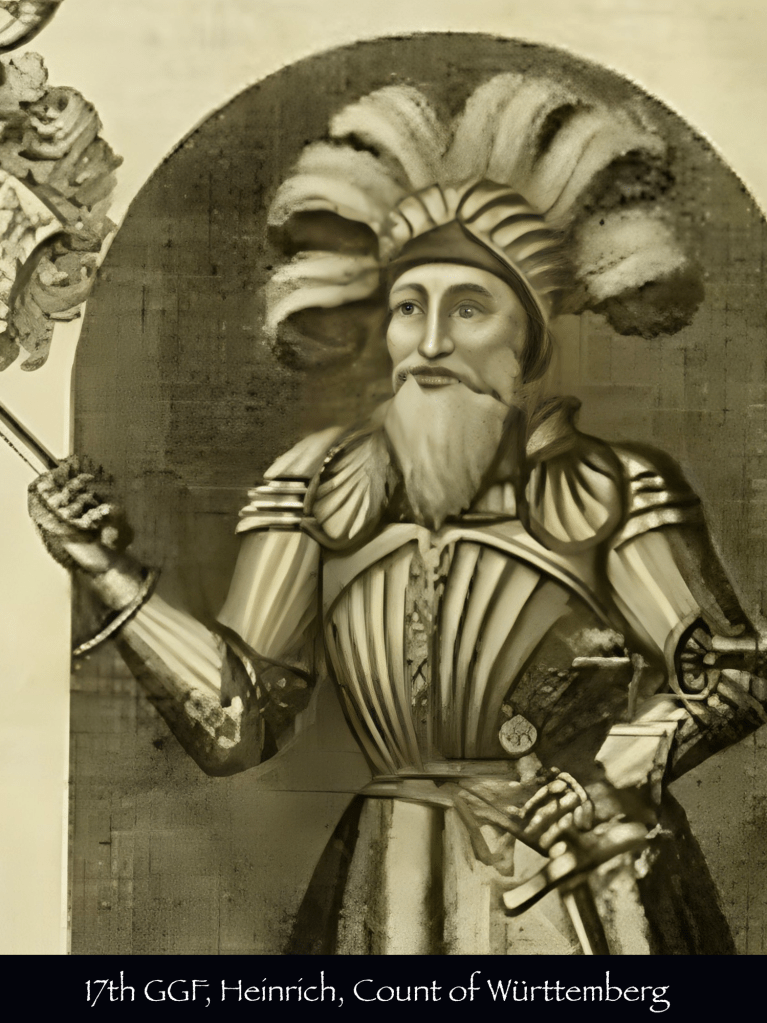
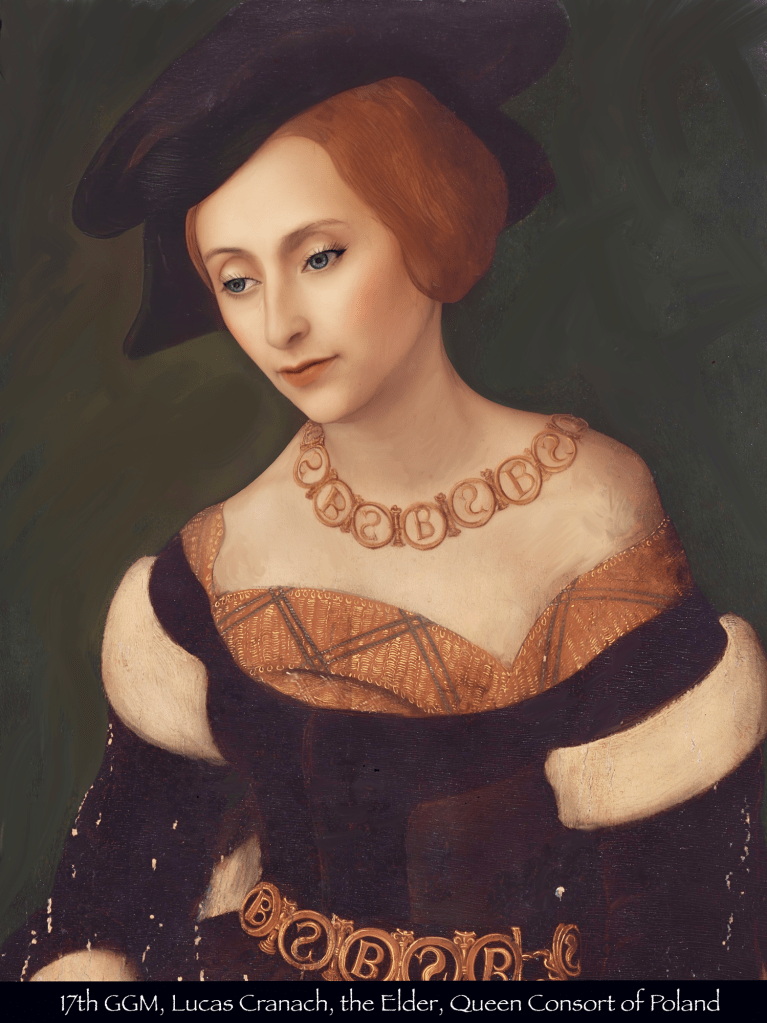
Of course it was always more than simple data… genealogy is about real people with real lives, facing history’s challenges.
But I’ve never paid much attention to the little images that showed up on the records. Yes, the photographs I paid attention to, but the paintings/sketches? I just assumed they were inventions to dress up the entry.
It turns out that some had very good connections to the people, of course the poor Norwegian/German farmers did not have portraits, but some of the minor nobility had a few.
So, I’ve been playing around, fixing things, restoring damage, maybe even a spa treatment or two.










Spring is Here!
Spring, the season of hope, emerges as the most uplifting of the four seasons. The very word “spring” signifies “coming forth”, likely inspired by dormant seeds, patiently awaiting through fall and winter, now germinating and thrusting green shoots into the air. It’s a riot out there!
Our ancestors must have been challenged to comprehend nature’s workings. They had to accept its rhythmic repetitions like clockwork. Today, of course, science illuminates the tilt of the earth that orchestrates the seasons, somewhat diminishing the romantic allure.
I recall the incredulity of my youth upon learning that while it was spring here, it was fall elsewhere, seeming as if I stood upright while others were upside down.
Reflecting on our ancestors’ perspectives on spring, Greek mythology offers insights into the complex Pantheon of Gods. Zeus, the chief, alongside his formidable brothers Poseidon and Hades, and their three sisters—Hestia, Demeter, and Hera—spawned from Rhea. It’s a convoluted family, replete with peculiar dynamics.
Cronus, having usurped his father Uranus to rule the Heavens, harbored the same apprehension. Upon Rhea’s childbirth, Cronus swiftly swallowed each infant, one by one. Yet, Zeus, the youngest, was spared when Rhea concealed a stone within swaddling clothes, tricking Cronus.
Zeus matured and eventually overthrew Cronus, liberating his siblings and marrying his sister Hera. Truly, a turbulent family affair.
Meanwhile, Hades, unmarried, set his sights on his niece, Persephone, daughter of Demeter. Despite Persephone’s disinterest, being deeply connected to the Earth like her mother, she was ensnared by Hades’ relentless pursuit. His black chariot, drawn by four steeds with fiery eyes, whisked Persephone to the Underworld to reign as its queen.
Consequently, Earth lost its idyllic perfection, descending into a singular, melancholic season. Demeter, devastated by her daughter’s abduction, plunged Earth into desolate winter, lamenting her loss. Eventually, Hera intervened, securing a compromise. Persephone would cyclically descend to Hades, marking the onset of fall, then ascend to reunite with Demeter, heralding spring’s return. Summers, meanwhile, were a time of revelry.
Thus, the year’s cycle was dictated by a dysfunctional family saga, transcending the mundane tilt of the Earth. Oh, and did I mention Persephone’s father was Zeus, the younger brother who reigned over all?
Martha Wainwright’s poignant song “Proserpina” (Persephone) on YouTube.com adds a musical dimension to this tale.
https://youtu.be/0CfwGwhcycI?si=-L-00hFkSGaGd4ZA