I emailed a friend that I now lived in an alley behind the Casa Orinda restaurant. He asked if I had become a rat.
A ridiculous suggestion, how could a rat afford an internet connection, or an iPad?
There is a bohemian quality of how we are living. It’s a furnished apartment, weathered leather chairs, 1930s style dresser and end table, terribly scarred refrigerator that actually works. Best of all, a bathroom that is so small that, if you stand in the right spot, you can touch everything in there without moving.
I had never experienced resting my forehead on the cool, ceramic sink, while attending to my morning toils. Ahem!
Lastly, the alley is a narrow one way lane, with 50% pedestrians going in either direction. Some alone, some in noisy clusters, activating the bright security light posted above the rear kitchen door.
Briefly the individuals are bathed in a 300 watt glare, then it shuts off 5 seconds later while they are still moving. Oddly enough, the light continues to turn on throughout the night when no one is in the alley. For a time I thought it was a part of someone’s String Theory, when I looked down on it from my shuttered second story window, the light immediately came on, perhaps because I was looking at it.
Then I considered that the 93 year old restaurant had stories of being haunted… perhaps some spirits taking a stroll. A better tale in the making.
The biggest change for us is the idea of living out of two suitcases, no real possessions, just some floss and toothbrushes. A little cheese from the Frankenstein refrigerator, a microwave hot cup of cold brew coffee seems like the perfect breakfast.
How long can this last? Perhaps until the house is sold. Maybe even longer.
Upon reaching 75, I presumed that I may have some words that may be wise. Just in case I ran my ten ideas through ChatGPT to see its analysis.
“Your list of wisdom presents a collection of thoughtful and practical life lessons. Here’s an analysis of each point:
1. **If you don’t have a plan for yourself, someone else will give you a plan, and you will be living someone else’s life.**
Analysis: This emphasizes the importance of self-direction and personal agency. It warns against passivity and encourages proactive planning to ensure one lives a life true to their own desires and goals.
2. **Anything that you do, means that you are not doing something else!**
Analysis: This highlights the concept of opportunity cost, reminding us that every action has an alternative that we forgo. It’s a call to mindfulness in choosing how we spend our time and resources.
3. **Do much, rest often… honor rest!**
Analysis: Balancing productivity with rest is crucial for sustainable well-being. This advice acknowledges the need for hard work while also valuing rest and recovery as essential components of a healthy lifestyle.
4. **See things differently when possible, if not possible then open your eyes!**
Analysis: Encouraging a shift in perspective, this suggests staying open-minded and being willing to reconsider or expand one’s viewpoint. If a new perspective isn’t possible, it advocates for a deeper awareness of the current situation.
5. **Listen to the silence, let it speak to you.**
Analysis: This invites introspection and the appreciation of quiet moments. Silence can be a powerful tool for self-discovery, reflection, and gaining insight that constant noise and distraction might obscure.
6. **Movement is life. Prove life, keep moving.**
Analysis: Physical and metaphorical movement is associated with vitality and growth. This encourages maintaining an active lifestyle and a dynamic approach to life’s challenges.
7. **Do not strive, unless it is to be humble. It doesn’t work, but it’s good to try.**
Analysis: This paradoxical advice suggests that humility is a worthy pursuit, even though true humility might be elusive. It implies that striving for humility can be a valuable practice despite its inherent difficulty.
8. **Yield more, obey traffic signs when no one is watching.**
Analysis: This encourages integrity and self-discipline. Yielding symbolizes flexibility and consideration for others, while following rules without external enforcement speaks to personal ethics and responsibility.
9. **Enter into moments gently, giving more than you take.**
Analysis: This promotes a gentle, mindful approach to life and interactions. It underscores the importance of contributing positively to situations and relationships, prioritizing giving over taking.
10. **It takes a lifetime, but be who you are!**
Analysis: This acknowledges the lifelong journey of self-discovery and authenticity. It encourages perseverance in the pursuit of one’s true self, recognizing that it is an ongoing process.
Overall, your list provides a balanced mix of practical advice, philosophical insights, and encouragement for personal growth. It addresses various aspects of life, including planning, mindfulness, rest, perspective, integrity, and self-discovery, making it a well-rounded guide for thoughtful living.”
Ha! I could not have said it better! Wait… maybe I should have…???
In our most magical moment, we made devices to measure time. At first they were hour glasses, with measured amounts of fine sand. Then at nearly the same time we made water clocks, driven by consistent drops of water. Massive things, dominating a corner of the room. An improvement was to have heavy weights to provide the energy to turn wheels and levers. Clocks were installed in the towers of the city square.
Someone came up with tempered steel springs, coiled up in a fixed case to drive sprockets, and clocks were small enough to be placed on mantles above the fireplace. Just wind them up!
In the 1500s, clock makers made them small enough to be personally carried as a time piece. And this is where it got a little weird. They were small enough to be worn on the wrist, but they weren’t called “wrist-clocks”, they were wrist “watches”. And they were made for women. The men kept their time-pieces in their pockets, but they weren’t called “pocket clocks”, they were “pocket watches”.
It wasn’t until the military started to rely on “synchronized” movement that watches started showed up on men’s wrists. Sailors had to time their “watches” while on duty. Watchmen had to walk their route according to a timed schedule. Perhaps this is why they were called “watches”.
In secondary school I became a “clock-watcher”. But not the one on my wrist. I had 7th period study hall and 3:00 was the end of the day. I would glance at the clock periodically, but from 2:55 onward I was intently focused on the wall clock.
I learned something amazing. When the clock hand was just about to move forward, it moved backward for a half second. Time went backwards, then moved forward, and then we were free.
So, I’m stuck once again because I can’t use the word “coincidence” to explain what has happened. I can’t use it because it doesn’t exist. It’s a lie, it’s a delusion,
This is very complicated so I must go very slowly to get all the nuances and subtleties.
I have a long time friend, very close when we were young men, then at a distance for forty years. Now we are reconnecting. Since we live in different states it’s important that when we have the opportunity to visit, then we try to shift things around in order to make that happen.
Ha! We are both retired now, so what do we have to shift? It’s not like “I’ll have my people call his people!”
Earlier this month, when Clay called and said he was coming this week for a short visit, I panicked. Weirdly, I have been preparing our house to sell all this month, I moved out, packed all our possessions into storage, had contractors, and stagers prepare our house for sale. On the very day the house was listed Clay called and thought I might be able to squeeze a lunch.
I might have even tried, I would have failed, and it would have put even more stress on me, maybe even caused a stroke, who knows? But I didn’t try, and when he called, I said no!
Mostly because I was pissed at him. I was mad because I had received a voice.google message from him when he called earlier and I didn’t answer.
Here is where it gets very weird. The message was like an accidental butt dialed phone call. It was most certainly Clay’s voice, he was talking to a woman. I knew he was planning to have dinner with his cousin just a few towns away, before coming to see me. It was strangely garbled except at the beginning, it went on for about four minutes with lots of pauses, sounds of eating, clinking of silverware, etc.
But the first few words were pretty clear, the recording started sometime after the sentence had begun.
“…diabetic, overweight, he hadn’t taken care of himself…”
Okay, I did gain weight, I am a diabetic, I had a heart attack, I also had prostate cancer. I would say that qualifies me to own the statement “hadn’t taken care of himself” But I .was still pissed about how he said it, and maybe even why he said it. It kinda felt like he was throwing me under the bus to his cousin, who I’ve never met.
Because I was pissed, I said I was too busy for lunch.
It could have ended there, and have it fester under a bandaid. I had sent the recording he made to him, but he either ignored it or didn’t think it was important. I didnt comment on it, I just titled the message with a bunch of question marks,
Several hours later I wrote a message. He had mentioned in the phone call that at least a had a “good excuse”, for not meeting for lunch.
After a few minutes I began to break things down. I wrote to him that I had said at the very beginning that it was a bad time. I didn’t have an excuse, I had a “reason”. I was mad. Of course I didn’t tell him on the phone that I was also pissed. So, I wrote to him that I was pissed, and I wondered why he was saying those things about me, even if they were true.
He didn’t respond to the lengthy message. I purposefully used messages because I didn’t want it to become lost in email clutter.
For nine hours he was silent. I’m thinking all kinds of potential responses, angry, embarrassed to be caught, or just plain vacant. I was waiting for a phone call that was going to be intense.
Near midnight I checked the messages and Clay had responded.
1. He doesn’t remember even using the phone at the dinner with his cousin, let alone leaving me a message. Yes, did have a conversation with her about their parents
2. The description of “diabetic, overweight, didn’t take care of himself” was about his father. Clay was sad that his father had died at 68 without having communicated so much more.
3. He has no idea how this happened, apologized for the confusion, treasured our relationship, and was looking for many more years of enjoyment together.
So, what am I to do with this? What am I to learn? Clearly it’s a good thing not to fester, but that’s okay, it’s not really the point.
I have this feeling that it was a complicated trap, well planned, well thought out. Absolutely the right “bread crumbs” to create a specific event. Maybe it’s just a maze.
Is that delusional thinking?
If this was designed, was it for good or evil? Did I stop the action, or did I give it completion.
Saying goodbye to a house/home that has witnessed a lot.
Moving is only a concept at first. Soon it becomes a crisis. Why do I have possessions? What do I take with me to the future? And then there is the permanent question of why?
What if I box it all up, find a cheap storage facility, and visit once a year??
Once every five years?
Do I possess them or do they possess me?
Is home in the boxes?
When does a house become a home? Is it automatic, or is it only due to a signature on a deed?
The house is ours, we still own it, but we don’t live here. It is no longer our home.
I sit in the open garage, looking at the driveway, the trees/hills, across the road, I’m no longer comfortable in my own house. I feel like a displaced spirit, no longer attached in a significant way, but still responsible, still on watch.
We have a disaster plan. We purchased storage food from a doomsday/apocalypse company.
We brought two 55 gallon barrels to store emergency water. And then we waited, knowing that mostly nothing would happen. But if something did happen, we would not be standing in line somewhere hoping to get food and water.
Then disaster struck!
Nothing happened and we decided to move our residence.
Naturally we move all our furniture and possessions into moving Pods for storage, and naturally we forgot about our emergency food and water storage. The very last things in our garage did not get into the Pods.
12 boxes of food, 110 gallons of water, 5 pails of wheat/corn, covered in the dust of twenty years in the rafters (or under the house for the water).
I dunno, it’s another full pickup truck to the dump as one solution. We could start eating and drinking for another solution.
I would have to start grinding a lot of wheat for the bread.
Some things get lost as time goes on. Probably because they are small and inconsequential. Nobody writes about it, even if it is an every day, every week, every month event.
I obviously remember banks, we had savings accounts, and a little book of deposits that was kept in a curious manila envelope that had two brown buttons, with a string to wrap around them to keep it secure. Why? It was paper! You could rip it in half if you wanted to get in to it.
Banks saved your money, banks loaned you money, but only the very rich had checking accounts. Who would trust a common man to write checks?
Banks would cash your salary checks, but only if you had an account there. The other possibility was your local bar or tavern, but only if you drank there. The bars had an understanding with their banks, and two party checks, particularly salary checks were approved.
So a small economic cycle occured with groups of bars on the streets of workers coming home, stopping to cash their checks for the week. Salaries were weekly. It was very rare to be paid every two weeks, or even monthly. Monthly salaries only became popular with direct deposit to the bank. Ha! Direct deposit only became popular when personal checks were accepted.
We forget how things were, shopping at stores that gave green stamps, collecting “blue chip” stamps and redeeming them for a blender or cake mixer. I once got a transistor radio! It ran on big batteries for several hours! Of course it was only AM frequencies, but it was high fidelity!
No one will find this interesting, unless they also “will remember when…”
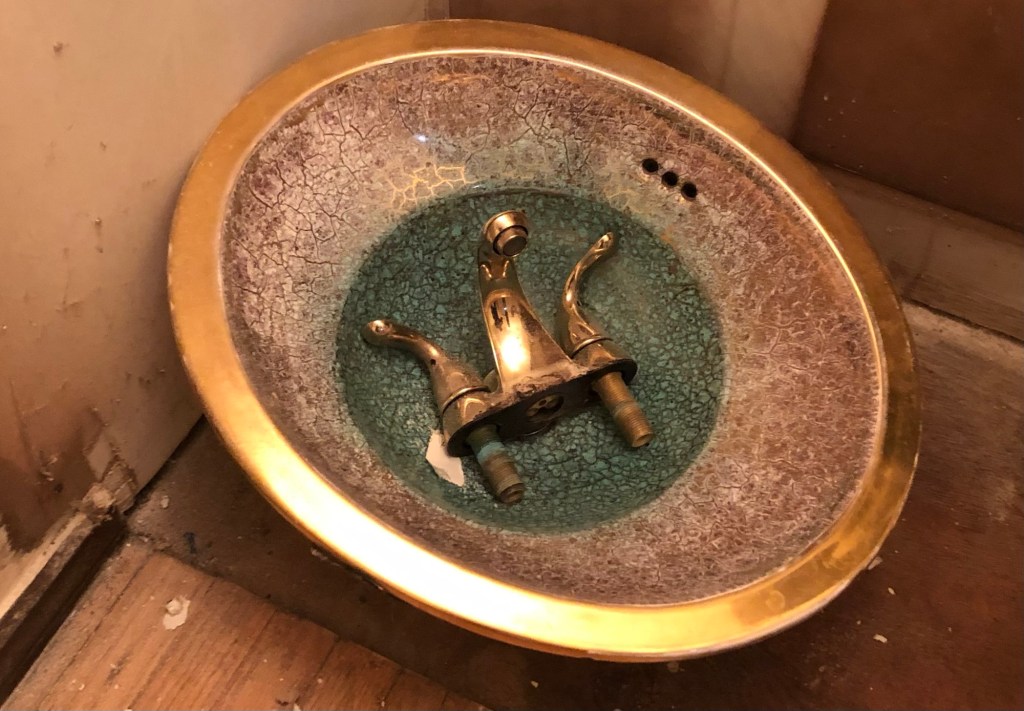
Inflation’s a beast, folks. Back in the day, a $55 dollar sink was my choice. Perfect for the guest bath by the door – a quick pit stop, not a spa experience.
But the master bath? That was getting the Italian stone treatment, complete with a perfect mosaic tile job. Picking those three sizes took forever, with countless trips to the charming (but slow) tile shop downtown.
Right there, tempting me by the register, was a display of sinks unlike any I’d seen. Forget utilitarian porcelain, these were artisanal masterpieces. One even had the artist’s signature! And a “Sale” sign. Intriguing.
On my third visit, curiosity gnawed at me. “Price on that beauty?” I mumbled, gesturing at the signed sink. His response was a quick “$1,600”.
The salesperson’s expression was a picture. He must have seen the “$55 sink guy” tattooed on my forehead. I mumbled thanks and stuck to the tiles.
But that sink… it lingered in my mind. Next time around, I found myself confused, trying to justify a $1,600 price tag. The poor guy thought I was negotiating! He whispered a desperate offer: “$900, take it or leave it.”
I was so prepared to leave it. Ha! But in my final stop after finding the right color grout, the salesman said, “$600!” And I surprisingly nodded yes!
Fifteen Years of Basin Bliss
For the next fifteen years, that sink became a source of pride. Guests got the full tour – the perfect granite countertop, the gold fixtures, the whole shebang. It wasn’t just a sink, it was art!
Fast Forward: The Staged Sellout
Now, we are selling the house. Times have changed in thirty years. Stagers are all the rage, promising a faster sale with their beige-on-beige nirvana. I get the logic, but ouch.
My glorious sink? Ripped out, replaced with a white quartz ghost. White on white, surrounded by white. My personal oasis, sacrificed to the market gods.
But the signed beauty? That’s coming with me. Not for handwashing, perhaps, but as a conversation starter. A reminder that a little defiance can be a good thing. Maybe even a nod to Duchamp, mounted on the wall in all its glory.
Cleaning my messages on my phone to create more space for more messages. Ouroboros!
I copied/paste from a message to a family member.
Some advice
Have you ever heard the phrase, “You are what you eat!”
There is another semi lie, “you are what you do.” When you retire you realize, “that you are what you think” and everything flows from that.
Your art doesn’t define you. You define your art.
I’ve seen drawings where the horse is hitched to the wagon, pushing it forward. It doesn’t work that way. You are the horse, and the wagon is your world, your art, everything… and it just follows you where ever you go.
The issue is that you must choose your path everyday, if you don’t, someone else will choose it for you, and you will be living someone else’s life.
You don’t have to be perfect, but sailing teaches you a lesson, if you don’t make tiny corrections early on, you won’t make the port you desire.
Freezing up, not moving the wheel, will guarantee a crash. Or sailing off the edge of the world, hahaha!
As a philosophical exercise, pick a reasonable goal, outline the steps that would normally assist you in getting there, then each day, for a month, assess how well you have done. Then make the goal bigger.
Hehe, I once removed the word coincidence from my vocabulary. It changed everything for me.
That was 15 years ago.
Everything is a plan, either my plan, or others. Some that are good, some that are bad. But nothing is by chance. Or luck.
Not making a plan, is a plan!
Then there is the old Irish saying, “Do you want to make God laugh? Tell him your plans!”
The Arabs often end every paragraph with, “in-shallah”, meaning “God willing.”
Here’s another thought. What is peace? The Hebrew word for peace is “Shalom”, the root word that creates shalom is “sacrifice”. There is no peace without sacrifice. A soldier knows this.
See what happens, you ask a simple question and you get word diarrhea from me.
I’m old and slightly demented I think the answer is somewhere in between everything that l’ve heard from everyone.
I prefer to think a bit, before I do. Take a beat!
It is complicated. Self-identity is always thick… with ego goo. The answer will always be the thing that works.
When I find something, it’s always in the last place I’ve looked. And I have never been lost… just misdirected for a few years.




The Dozen
Reasons why good people are outstanding!
1. They give us hope
2. They are selfless, they are not takers
3. They are there for their loved ones
4. They are productive, and they prioritize
5. They don’t judge others, or look for praise
6. They are role models, their acts are contagious
7. They have integrity, humility, compassion
8. They contribute to their communities
9. They are open-minded and diverse in ideas
10. They practice gratitude, kindness, positivity
11. They encourage, and lift others up
12. They do these things when no one is watching