
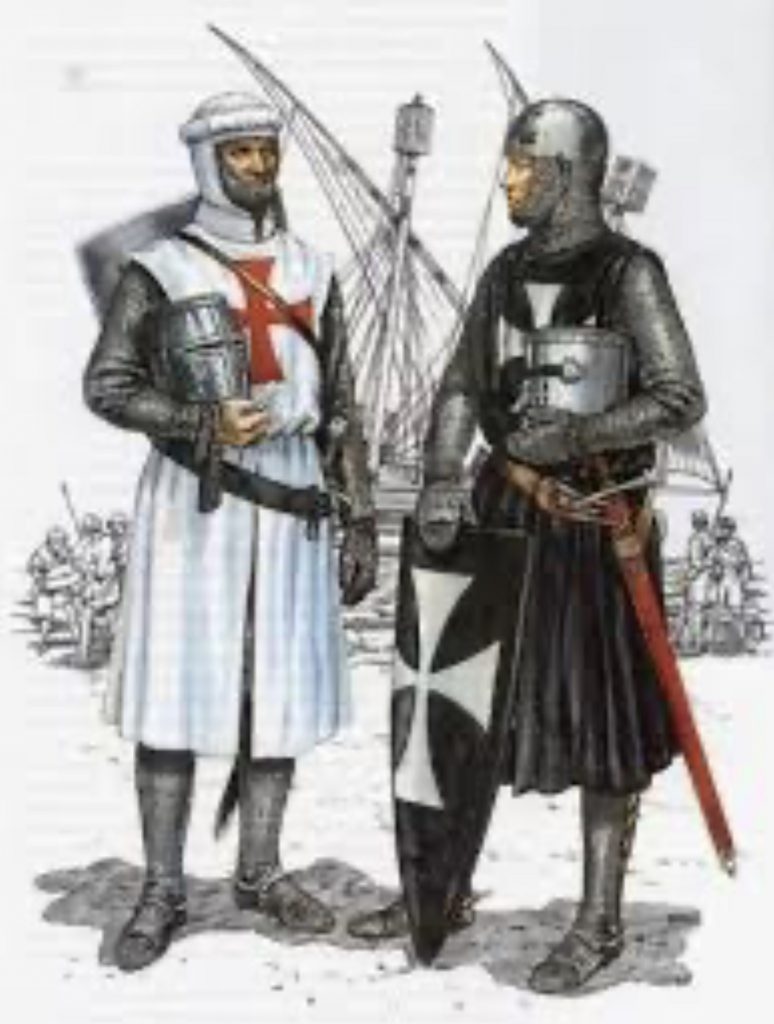
Teutonic Knight, Wilhelm von Ütgenbach, Herr zu Ehrenstein. My 18th great grandfather, and his grandfather, Teutonic Knight, Gerlach von Ütgenbach und Ehrenstein. My 20th great grandfather,
Teutonic Knight, Gottfried III, von und zu der Heess. My 17th great grandfather
They belonged to a crusading military order, officially named the Order of Brothers of the German House of Saint Mary in Jerusalem, founded as a military order c. 1192 in Acre, Kingdom of Jerusalem.
The Teutonic Order was formed to aid Christians on their pilgrimages to the Holy Land and to establish hospitals. Its members have commonly been known as the Teutonic Knights, having a small voluntary and mercenary military membership, serving as a crusading military order for protection of Christians in the Holy Land and the Baltics during the Middle Ages.
It is also true that there were many other reasons for a noble house to join an order beyond the stated “protecting pilgrims”. While it is important to always be aware of changing motivations, it is also cynical to believe that the founding reasons weren’t sincere. Within a very short time there were more than a dozen military orders that a noble family could pick from in order to assist in their need for piety in action. Basically, there had been two lines for the male children to follow, there were the succession lines, princes that would succeed their fathers, perhaps two or three in number. Then there wer male children that were dedicated to the Church, to become priests or bishops, or perhaps scholars. The creation of military orders was a third option. You could still utilize your military training, but do it in the service of the Church, and the Grandmaster of the order.
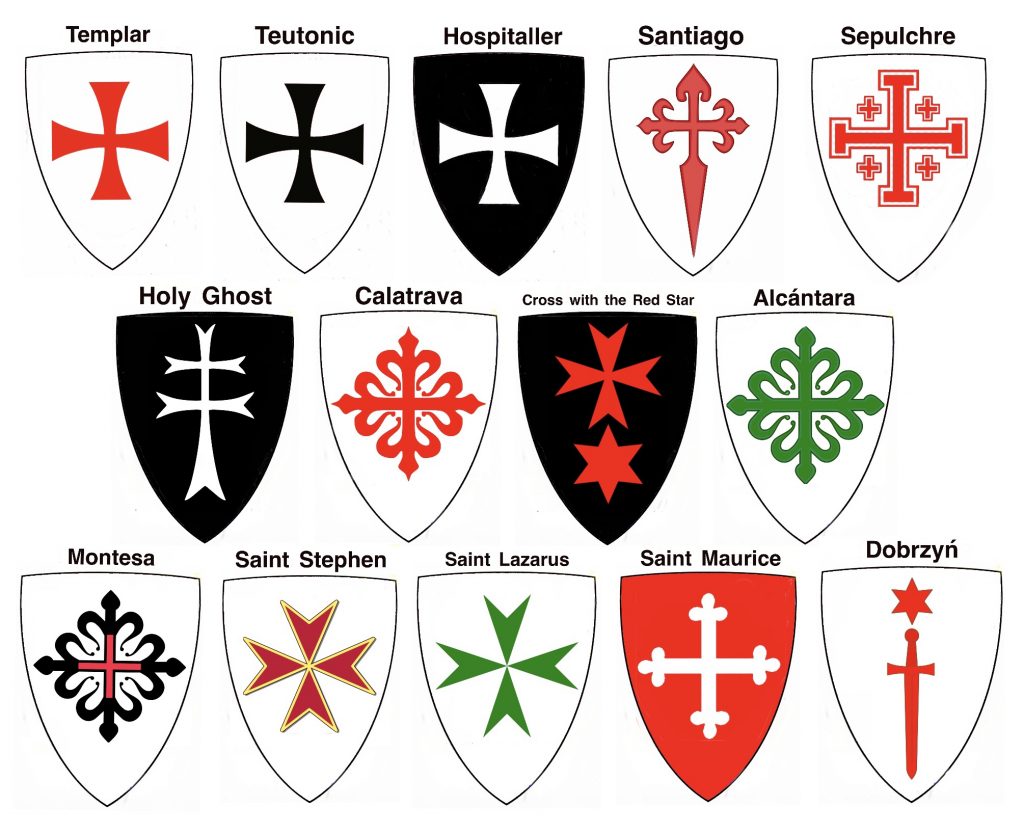
The most famous of the Orders is probably the Templar’s, or the Order of the Temple, as they took residence on the Temple Mount after the conquest of Jerusalem in 1099. Much has been written about the First Crusade, but there is no doubt that the timing was just about right for the Crusaders, the main fighting force they expected was busy somewhere else putting down rebellion.
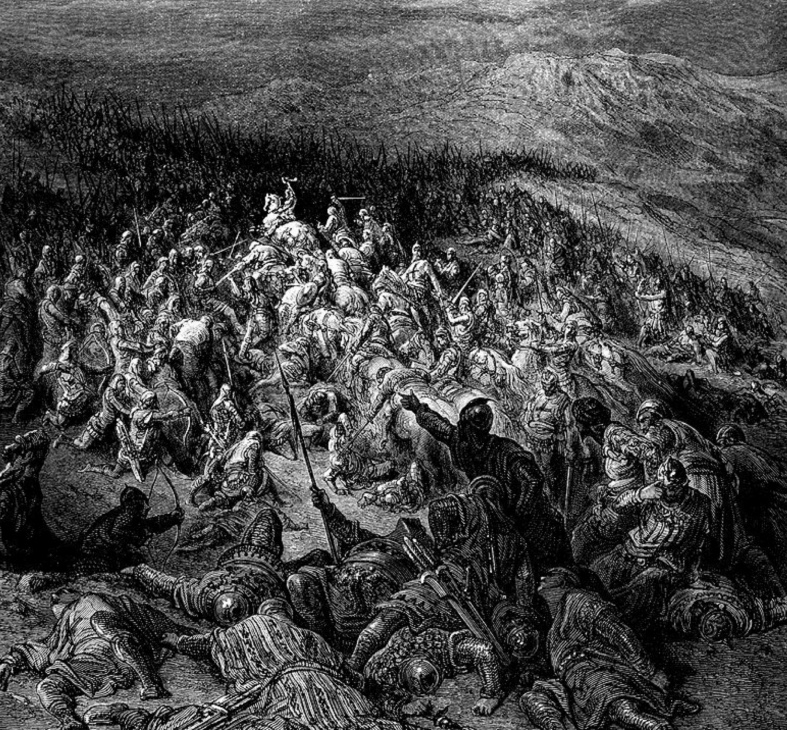
Actually, the first Crusade is really in two parts, the first part was composed primarily of peasants, women, children, and a few militia that set off for thr a Holy Land under the guidance of Peter the Hermit. They couldn’t wait for the organized military, they would go, and conquer the county because “God wills it”. Along the way they would terrorize local communities, commit atrocities, pogroms against Jews, pillaging villages for food, etc. The Byzantine Empire was between them and the Holy Land and they did not respect the Empire. The Empire was Greek Orthodox, and that was barely a Christian. The city was closed to the horde, so they moved on into Seljuk Muslim countryside. Within weeks they were either slaughtered, or captured, and sold into slavery. Not one of the People’s Crusade made it anywhere near Jerusalem, anywhere from 50,000 to 200,000 people went missing.
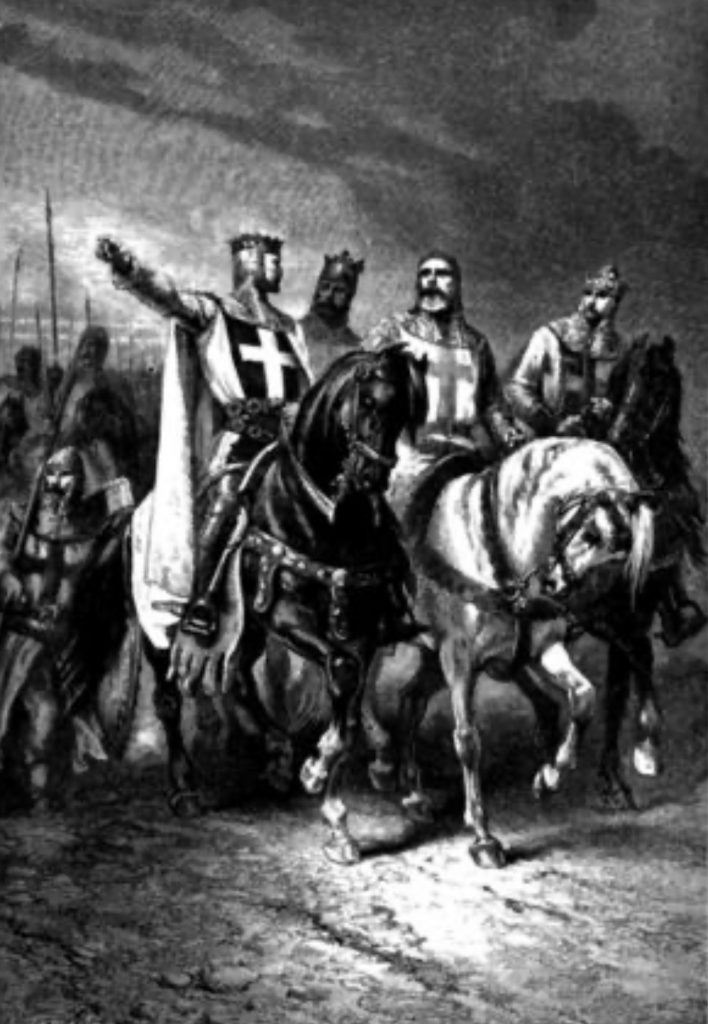
The official part of the First Crusade is sometimes called the Prince’s Crusade, because it was led by five princes from the noble houses in Europe. This was the premier fighting force of knights trained to do battle. They were also political to the extent that the Byzantine Empire received and supported them. They were intended to win back the lands that the Empire had lost. This was not something that the princes ended up doing, treaty or no treaty.
The reality of fighting in the Holy Land became very evident. There was a need to provide protection for Christian pilgrims. As the numbers of pilgrimages increased the local authorities did not see them as helpful tourists. The Muslims had taken Jerusalem from the Byzantines, and they were not giving it back. A few churches had remained occupied throughout the Muslim takeover, but this increase in pilgrimages was seen as a threat.
The five top military orders in terms of power and influence were: the Templar’s, the Hospitaliers, the Teutonic Order, the Order of Santiago, and the Order of the Sepulcher. Most had centers of operational control, most had established hospitals for pilgrimage and Crusaders, some were also fully trained as medical doctors. All were heavily armored and supported by their families and home countries, some orders became very wealthy with donations in cash and land.
Overtime, the pressure and temptation of wealth and power overwhelmed the primary mission of the orders. And of course, eventually they lost all that they had gained by losing territory. Jerusalem fell, and they retreated to Antioch and Acca. Antioch fell, and they were pushed out of Acca. They went to Cypress in order to reorganize for another attempt at Jerusalem. They were pushed out of Cypress, and the Hospitaliers went to Malta. The Templar’s became advisors to most of the kings in Europe, and abandoned any attempt of protecting pilgrims. They had become financial bankers to royalty, using the wealth that had been donated for a different cause. Eventually, Philip IV of France, with the Pope’s blessing, attacked the leadership throughout his country on one day, trying capture the control and wealth of the order. They mostly succeeded, although there are still rumors of Hidden Templar Treasure. While other counties did not arrest and execute Templar’s, their power was broken.
The Teutonic Knights were the only order that simply moved to a different location, and continued the fight against pagans, they went North, to the Baltic area. The local Christian kings were under constant attack from various groups. The Teutonic Knights came in with their experience in the Holy Land and made a difference. Within two hundred years most had converted to Christianity. The Teutonic Knights had also nearly wiped out the pagan Prussians. When the Prussians had captured a knight they generally threw him, and his horse into a bonfire, armor and all.
After years of conflict, Poland, Estonia, Lithuania were all Christian and the Teutonic Knights lost their mission. The kings withdrew there support and the order reformed to do charitable work. This is true today with almost all of the orders that still remain. Only the Templar’s are missing completely.
My three great grandfathers had taken a vow to be in the service of the Grand Master, and the Order. They had families, they had property, but they also had a religious commitment to serve the Church with their sword.







“I don’t understand!”
“Well, I’m not surprised. Did you perhaps take any theoretical physics classes? Do you have a vague understanding of ‘string theory’? Are you at least aware of the electrical activity of your physical brain?”
“Yes, of course. I know about synapses and maybe a little about dementia. I’m not so sure about psychosis, and perhaps what I’m experiencing right now.”
“Okay then, one more time. You’re dead, or at least your body has died. This isn’t heaven, or even purgatory. Maybe they both exist, but for right now, this is what you have. The essence of who you were was a collection of electrical charges that continued outside your physical body, and found itself in the electro-mechanical properties of what we might call the ‘fifth dimension’, not the group you might remember, but a couple of dimensions up from the three dimensional world that you knew so well.”
“Umm, how do you know this?”
“Great question, I don’t know. We don’t have books, and no internet, I wish I knew what that was like. Everything so far seems to be a thought download from others, who have been here longer. In a way, it’s like an ‘oral tradition’, except we don’t really speak, or hear. You might notice that my lip memory is a little out of sync from the thoughts that I’m communicating to you. I’ve been here long enough that I’ve forgotten some physical controls.
You are going to meet some people that don’t even bother with lips or ears. In fact, some go all the way, becoming glowing balls of electrical light.”
“Yeah, I’ve seen that on the way here, in fact, I was surrounded by them at first. They seemed to know me.”
“Sure, they were your direct ancestral family. Electrical DNA is still a thing. It’s a lot easier to connect, or maintain connection. Close friends somehow make the connection as well, so some of those that greeted you might have been friends from the past. It’s a bit of a shock, so maybe… well, don’t be too hard on yourself if you don’t understand. Haha, “walk towards the light,” and all that!”
“Umm. No one said walk towards the light. I just remember going in for a procedure, then waking up here.”
“Well, everybody is different. Oh, by the way, I’m your great grandfather, mother’s side, call me Michael.”
“Really? Damn, no one knows anything about you. You left a wife and six kids two years after you came over. People think you went to Canada and were eaten by wolves.”
“Almost true, I was looking for work, for several months, I got drunk and joined the Canadian Army, went to France and got gassed. Then I was here.”
“So, you’ve been here awhile?”
“Well, time is more of a ‘fourth dimension’ thing. As eternal creatures, we begin to restructure our thoughts about time. It’s accurate enough to say that I’ve been here awhile. It’s nice to know that I’m still remembered.”
“Not in a good way!”
“Your great grandmother is here, and she seems fine with me. Of course she has more experience with my electrical essence.”
“Are your flaws also recorded?”
‘“Every thought and deed is recorded. It is what it is.”
“Okay, okay, so just tell me. What’s next? What am I supposed to do? Where do I go? Am I waiting for something? Is there like… a judgement or something?”
“Dunno, maybe. So far, I’ve only noticed one thing.”
“Well, tell me! I want to know!”
“Um, well… sometimes you can see some people slowly fade. I mean their image fades. Doesn’t seem to matter if they have kept their body image or the ‘ball of light’, they just seem to slowly discharge, then ‘poof’, they are gone. I’ve seen it myself, hundreds of times, maybe more. Again, it’s just something I know, counting is not the answer. It isn’t true because of numbers.”
“Well, we aren’t exactly solid anyhow, transparent is more accurate. But you say that we can get more transparent, and then we are gone? Do we go somewhere else?”
“Well, if we are eternal, then yeah, we probably go somewhere else, but no one has come back to explain it. It just happens.”
“It happens to everyone?”
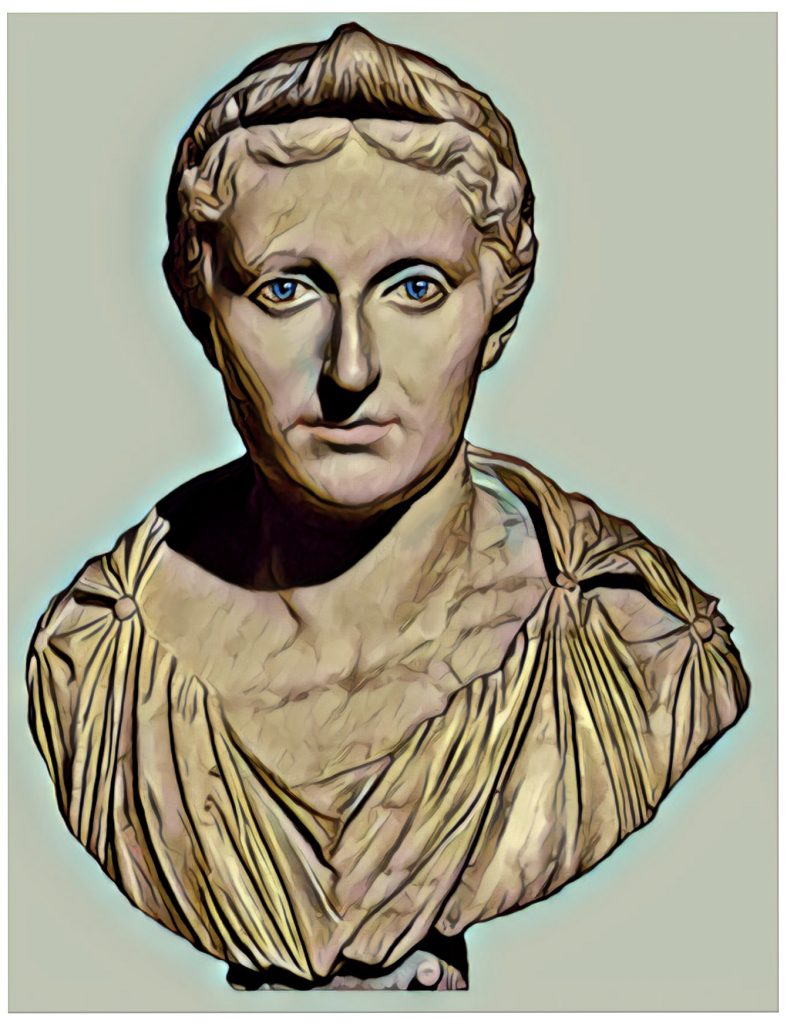
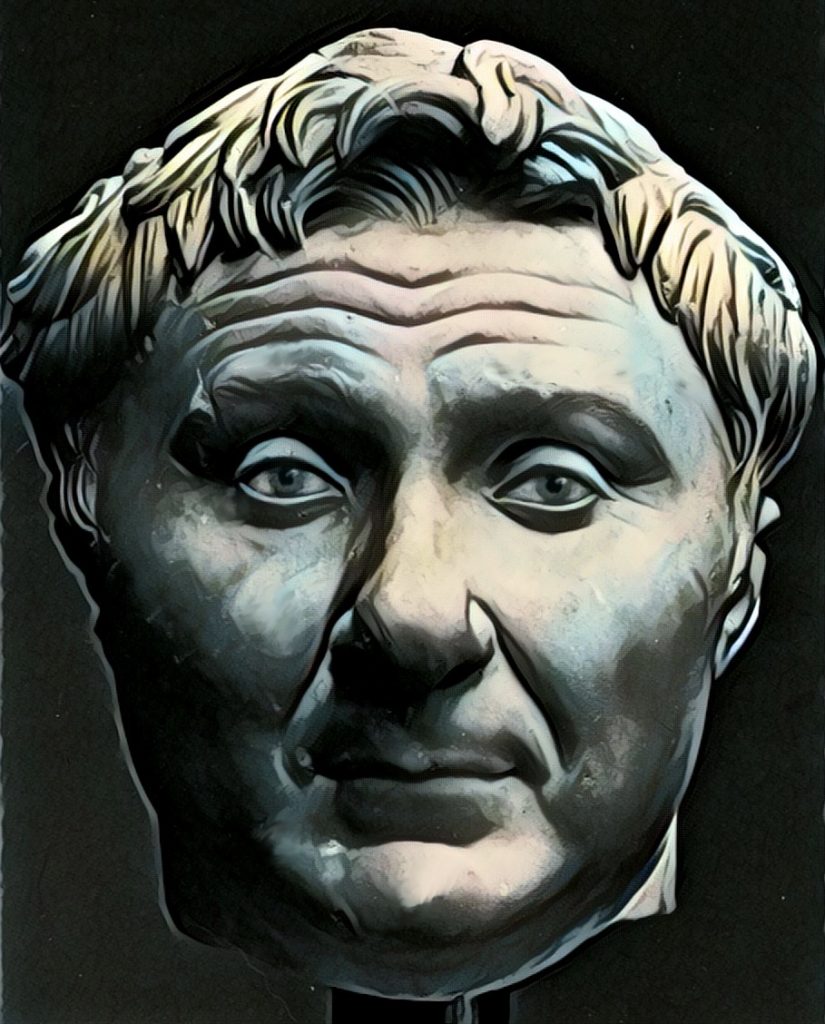
“Well, yes and no. Again, time is a slippery thing here. But I’ve been told that Socrates, Plato, and Aristotle still hang out, and they don’t seem any the worse for wear. Then again, others seem barely visible.”
“This can’t be happening, there must be some rational structure. There has to be reasons for things. Tell me what most people who have been here a while, what do they think?”
“Okay, okay. There are theories, but only theories. It seems that our electromechanical connection in this fifth dimension is connected to the electromechanical structure back there in the third dimension. Not sure how that works, but it seems to be true.”
“Tell me more.”
“Back there we were created as a unique person, our physical bodies created electromechanical impulses that extend here. When we left there, that gave us only our electromechanical essence here, but not maintained by our physical body because that was buried or cremated. Are you following this?”
“Yes, of course. Wait, so what is our connection back ‘there’, if we have no physical body?”
“Exactly… good question. Memories! Other people’s memories, which are still electromechanical and somehow sustain that connection to those of us that haven’t faded.”
“Wait…so you are saying, because my family remembers me then I get to be who I was, here in this place?”
“Well, it’s a theory.”
“And I suppose, if you somehow managed to write a book, or get discovered as a long lost poet, then you don’t fade away?”
“Yes, it does explain why some people seemed to fade, and then mysteriously come back stronger, only to fade again. Can’t really be sure because we can’t know what is going on back there? It’s all conjecture.”
“So, souls are connected, and if you are forgotten there, you disappear here?
‘“Yep, pretty much it. Except, the Electromechanical DNA factor changes things, sorta. Who we are here, is based upon the person we were from our existence… and the electromechanical essence created by others who only read about us is based upon their memories. Something gets lost.”
“This is getting weird. I am who I am!”
“Careful there, only one essence can actually say that…”
“God, are you talking about God? Is he here? Can we go see him?”
“Umm, maybe. No one seems to know. It seems reasonable.”
“This just got weirder. Are you telling me that we can tell when we are forgotten? And we can tell the difference between the family remembering us and when someone else just reads a book, or sees a movie about us.”
“That wasn’t so hard, it’s taken others a lot more time to get this, if we had a better sense of time in the first place.”
“So, our purpose here is only to wait, and watch until we fade away, and then we move on to some other place. Unless we are recreated as a fictional memory, then we are stuck here until media itself disappears back there?”
“Well, maybe. It’s hard to say. Physics in the fifth dimension doesn’t seem to be an exact science.
I can’t say for sure, but I get the feeling that maybe someone in my own family never knew of my existence, except in the sense that I must have existed because DNA got passed along. Then, suddenly, old records popped up, maybe a photo or two. Then I get mentioned at some family dinners. And here I feel more like me, like the person that I remember. I’ve been told that the fictional electromechanical essences know that their real essence is gone, but they don’t have any memory of it.”
“At least that’s the sense of the last download I remember. See that? I can explain this so much better with the new technology of your time. Download is so much more accurate than how this was explained to me. We talked about “essence letters” back then, potentially very confusing. What language were they in? Was it paper or parchment?
“Can I take a nap?”
“Always.”
(From a partially awake dream)