Brain Cells

I’ve been thinking about brain cells. Obviously they are in the brain, so…the thing that I am, is safe behind a skull, which used to have a cushion of hair around it. Is male pattern baldness the first step to eventual oblivion? Is the brain in danger?

Then it occurred to me that a certain percentage of brain cells may have escaped and taken up residence somewhere else. We talk about “gut feeling”, is it really “gut thinking”? Or, what about the heart? Why is it that the lungs never get feeling/thinking credit? Or perhaps the tip of the little finger on the left hand? Could millions of brain cells decide to migrate to the little finger, knowing that age has exposed their native “homeland” to danger? They are “brain cells” after all, they could think of these things.

As always, Google search can offer some suggestions…

Aside from the structural tissue and blood vessels, the brain consists of two types of cells, neurons and glia cells. Neurons have this wonderful electrical ability to pass information from one cell to another. Neurons group together in nuclei, and are connected to other nuclei by tracts. Their “homeland” is the cerebral cortex. However, neurons exist throughout the body and fall into three categories: sensory, motor, or interneurons. Sensory is massive throughout the skin, and they send messages about the world back to the brain. Motor neurons are in the heart, intestinal system, diaphragm, and glands. They assist in the primary functions of those tissues.

Glia cells are the most numerous and mysterious. They assist the neurons but nobody is quite sure of everything they do. I’ll just repost this paragraph because I’m not certain how to reword it.

“Glial cells are the supporting cells of the neurons. The three types of glial cells are astrocytes, oligodendrocytes, and ependymal cells, known collectively as macroglia, and the smaller scavenger cells known as microglia. Glial stem cells are found in all parts of the adult brain. Glial cells greatly outnumber neurons and apart from their supporting role to neurons, glia – astrocytes in particular have been acknowledged as being able to communicate with neurons involving a signalling process similar to neurotransmission called gliotransmission. They cannot produce an action potential as generated by a neuron but in their large numbers they can produce chemicals expressing excitability that exert an influence on neural circuitry. The star-like shape of the astrocyte allows contact with a great many synapses.”

Very suspicious, and maybe glia does some thinking as well. I bet that if some independent minded neurons left the brain, a good many glia cells would follow and help set up camp wherever they went.

Interneurons provide the inter communication between the sensory and the motor neurons. So, knowing this… which neurons think? I’m betting that thinking and communication are linked, it makes sense that interneurons throughout the body provide some sort of “thinking”. We somehow accept a “gut feeling”, but what about the skin? If you say no, then why does your skin “crawl”?

Your lungs appear to be somewhat empty of neurons, but the diaphragm has a bunch. Ever catch your breathe? Taste, hearing, smell and sight also has tons of interneurons, but we never (or rarely) give credit for them thinking. There maybe something special about smell neurons connecting to memory storage.

The possibility of brain cells intentionally migrating to safer parts of the body is intriguing, but going to the extremities seems not logical. Stubbing your toe, or getting your hand caught in a door is proof enough that it is dangerous out there.

My bet is that the “colonists” would head for the “Vagus Nerve”. Look it up, it’s a spinal nerve, completely protected by the torso, with quick exits to all the major populations of interneuron activity. Apparently there is a major collection near the tail-bone, where it is no longer needed to wag something.

Perhaps we can “think” from our butt in future decades.

Posted in Commentary | Leave a comment

Heroes of History

Is it fair that some of my hero’s/heroines may not be entirely historical? I have written before about my attraction to individuals who made impacts coming from an isolated existence.

Temujin is a perfect example, his tribe nearly wiped out, living alone outside of the community, with only his mother able to help him. Eventually he challenged the leader of a small clan. He won, then he used those men to challenge a larger clan, he won. This repeated over and over, like a winning streak at a roulette table, Temujin became a man of importance and the tribes renamed him Genghis Khan.

My personal favorite is Harald Hardrada. His life story sounds like an action movie. Wounded at age fifteen when there was a battle for the Norwegian crown, and the victor tried to kill all the remaining contenders. Harald escaped to Kiev, ended up in Constanople, fighting for the Emperor, grew rich. Harald then used his wealth to return to Norway to take back the crown. At the age of fifty he set his eyes on the crown of England, and died trying to take it. His defeat ended the Viking Age. He also managed to kill 2/3rds of the English army, which made it much better for William the Bastard, to become William the Conqueror at Hastings two weeks later. The world changed because of the life and death of Harald Hardrada.

There was a time that was called the Dark Ages, only because there wasn’t much written that survived, plus this was before great strides were made in all forms of human effort. A driving force at the turn of the millennia was Hildegard von Bingen, 1098-1179. Many scholars believe that her intelligence, and grasp of new possibilities far exceeded anyone on earth, even to include Einstein and Hawking. She was given to the Church at a young age, but it did not hide her talents.

She wrote music that is still played, she wrote and illustrated a botanical encyclopedia, she was a healer, an adviser to kings and emperors, she was the first woman to begin and run an abbey. She was also a pioneer in math, and was one of the first to popularize the Arabic numeral system. Imagine trying to do trigonometry with Roman numerals. The world was different because of Hildegard.

I can think of dozens of individuals that just made one difference, but we don’t know where, or what their name might have been. The first person who made fire, and was able to teach others. The first person to tie reeds together to make a craft for the water. The first person to attach a keel to their round bottomed boats, for better directional stability. The first person that harnessed the wind with woven material acting as a sail. The first person that made standardized marks that became a written language, the first person that turned a chant of grunts into music and found instruments to accompany the song.

The list of first is truly endless if you think about it. We also look to individuals that took on leadership responsibilities, to protect the people and begin to create culture and civilization. This is a hard category became with power comes so many abuses. I do have my favorites however.

I’m very fond of two Romans who had absolute power, and when they were done, they retired and went back to their farms. Cincinnatus, or Lucius Quinctius Cincinnatus, was a Roman statesman, 517-430 BC, who accepted the role of Dictator offered by the Senate in a time of crisis. He solved the problem, then resigned. Another problem occurred and he did the same thing, he did not profit from ultimate power.

The other Roman was Lucius Cornelius Sulla Felix, or commonly known as Sulla. He was not a better person than Cincinnatus, but he was offered the Dictatorship. The difference was that he decided later to seize it on his own. It was the first time that a general used his army to seize ultimate power. He was brutal in enforcing his reforms. Yet, he fulfilled his promise and gave up power to retire to his villa. Roman historians were not kind in retelling how he spent his retirement. Later historians said that Sulla provided the model for future military takeovers.

His rival, Gnaeus Papirius Carbo, described Sulla as having the cunning of a fox and the courage of a lion – but that it was the former attribute that was by far the most dangerous. This mixture was later referred to by Machiavelli in his description of the ideal characteristics of a ruler.

He wrote his own epitaph carved on his tomb, “No friend ever served me, and no enemy ever wronged me, whom I have not repaid in full.” This was also his personal motto, “no better friend, no worse enemy.” Maybe I like him because he might be a relative.

By far, my personal favorite king/leader is Chandragupta Maurya, the founder of the Mauryan Dynasty in India, 321–297 BC. Alexander the Great was taught by the philosopher Aristotle, he conquered much of the world until he invaded India. He found the Nanda Empire too strong, his men rebelled, and Alexander turned around, leaving a few satraps in charge.

Chandragupta was also trained by a philosopher named Chanakya, he conquered the Nanda Empire and beat the Macedonian Satraps that Alexander had left behind. His rule was amazing and changed the Indian sub-continent forever. He truly was in same category as Alexander, and Charlemagne, yet most people in the West barely know of him. What I find fascinating is that at the end of his reign, he gave it all up, and became a monk. He also repented of all the violence that occurred while he was building the Empire, and eventually became an ascetic, stopped eating, and died.

The man is worth studying.

Posted in Commentary | Leave a comment

The Purpose of History, pt. 2

Yesterday I wrote that the biggest threat to history is the lack of truth. Will Durant, an eminent historian, once said that history is mostly guessing, and the rest is prejudice. This is similar to “History is written by the victors.” It may be true in some cases, but is this a general truth?

Unfortunately, it is almost completely true in the “Classic History” category, where scholars dived deep into source material. My daughter reminds me that “truth and evidence” for the professional historian is barely two hundred years old. So what drove the classic historian before that? Patronage and ego!

One of the great mysteries in history is the event that occurred in the late Bronze Age. There were hundreds of cities that had archeological evidence of being destroyed within a very short time in a broad are of the world. Cities and cultures that had been developing for a long time didn’t just slowly morph into sleepy villages. They were burnt entirely to the ground with thousands of arrowheads in the ash. There was only one superpower the survived the assault. Egypt!

Egypt had a complex writing system, and artisans trained in illustrative ability. They could have documented what had happened, and instead, a giant temple complex provides a blank slate for Pharaoh Ramesses III to record his “victory”. To his credit, he did seem to fight off the invasion, but this rest of the known world was in chaos. Egypt was highly involved in trade, there were connections made, and markets established. Egypt had no place to sell her goods, and no place to buy the goods they required. Ther may have won the battle, but it was the first stage of a long decline. If “truth and evidence” had been applied maybe the decline would have been shorter, and less steep.

So what do we know from the temple of Medinet Habu? It appears that the attackers were a confederation of different peoples. Today’s scholars simply lump them together as the “Sea Peoples”. Ramesses gives us some names, and even illustrates the differences in dress, armor, and facial characteristics. Later Pharaohs even hired some of these tribes as mercenaries. Unfortunately there was no effort to record where they came from, or what was there purpose. They were simply pirates and barbarians looking for plunder and delighting in destruction. We are not even sure that some of the tribes even existed, perhaps Ramses inflated his enemies to give himself more credit. It is no accident that the officially approved style of illustration was to represent Ramses as a giant twenty times larger than the other individuals in the battle.

I can understand this, there is no question where Ramesses stood in the thick of battle. If you look at the Bayeau Tapestry of the Battle of Hastings , it can be hard to spot William and Harold.

Some of the Sea Peoples are quite different from the Egyptians, with feathered headdresses and horned helmets. Not the great horns of the Wagnerian opera, but small goat horns, or small disks on a stem. we know them as the Peleset, Sherden, Deneen, Ekwesh, Lucca, Shekelesh, Teresh , Tjerker, and the Weshesh.

The only definitive statement was their connection to the sea. Like the Vikings centuries later, they showed up suddenly, with no warning, fought hand to hand, and with bows and arrows. The late Bronze Age had highly developed chariots powered by horses, they were destroyed by lightly armored runners with javelins.

This “propaganda” was repeated thousands of times by the victors as history was mostly about war.

The first great historian, “the father of history” was Herodotus, 484 BC. His book The Histories, a detailed record of his “inquiry” on the origins of the Greco-Persian Wars. The bulk of his writing has been verified by scholars and archeologists. Herodotus did receive some criticism by Athenians in his own time. They called him a “storyteller.” It is true that Herodotus included many fanciful tales in his book, as supplemental material. He did provide the caveat that it doesn’t mean that he believed it, he was just repeating what he had been told. At one of the Olympic Games in Athens, Herodotus read the entire Histories to the crowd, and they cheered him on with great applause.

The other great Greek historian was Thucydides, 460 BC. There is a great deal of difference between the two historians. Thucydides was much more “scientific” and did not record “facts” told by travelers in taverns. Thucydides was also a general so he had an inside perspective on warfare.

We actually only have three or four authors whose works have survived. There were many more historians that we known only by their names, not the actual books. The third Greek historian was Xenophon, my personal favorite. His book, The Anabasis, is about the ten thousand Greek mercenaries that found themselves trapped in the middle of Persia, having to fight their way back to the Black Sea and safety. Xenophon was a minor leader of the troops, but after the Persian had murdered the Greek leaders at a banquet, Xenophon was elevated to lead the remaining men back to Greece. The book was essentially about the journey and difficulties faced when behind enemy lines, but was very informative about the customs of the times. Xenophon was also great friends with Socrates.

If war and military exploits were the subjects of Greek historians, it didn’t change much with Roman authors. Livy, Strabo, Plutarch, and Tacitus stand out for me. It’s true that much of what they wrote was the military victories of Rome, but they also included snapshots of daily life. Fortunately we have quite a few lesser known author’s works.

The interesting one for me is Flavius Josephus, who wrote the Jewish War. Josephus had the unique perspective of having been a former Jewish general who had been captured, then worked with the Romans to put down the rebellion. He was rewarded by citizenship in Rome, a villa, and protection by powerful leaders. The fact that he reported on the destruction of Israel and the beginning of the Diaspora, was in his favor because his readers were Roman.

Because I’ve introduced Rome, I have to mention the historian that organized the best concise history of the fall of Rome, Edward Gibbon. His book, History of the Decline and Fall of the Roman Empire, is a Western classic. What most people do not know is that Gibbon is not a modern writer, he was born in England in 1737, and published his book in 1780. He a perfect example of the Enlightenment of the times, but later critics question the central reason that he presented for the cause of Rome’s fall. Gibbon believes that Christianity was the reason of the collapse. He specifically states that the wealth of the Church siphon off money that could have been used the beef up the military to stave off the barbarians. Remember, he was an Englishman in the late 1780s, and no friend to the Catholic Church.

Recent historians have traced the negative stories of the Crusaders to Gibbon. In his view the Crusaders were pawns of the Popes, and the Crusades were entirely caused by the Church. From that premise, the Crusaders were pirates, interested only in greed, power, and regions bigotry. There is no doubt that some of that is true. Modern scholars now believe that the Crusaders were also motivated by a number of issues, including a desire to protect pilgrims. Muslim invaders had invaded Spain and created independent states, the Crusaders also invaded to create the Latin States. It was the way of the world.

I jumped right through the medieval period, bypassing many historians that I have enjoyed. My favorites are:

Gregory of Tours (538–594), A History of the Franks

Bede (c. 672–735), Anglo-Saxon England

Adam of Bremen (later 11th century), historian of Scandinavia, Gesta

Anna Komnene (1083–1148), Byzantine princess and historian

Ambroise (fl. 1190s), writer of verse narrative of the Third Crusade

William of Tyre (c. 1128–1186)

Snorri Sturluson (c. 1178–1241), Icelandic historian

Templar of Tyre (c. 1230–1314), end of the Crusades

Of the Modern historians, I haven’t decided on my favorites. I’m fond of Carl Sandburg’s work, and Will Durant. But there are so many, and so many with specific agendas. I have trouble enough with my own agendas.

Posted in Commentary | Leave a comment

The Name Game

In Genesis, Adam spent a great deal of his first days, naming everything that he saw. This is a good thing. Asking for the “whatcha-ma-call-it” can present some amazing results. Existence can be broken down into discrete objects. It is a tree, or a bush. It can also be a redwood, or a primrose. This does not come with genetic evolution. It is entirely conceived by humans thinking, and breaking things into manageable chunks. Fish swim, birds fly… uh oh.

Okay we do have flying fish, and penguins swim, but these are exceptions. And sometimes birds walk, and fish walk… more exceptions. Structured naming is still a difficult process. A little historical background…

In pre-history people seemed to function with one name. The name could be passed down from generation to generation. It could be an object, an animal, a characteristic, or possibly even a place name. Sometimes the culture was large enough that further naming was necessary to differentiate one individual from another. Often this was done by adding the father’s name as a second name. This became a classic standard in the Scandinavian naming pattern. My name is John, my father’s name is Edwin, so I could be known as John Edwin to be set apart from all those other Johns. Except that in the Scandinavian system the addition of “son” would be added, so I would be known as John Edwinsson, my brother would be Robert Edwinsson. My sister could be similar, or she could also be Gayle Fargo, because she was born on a farm in Fargo. Girls would generally use “datter” or “dotter”, so it would be Gayle Edwinsdatter. Then, shorter constructs were used, like “sen” or “son” for boys and “dtr” for girls.

This went on for hundreds of years until sometime in the late 1800s the patronymic style of naming in Scandinavia faded away. The “last name” became fixed. Today, only Iceland still uses the patronymic system.

The European and American naming system often uses three names, first name, middle name, and last name. The last name is the family name. The middle name could be anything, but often it is remembering a relative, or close friend. The first name could also be a family tradition. Many German families rotate two names from brother to brother, Frederick William, and then William Frederick. This doesn’t sound very organized but the source for most of the three name patterns was very organized. It was the Roman naming system.

In fact, the tri-nomen pattern was the most obvious sign of Roman citizenship. It started as a bi-nomen system with less than twenty different names used for the personal name, the praenomina. This identified each member of even large families with a personal connection. The second name was the nomen, or the family name, sometimes called the gen. This looks very similar to a standard that we have now. But even the nomen was limited.

As Rome grew, and the republic turn into the empire, Romans added a third name, the cognomen, a very complex name that served many purposes. The cognomen was at first a nickname, then it became hereditary and the aristocracy used it to further differentiate their families from others.

What is interesting is that generally, there were no more than twenty male names, and twenty feminine versions, that were used in combination for all Roman citizens. A scribe, or a clerk, knew everything about the individual by knowing the “nomens”.

Today we pride ourselves in knowing the “trinomial nomenclature.” of botany. Rome lives on!

Posted in Commentary | Leave a comment

The Purpose of History

I love history, but I don’t often question the “why” of history. In some way, I delight in knowing something that is important, but widely ignored. Is this an ego thing or is it a process of bringing attention to something important? The most often used quote is from the writings of Winston Churchill “Those who fail to learn from history are doomed to repeat it.” But he wasn’t the first to ponder the concept.

Edmund Burke is often misquoted to say, “Those who don’t know history are destined to repeat it.” What he actually wrote was, “People will not look forward to prosperity who never look backward to their ancestors.” George Santayana is credited with the aphorism, “Those who cannot remember the past are condemned to repeat it,” Burke may have started the conversation, Santayana simplified it,and a politician made it popular.

Edmund Burke is widely misquoted by the way. The other “quote” that he may never have said, is “The only thing needed for the triumph of evil is for good men to do nothing”. This might have been a mash-up of Thomas Jefferson’s, “All tyranny needs to gain a foothold is for people of good conscience to remain silent.” Scholars have not found this quote in his published books, the closest is “When bad men combine, the good must associate; else they will fall, one by one, an unpitied sacrifice, in a contemptible struggle. “. That’s a lot of words for a declarative sentence.

A little Google search on history quotes gave me the following…

1. “History is the version of past events that people have decided to agree upon.”, Napoleon Bonaparte

2. “If you are neutral in situations of injustice, you have chosen the side of the oppressor. If an elephant has its foot on the tail of a mouse and you say that you are neutral, the mouse will not appreciate your neutrality.”, Desmond Tutu

3. “Our greatest glory is not in never falling, but in rising every time we fall.”, Confucius

4. “People are trapped in history and history is trapped in them.”, James Baldwin

5. “History is an account, mostly false, of events, mostly unimportant, which are brought about by rulers, mostly knaves, and soldiers, mostly fools.”, Ambrose Bierce

6. “The history of mankind is the instant between two strides taken by a traveler.”, Franz Kafka

7. “What is history? An echo of the past in the future; a reflex from the future on the past.”, Victor Hugo

8. “History is a gallery of pictures in which there are few originals and many copies.”, Alexis de Tocqueville

9. “History is mostly guessing; the rest is prejudice.”, Will Durant

10. “History is a race between education and catastrophe.”, H.G. Wells

11. “History is a vast early warning system.”, Norman Cousins

12. “A myth is far truer than a history, for a history only gives a story of the shadows, whereas a myth gives a story of the substances that cast the shadows.”, Annie Besant

13. “Isn’t history ultimately the result of our fear of boredom?”, Emile Cioran

14. “History is not a burden on the memory but an illumination of the soul.”, Lord Acton

15. “Without words, without writing and without books there would be no history, there could be no concept of humanity.”, Hermann Hesse

I think Hesse has it right. The very concept of humanity is the purpose of history. Yes, we should use it to learn our mistakes, but we may make the mistakes for a long time before learning. This is not a formula but a process.

The essential problem of history is about truth. History documents change, but the truth of change is elusive. Have we honestly looked at what we have gained, and what we have lost? After that, we need to look at the price we pay.

In many ways, history is used to punish others. This can change almost overnight, leaving people confused and disoriented. Generally, no one looks to the agenda of those who wish to punish. Is it simple revenge? Is it justice? Or is it just another tool in the quest for power?

To simplify Hesse’s statement to the most simple- “History is an attempt to discover a recipe for better tasting food.”, John Diestler

I gather my utensils, my appliances, raw materials, supplemental ingredients, and then I write down what I did. If it is good then I save it, if it is not good, I save it so that I won’t go down that road again. This is what is so often missed about the quotes of history. The mistakes are many, and yes we need to save them for reference. But the successes are what we can give to others, recipes for the future!

Phoenicians sailed nearly around the world before we even knew the extent. Scholars asked “How did they do that?” You don’t have to invent help from “ancient aliens”. You just have to invent an alphabet to write the truth! They sailed near the coast and wrote down the days, and the descriptions of the shoreline. Then they doubled checked on the way back, gave their “book” to another captain, and he went a little further and added to the book. And he checked the accuracy on his way back. Later on the Portuguese called the books of “sailing directions”- rutters. Eventually the word described the rudder that determined the direction the boat would go.

So maybe, “History is the Rutter for movement in the world.”

Posted in Commentary | Leave a comment

Common Ratios

2/1 = .5, 3/2 = 1.5, 5/3 = 1.666, 8/5 = 1.6, 13/8 = 1.62, 21/13 = 1.615, 34/21 = 1.619, 55/34 = 1.6176, 89/55 = 1.61818, 144/89 = 1.61797

Math is an exact science, carried out to infinite sequencing, such as pi. The same is true for the Fibonacci sequence of numbers. The ratios above are expressions of lengths to widths that have eventually been called the Golden Mean, or Divine Ratio. (The curious thing is that as the ratios continue, the “Golden Mean” approaches the mathematical formula of the Fibonacci Sequence. They are related!)

Supposedly these ratios create a rectangle that is the most pleasing to the natural eye, so that compositions in art or architecture are said to have these ratios imbedded in them. To a certain extant this may be true.

Classic photography has taught the rule of thirds for decades upon decades. Then, the more advanced courses modified it to 8/5s. Basically meaning that the best division of a rectangle is to divide it into 1/8s and then draw a line at 3/8s or 5/8s and that gives the “best” dividing line. The ratio is 1.6, and the most accurate Fibonacci sequence is 1.61797. We used to that this is “Good enough for government work”.

The “Golden Mean” and the “Fibonacci Sequence” are said to be a part of a standard composition practice. It may be true in a sense. We compose things to patterns that are most familiar. Because these ratios are so similar in so many images and objects, we are certain to find them as ongoing patterns in our own work. But in general, the exact nature of the mathematical basis is rarely found in art or architecture, approximations yes, exact no.

The one area that appears to have the most accuracy is in nature. The pattern of leaves and seed pods seem to reflect the formula with the most accuracy, far more than random chance. Unfortunately, the most famous example of the appearance in nature of the Fibonacci Sequence is the Nautilus Sea Shell, and that probably is not true. It is a spiral but not as exact as other more naturally occurring Fibonacci spirals. The controlling factor appears to be rain and sunlight. The Fibonacci Sequence give the optimum distancing to give each leaf/seed the most exposure.

So why do we see this ratio in art/architecture? It most certainly has been intentionally used in some cases. Mostly, the ratio we see is the “learned patterned”. We see repeated ratios of television/monitors, magazines, architectural facades. Sometimes they are so close to 1.6 we just assume that it was intentional. In point of fact, there isn’t a “perfect rectangle”, only the most observed rectangle.

Even still, I intentionally use the 8/5s ratio in my photographs and my artwork (when I remember that I can, hehe)

Posted in Commentary | Leave a comment

Trophes

I was thinking about Venusians. Venus had been an early target for space probes, but we haven’t been back there in decades. Why? Perhaps because the probes sent back all the important information we needed. Perhaps it was because the Soviets beat us there with the first of many probes.

Perhaps because the surface is so harsh that nothing sent there lasted more than 54 minutes. Why go back?
If there were life, it would be life unlike anything known on this planet. Perhaps a little bit like the life found around the sulphur vents in the deep ocean.

Yes, the Venusians, if intelligent, would have very little in common with us.

I wonder what any other life forms would think of us? I’ve learned that we are heterotrophs. In fact, all animals and most fungi are heterotrophs.

Fancy word for life forms that live by eating other life forms. This is not an encouraging fact for creatures from another planet. Where are the boundaries?

I mean, let’s just say that Venusians are found to be intelligent, but also the best tasting, high protein, gluten free, low calorie, low fat, low sugar, non-allergic, food that provides all the essential nutrients and vitamins. Literally the perfect food!

Okay, sure, they are intelligent, but they don’t have to have a first name, (my current rule for the question, Is it edible?) And their thoughts, stories, philosophies, might have no relation to anything we can understand. But somehow we found out that Venusians make a great barbecue. And there is also a tremendous amount of Venusians, almost inexhaustible because there are no heterotrophs on Venus.

Hmm, decisions, decisions. By the way…autotrophs do exist. Most plants do not need living food, but that does not mean that they are safe. We find most autotrophs quite tasty if prepared well.

It might be said that vegetarians are kinder because the only eat plants. Kinder? Eating defenseless autotrophs, plants that can’t even run away?. Heterotrophs that eat other heterotrophs seems more fair. At least for the main entree.

Gotta stop thinking, I must be hungry.

(Reposted from 2017)

Posted in Commentary | 1 Comment

Rules for HitchHiking

Two things that are odd. 1) that there should be rules for something as iconically free spirited as hitchhiking. 2) that I haven’t thumbed a ride in nearly forty years. There is a chance I’ve forgotten a few things.

So perhaps these are not rules, but instead, strong suggestions. And that these suggestions come from five years of experience, three years that were pretty steady. In truth, it was almost entirely the summer months in the west, so we are not talking about rain and snow. Bad weather introduces an entirely new set of suggestions that I haven’t practiced very much.

1). The first rule is do not hitchhike. The salad days of freely hitching down the road are over. It was never safe, but the safety factor is easily ten times what it once was. Are there more Landsharks than then? Hmm, no, I don’t think so. We haven’t entered into an age of rampant lawlessness on our nation’s highways. I think the number of bad guys are about the same. The problem is that the number of good guys that extend the safety of their vehicle is far less. People are fearful and perhaps have good reasons for that.

In my humble opinion the ratio has gone too far in the wrong direction. There are still more good people than bad, but the odds are now skewed so that the chance of running into a landshark is much higher.

I use the phrase landshark to describe an individual that will harm you because of their nature. It is not something that you did that causes the harm, it is simply the nature of the beast. If they are hungry they will eat you, and they are not hungry they may still bite because they can.

There should be no more rules or suggestions after this cardinal rule but sometimes there are circumstances where hitching is the only solution. The following suggestions are meant to be helpful.

2. Always be the first to ask where they are going. Vague answers are a red flag. A quick response of a town further down the road has a much better chance of being truthful. The real reason to ask this is to have the time to assess the driver and the interior of the car. Much information can be gleaned from a quick inspection. Next time you see a highway patrolman you can bring up this subject and you will learn far more than I can state here. In general, the cleaner, orderly interior, will be safer. The cleaner and more orderly driver likewise. I do not fit this model in either case so I know it is not absolute, but merely playing the odds. Landsharks do not care where they are going, as long as there is food there.

3. In all cases, protect what is valuable to you. With enough temptation, a landshark will bite. Keeping this in mind the thing that is most valuable to me is the pack that I carry. Never put the pack in first. Enter the vehicle then grab the pack. I know this is awkward in many small cars. It is so natural to open the back door, or trunk, and throw the pack it, then wander over to the passenger door, hoping that it is unlocked. The advantage to traveling in pairs is obvious. One person enters, one person loads gear then is the last inside. Even if you are a single hiker, open the passenger door first, then open the rear door with the idea that you might quickly jump in if the car lurches ahead. One thing to consider, if the vehicle is actually speeding away, you might want to count your blessings that you didn’t jump in. If at all possible I had my pack on my lap, last in, first out. Landsharks take advantage.

4. Always consider that women are possibly targets. Never let women enter first, always let women exit first. Landsharks are often sexist.

5. Engage the driver in conversation, but do not dominate. It is always good to assess the character of the driver beyond a visual once over. Be careful if there are landmines in the conversation. Getting no response to questions about relationships and family can be natural and not an issue if you are at a cocktail party. A chilled no response, trapped in a moving car doing seventy, is an entirely different animal. Landsharks are touchy.

6. Never give away your right to exit at any time. It may be awkward but I quick “Could you pull over at the next safe spot?” is always correct, if you feel it necessary. Telling an untruth is also an option. “I feel sick!” Is pretty good, “Oh, my gosh, I left my ID back there!”, is another. I once jumped from the backseat (it was a two door) when the drivers were in the station office selling the almost new tires to the attendant for gas money. Selling off parts of the vehicle is a red flag. Landsharks are very inventive.

7. Never sleep while the driver drives. Catching some sleep while your partner is on watch is a better solution. Having everyone watchful and awake is the best solution. Too many things can happen if you are not watchful. Take nap before hitchhiking if necessary. Landsharks love to bite when you are not looking.

8. Never volunteer “gas money”. You are hitching because you are broke! Landsharks are greedy!

9. In conversations, ask more questions about them. If they do most of the talking they will consider the conversation positive and good things will flow. Useful for hitchhiking, useful for job interviews. Landsharks are egotistical.

10. Refrain from smoking, eating or chewing in their vehicle. There may be rules, better to assume that they are there, than to find out that you have broken them.

There are more things to consider when you are on the road, but these relate to basic safety.

Other examples:

11. Do not upstage hitchhikers already in position. Walk downstream and allow the first ride to pick them up. Go down far enough that if a ride does pass them but picks you up… well, go far enough to not hear the yelling.

12. If you make camp mid-day, be out of site, out of mind. Pick higher ground, with good visibility of anyone coming. No fires!!! If fire, no smoke, and block visibility!!!

13. Walk for miles to find a spot where you are visible for at least 500 feet, and that there is a safe turnout for them to pull over, regardless of their speed.

And finally, never break rule number one. Do not hitchhike!

Posted in Commentary | Leave a comment

Songs of the Heart

Imogene Heap- The Moment I Said It

The moment I said it…The moment I opened my mouth…Letting your eyelids…Bulldoze the life out of me…I know what you’re thinking…But darling, you’re not thinking straight…Sadly, things just happen we can’t explain.

It’s not even light out…But you’ve somewhere to be …No hesitation…No, I’ve never seen you like this…And I don’t like it, I don’t like it…I don’t like it at all.

Just put back the car keys…Or somebody’s gonna get hurt…Who are you calling at this hour?…Sit down, come round, I need you now…We’ll work it all out together….We’re getting nowhere tonight…Now sleep, I promise it’ll all seem better, somehow…In time.

It’s not even light out…Suddenly, suddenly…Oh, you’ve somewhere to be…No hesitation…Mmm, I’ve never seen you like this…You’re scaring me, you’re scaring me…You’re scaring me to death.

Don’t! oh, (smash…) please…Don’t! oh, (And another one) please…Don’t! oh, (smash…) please-…Don’t! oh, (And another one) please

I’m losing you…Trust me on this one…I’ve got a bad feeling…Trust me on this one…You’re going to throw it all away…With no hesitation…(Smash…)

Anouk- I Don’t Want to Hurt

We’re breaking things we cant repair…None of us will take them blame…No nothing can be done this time…All the memories that we’ve made…I threw them all away…There’s no need to talk it over…Dont let me get you down…Let’s just move on…I am setting you free.

Cause I dont wanna hurt no more…I dont wanna make you go …Through one more rainy day…No I dont wanna hurt no more…Strange enough I always knew…I’m taking off today…Dont wanna hurt no more.

Darkness you left in my soul…Now do we know how much we’ve lost?…Will the moon be shining as bright as before…And as I am singing this song…The tears went up in my eyes…And I will always wonder…Why I will never have the life I wanted…Now I’m letting it go.

Cause I dont wanna hurt no more…I dont wanna make you go …Through one more rainy day…No I dont wanna hurt no more…There’s not much more to say…Cause it’s to late now…I wont hurt no more..

So I’ll wait till morning comes…You made it clear it’s been only pain loving me…Things that we dont do for love…I am setting you free

Cause I dont wanna hurt no more…I dont wanna make you go …Through one more rainy day…No I dont wanna hurt no more…Strange enough I always knew…I’m taking off today…I’m letting you go…

Beth Hart- Take it Easy On Me

God bless this,…God bless that….God I’ll miss you now.

All the people left,…when the blue sky crashed…and I can’t do this alone.

I am scared to change, …To stay the same,…When I’m calling out your name..

Take it easy on me,…Take it easy on me,…I will trust you,…I will let you hurt me carefully.

Take it easy on me,…I break easily and…this steel butterfly will learn to fly…eventually..God take it easy on me.

When I talk like that,…When I tear me apart….When I raise my voice,…I break my heart.

But if I gave it up,…let the wall come down,…Would you take my hand?…Would you show me how?

I don’t know my place,…I don’t know my own face,…Just the lines I can’t erase.

No, I was never one to lean on….Fighting this war against the wind. ….When I find ground to rest my feet on. …I will lay my weapons down..

And another one bites the dust…But why can I not conquer love?…And I might’ve got to be with one…Why not fight this war without weapons?

And I want it and I wanted it bad…But there were so many red flags…Now another one bites the dust…And let’s be clear, I trust no one

Sia- Elastic Heart

You did not break me..I’m still fighting for peace…Well I’ve got thick skin and an elastic heart…But your blade it might be too sharp

I’m like a rubber band until you pull too hard…But I may snap when I move close…But you won’t see me move no more…Cause I’ve got an elastic heart

I’ve got an elastic heart…Yeah, I’ve got an elastic heart…And I will stay up through the night…Let’s be clear, I won’t close my eyes…And I know that I can survive…I walked through fire to save my life

And I want it, I want my life so bad…And I’m doing everything I can…Then another one bites the dust…It’s hard to lose a chosen one

You did not break me (You did not break me, no, no)…I’m still fighting for peace…Well I’ve got thick skin and an elastic heart…But your blade it might be too sharp

I’m like a rubber band until you pull too hard…But I may snap when I move close…But you won’t see me move no more…Cause I’ve got an elastic heart…Well I’ve got thick skin and an elastic heart…But your blade it might be too sharp

Lamb- Gorecki

If I should die this very moment…I wouldn’t fear…For I’ve never known completeness…Like being here…Wrapped in the warmth of you…Loving every breath of you…Still my heart this moment…Or it might burst

Could we stay right here…Until the end of time until the earth stops turning…Wanna love you until the seas run dry…I’ve found the one I’ve waited for

All this time I’ve loved you…And never known your face…All this time I’ve missed you…And searched this human race…Here is true peace…Here my heart knows calm…Safe in your soul…Bathed in your sighs

Wanna stay right here…Until the end of time…’Til the earth stops turning…Gonna love you until the seas run dry…I’ve found the one I’ve waited for… The one I’ve waited for… All I’ve felt was leading to this

All I’ve known…All I’ve done…All I’ve felt was leading to this…All I’ve known…All I’ve done… The one I’ve waited for… The one I’ve waited for

Wanna stay right here… Til the end of time ’till the earth stops turning… I’m gonna love you till the seas run dry… I’ve found the one I’ve waited for

Wanna stay right here… Til the end of time ’till the earth stops turning… I’m gonna love you till the seas run dry… I’ve found the one I’ve waited for

The one I’ve waited for… The one I’ve waited for

Songs of failed relationships, songs of relationships completed. What a wonder… the heart drives words and rhythms.

Posted in Commentary | Leave a comment

The End of Childhood

I think Jack Nicholson copied Obert

There can be a lot of discussion about this. It happens to every person. One day, you are a child, the next day you are not. It certainly is not a calendar thing, or a particular age. It may also be different for every person. For some it might be an event, not necessarily an event that causes the change, but an event that brings the change into focus. For me, it was Halloween 1964.

It was the first Halloween that it seemed too ridiculous to dress up and go trick-or-treating. It was an end to a decade of crafting the methods to scam the neighborhood out of candy. It wasn’t just a full grocery bag, it was multiple full bags of candy. Enough candy to last through the winter and perhaps some stale candy corn into the summer.

Now, that was all in the past, and we were adrift, not old enough to drive, and too old to ride bicycles. What to do on Halloween?

It was the three of us; Jack (the athlete), Obert (the musician), and myself (undetermined). We thought it would be a good idea to walk the neighbor, and perhaps beyond. Actually, we thought it would be a good idea to walk by the house where the cutest girl in high school lived.

We certainly didn’t have eggs to throw, we weren’t planning any mischief. If we had a car, or a driver’s license, it would have been like “dragging the main”. We wanted to see, and to be seen.

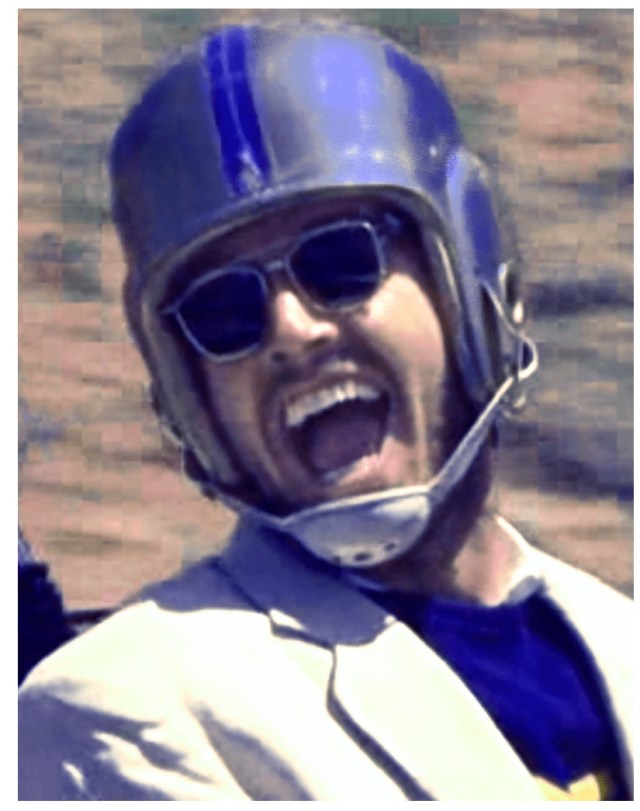
Only one thing was unusual. Obert was wearing a shiny, deep blue football helmet. It may or may not have had a face guard. Later he did remove the face guard, but it might have been attached at this time. This was Halloween, but Obert was not dressing up as a player. Every time Obert left his house he had to wear a football helmet. Sometimes even in the house he had to wear a football helmet. It depended upon what he was doing.

Obert had a hole in his head. Specifically, he had a half-dollar sized hole in his skull with a thin layer of skin over his brain. When he had the helmet off, you could touch the spot with your finger to feel his brain pulsing, probably not with thought, just blood. Also the stubble of his hair was growing back.

That summer Obert had lived in Battle Mountain, Nevada. Not much to do in Battle Mountain but drive around. Obert didn’t have a driver’s license but he could be a passenger in the back seat. I can’t remember who was in the front seats but it is safe to say they weren’t careful drivers. On a long uphill incline they decided to pass a slower vehicle. They had done this several times. This time, near the crest, another vehicle was in the lane, and it was a head on crash. I don’t think anyone was killed, although everyone should have been seriously hurt. Obert was in the backseat without seatbelts. They didn’t often exist at that time. No one is quite sure exactly what happened, but Obert flew over the front seats head first, and perhaps hit one of the radio knobs, and punched a hole in his skull.

The surgeons removed the bits of broken skull and sewed over a flap of skin. The intention was to allowed the skull to grow, causing the hole to shrink and -provide a ledge to drop a steel mesh to protect the brain. In the meantime, go home and take two aspirin.

So, Obert came home and joined us on our stroll through the neighborhood. Everything had gone very well, especially considering one guy seemed to partially dressed as a nondescript football player. We did not beg for candy, nor did we trick anybody.

We were several blocks from our destination (the pretty girl’s house) when we heard a car come to a quick stop. Three or four guys jumped out and proceeded to jump on us. There was a lot of pushing and shoving. No real fists swung, but they were armed with cans of shaving cream. Jack resisted, so at least two of them were wrestling him to the ground. Obert had the attention of one guy with the shaving cream, and I was free to run up the nearest porch to bang on the door. No one answered.

Jack had broken away and ran up on the porch next door to bang and yell, “Mom, Dad! Open up!” Looking back I could see that the guys were heading back to their car, but not before they had all emptied their shaving cream cans into the holes of Obert’s helmet. Jack yelled something about Obert being hurt, but they didn’t listen. Obert lay half in the street trying to scoop out the shaving cream from behind his glasses. We both came down to help him stand up. We could see the car about halfway down the street with their brake lights lit up. I don’t know if they were intending to turn around, or just stopping for another victim.

Jack stood there with a lot of anger building up. Frustrated, he reached into his pocket and found a decent sized pocket knife. Without unfolding it, he heaved the knife down the street at the car. To me, it looked to be at least a football field away, 100 yards! It was dark so we couldn’t really see if Jack’s aim was correct, or that he could throw it that distance.

Seconds later we heard glass breaking. Apparently the pocket knife had hit the back window of the car and shattered it. For a second no one moved, then we turned and ran, zig zagging around the corner and hiding in the bushes. We believe the cat turned around the follow us, but we hid so well that they didn’t see us.

Making it back to safe territory, home turf, took a long time, especially hiding from any oncoming headlights. Then we thought that they might have been searching on foot, so we hid from anything moving. Halloween was a busy night, we hid every few minutes.

We finally made it back, we had vestiges of shaving cream, a lost pocket knife, and a right of passage from our childhood. It was a good night!

Posted in Commentary | Leave a comment