Cities Beneath the Waves

I do like finding things, or actively going out to find things. I also like having things brought to me. We have been to Hawaii several times and with very enjoyable results. It was always best to find a good spot and just park there. No packing up, moving to another hotel, find transportation, etc. that’s a fine way to travel but it is quite a production.

One year we flew to Hawaii, and jumped on a cruise ship for eight days.

Obviously this was pre-COVID days, but we spent the extra money to get a suite with a balcony, and it was very nice. It didn’t take long to realize there something different about this trip. We weren’t going to the islands, the islands were coming to us! A wonderful perspective. Each day a new island view from our balcony.

It is this same concept with the internet. I have the complete power of various search engines, I can go anywhere, use Google earth to see anyplace that I’m thinking about. But sometimes, out of the blue, the internet brings me something. I don’t know if it is artificial intelligence that determines what is presented, or if it is just random choice, but today I was presented with the continent of Mu.

The term was first introduced by Augustus Le Plongeon, who used the “Land of Mu” as an alternative name for Atlantis. It was subsequently popularized as an alternative term for the hypothetical land of Lemuria by James Churchward, who said that Mu was located in the Pacific Ocean. I believe he looked at a globe and determined that the Pacific was just too big to be only about water. The place of Mu in literature has been discussed in detail by one of my favorite authors of sword and sorcery novels, L. Sprague de Camp, in Lost Continents.

So Mu could be Atlantis, but now is something different. And Atlantis is still sunk just outside the Mediterranean, and stories are bountiful about other lost lands. It got me thinking.

Where does this concept come from? I propose distant memories, that have the concept being passed on, but the specific details get confused. As people on this planet we have experienced floods. Floods that have displaced us from our homes, forcing us to move to dryer, and safer lands. I’m not sure about sinking continents.

The immediate thought is about Noah. It has been mentioned many times that other cultures in the Middle East have stories similar to Noah, and not because they were influenced by the local Hebrew population. The most logical explanation is that a widespread flooding event occurred and was remembered by those living around it.

The Black Sea can be thought of as a lake where several major rivers drain into it, and then it drains into the Mediterranean, and then it drains into the Atlantic. Atlantic storms rain onto Russian soil, and then it drains into the many rivers going to the Black Sea and the cycle repeats. But it was not always so.

Thousands of years ago, when humans had been in the land for centuries, they had built hundreds of fishing villages on the edge of the Black Sea. The Dneiper, the Don, the Volga, and hundred of other rivers had all drained into the Black Sea, but the balance was that the water evaporated at a steady rate, so the shoreline was relatively stable. There may have been a smal river that drained into the Aegean Sea but the Black Sea was a fresh water lake.

The Mediterranean Sea was connected to the Atlantic Ocean and the level there was also balanced except for the melting of the ice packs covering much of Europe. There was a lot of water involved, so much that the levels rose in the Mediterranean. On the east shore of the Mediterranean, there was a small river that flowed into the Mediterranean coming from the mountains in the east. It’s still there, it flows right past Istanbul, Turkey. When the Mediterranean rose the water went up river to the mountains. Eventually it reversed the flow of water, broke through the ridge, creating a tremendous waterfall down to the Black Sea, estimated at two hundred times the flow of Niagara Falls. This may have occurred 8 to 9000 years ago.

It didn’t take long at that rate to completely engulf the thousands of villages on the shore of the Black Sea. Not like a tsunami, but perhaps a steady few inches a day. But people remembered, and perhaps it rained as well.

So, there is a possibility of remembering cities under water, but what about a land?

There is recent scholarship concerning Doggerland. This was a boggy area between England, Denmark, and Belgium. It is now one of the prime fishing grounds in the North Sea. It used to be slightly above water. It disappeared at roughly the same time as the Black Sea villages. Dredges have picked up bones of mammoths, lions, and deer. Also some Stone Age tools, so people lived or traveled there.

We apparently have real evidence that some of our “cities” have disappeared beneath the waves. But Mu, I’m afraid, is just a good story.

Posted in Commentary | Leave a comment

The Tiny Coffins of Edinburgh

Something was found in 1836 near Edinburgh that has remained a mystery for well over 250 years. Naturally, we tend to end mystery with speculation, and you can imagine where the different storylines have gone. But first the known facts.

A group of boys found these “coffins” on a hillside near Edinburgh, Scotland known as “Arthur’s Seat”. They found a large piece of slate partially buried, and when they removed it, there was a small opening in the earth. In it there were 17 tiny wooden coffins, in three tiers. Two tiers of eight coffins, and one tier of one coffin. It appeared as if the coffins were placed one at a time with some interval between. The oldest coffins seemed to have suffered damage, the last coffin seemed much less damaged. Of course this might be due to the dampness & weathering.

What becomes interesting is that each coffin contained a small wooden doll, male, eyes open, 3 or 4 inches tall, dressed in common weavers cloth. 17 figurines placed with care in a hillside “cave” above Edinburgh.

This is not a natural occurrence, it is not successive natural tree root formations. It is not ginseng grown in the shape of a human. It is a human construct, constructed for a purpose, carefully planned, and possibly maintained over several years. The similarities seem to suggest that one person one responsibility, but left no written reason for the “dolls”.

It is also fairly clear that the coffins were not expected to be found, so the reason for their construction appears to be personal. Over the years it has been suggested the dolls were the work of witches, or represent the bodies of sailors lost at sea.

It has also been suggested that they are a memorial to the victims of the notorious and murderous bodysnatchers William Burke and William Hare, who carried out their gruesome deeds in the capital during a 10-month spree in 1820. Several movies have been made detailing with the business of providing fresh cadavers for the use of future doctors. The problem is that Burke and Hare have the right dates, but most of the victims were women, and all the dolls were men.

An on-going shrine for sailors lost a sea seemed like the most likely reason, based upon the style of clothing and common material.

Eight of these coffins are on display in the national museum of Scotland, and remain a very popular exhibit.

Recently a new theory has been proposed, referencing a long forgotten rebellion that was severely repressed by the British government. In Edinburgh there were factories as part of the Industrial Revolution. Weavers of cloth had moved from small local looms, to great buildings with looms run by a collection of belts powered by water wheels. The conditions in these factories were horrific, with hundreds of children working the looms. The workers protested and struck.

The authority rounded up the leaders of the protest and hanged a number of them. The rest were placed on ships that sailed for Australia. For the out of work weavers, Sir Walter Scott recommended that they should be put to work making a road around “Arthur’s Seat”. Not a very fit thing for weaver’s to do. But perhaps the coffins were a memory of those hanged or sent to Australia.

In either case, the Rebellion was forgotten, Britain lost control of Scotland’s governance, and the little coffins are displayed in the National museum, still a mystery, but honored.

(Inspired by a story written by Charles Fort)

Posted in Commentary | 1 Comment

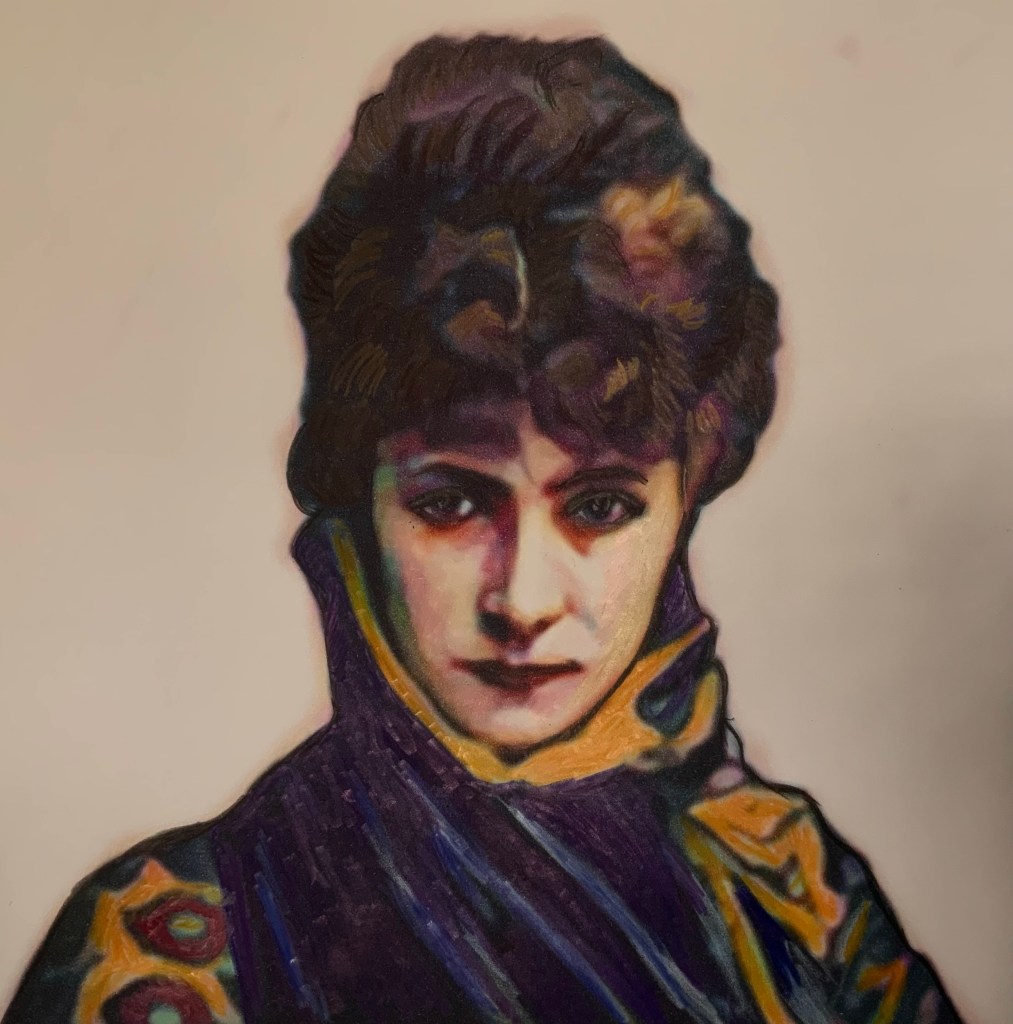
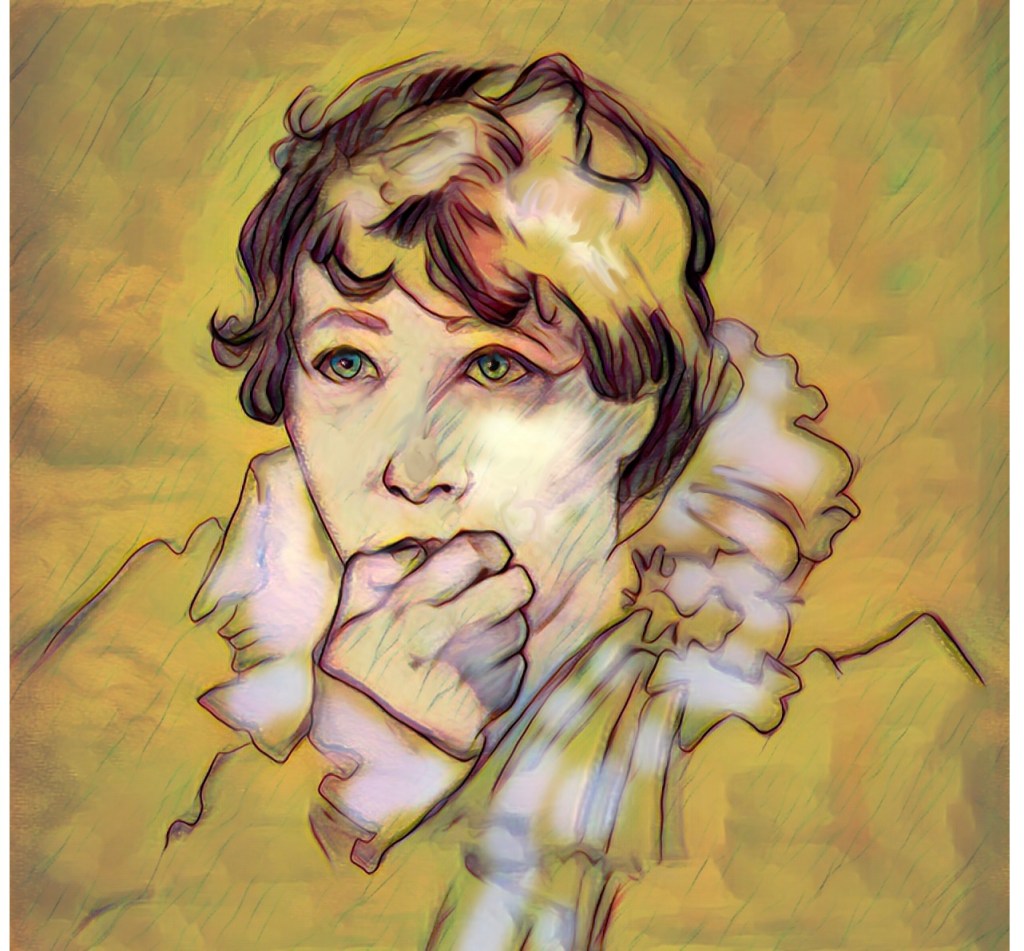
Tribute Van Gogh

Road men

Heading to exhibit in SF next month.

Posted in Commentary | Leave a comment

Doubt

I’m getting philosophical again, pondering the word “doubt”. Is this a good thing? After all, there is something absolutely the same for people who believe nothing, and people who believe everything. They do not think! Thinking requires doubt, or at least doubt kickstarts thinking. Presuming that with enough thinking, doubt will disappear, and certainty will reign. Or, with enough thinking we can be certain that we do not know. The question might be whether doubt will actually motivate thinking. Perhaps doubt is perfectly fine being static.

Rene Descartes had a thought about thinking, and he used the technique of “methodic doubt”. He looked at three different categories of knowing: authoritative, empirical, and mathematical. Each category had serious issues of being fallible, thus dubious.

He found knowledge from tradition to be dubitable because authorities disagree; empirical knowledge dubitable because of illusions, hallucinations, and dreams; and mathematical knowledge dubitable because people make errors in calculating.

He proposed an all-powerful, deceiving demon as a way of invoking universal doubt. Although the demon could deceive men regarding which sensations and ideas are truly of the world, or could give them sensations and ideas none of which are of the true world, or could even make them think that there is an external world when there is none. The one thing the demon could not make men think is that they exist, when they do not. Thus, “I think, therefore I am.”

Doubt appears to be a “way station”, a good thing for a time, but a place to gather facts and feelings. It is not a place to plant roots and stay. How long can we linger in doubt? Ahh, there’s the rub, too short of a time and you are lazy, too long of a time and you are indecisive. It may be similar to buying fruit, too soon and it may be green. Too late, and it’s well on the way to rot. Again there is no hint of what that timing is in hours, days, weeks, or years.

In some circles “doubting Thomas” is a negative stereotype. In other circles he is proof that reality can be tested.

I think “doubt” is fungible, in some cases it is necessary to decide in seconds or parts of a second. This may mean the difference of life or death. In most cases doubt has timing that is appropriate to the importance. The “lifetime” doubt is only a problem if it isn’t resolved by the time of death.

Descartes envisioned a demon to explain his view of knowledge. I’m envisioning an individual walking around full of certainty. This is an individual that I would actively avoid. Give me a portion of doubt, periodically.

Posted in Commentary | Leave a comment

I’ve Been Making Things

Everybody very sharp and beautiful!

Posted in Commentary | Leave a comment

She Was a Dancer

She was a dancer, she was always a dancer. From the time her memories started she had already been taking dance lessons for two years. Admittedly it was mostly disorganized jumping and spinning around, but she had several costumes from several ensembles. And one more thing, even the parents of other children began to watch her when she came on stage. She had presence, stage presence.

Her father watched her every rehearsal, and remembers almost the exact week when the joyful romp became a joyful performance. She counted out the choreographed steps and used concise, but shortened hand and wrist movements to memorize the routine . She could do this anywhere, waiting for food at restaurants, watching television, anywhere at all. The dance floor was in her mind, and the shorthand was an extension of her body.

When the actual rehearsal came, her body mimicked what her shorthand had already worked out, except for the spinning. The shorthand for spinning was a little twirl of the wrist, but that was not at all like the real thing.

Initially, she spun and just got dizzy after a minute. It took years before being able to “spot” off stage by keeping your head fixed, then quickly spin it around to complete the next turn. We have all seen the technique in professional dancers, but it was amazing to see this in pre-teens. By the time she was a teenager she had the technique down pat. And she  was improving her speed of turning her head after having it fixed on a point.

All the while her body was perfectly vertical, arms and legs in exact pose. It was powerful to see, and powerful to experience. And then something happened.

Her eyesight began to fail her. The snap turning of her head to the fixed point began to give her blurred vision. She said nothing at first, worrying that she might have to stop dancing. She continued on, and unless the performance required a tight spin, she never noticed the blurred vision.

Unfortunately a new choreographer like to introduce several star dancers by writing in long spins, longer than she had ever done before. As it turns out, she could easily outspin everyone in the class, so she got the starring lead. Happy as she was, she began to worry about the blurred vision. Could it have longer lasting blurring for the next series of steps?

For several days of rehearsal she studied what was happening. It seemed to her that it was just blurred vision, not dizziness or nausea, certainly not upset stomach. That was a relief, so she focused on what she could actually see, something that a fast camera lens could capture.

It took several weeks before she was certain it wasn’t blurred vision, it was blurred objects, not her vision of the objects. She was seeing clearly , but what she was seeing was blurry. She tested this theory by slowing her spin slightly, and the result was that the box shaped object that she used for her focal point was sharper and less blurred,

She knew that this might seem like a perspective issue. Logic told her that the perception of the box being in focus could be the effect of going slower. It just seemed unusual that it was so consistent, by going just a little bit faster there was an exact degree of blur that postured . After a time it didn’t seem reasonable that her body was that responsive. Some days it shouldn’t be as blurry if it was her fault.

Her final conclusion is that it didn’t matter what she thought she saw, she wasn’t dizzy and she came out of the spin exactly when she needed. The show was a hit, and everyone agreed that they couldn’t take their eyes off of her .

It’s now years later, she is still dancing, but also taking physics in college. The professor offhandedly states that nothing is created and nothing destroyed, just states are changed. Very typical sophomore concepts to open the inquiring mind. Nothing destroyed, just changed.

She thought about this, and reasoned that it made sense when times were simpler, and change was slower, in a practical sense it meant that all atoms, or even parts of atoms are already existent. Nothing new created since the Big Bang. Everything made since is using the current storehouse. The question is, when do we run out of supplies. We want to make sometime new but there aren’t “parts” available. Where do the parts come from if nothing new is created. The answer is simple, some things must be taken apart so that new things can be made.

This balance would be perfect if we don’t mind losing some things in order to have new things. The trouble is that the timing can be all wrong, millions off  things  are  still needed  in  the  modern world and billions  of  things  want to be  made.  The  young dancer  thought  that  physics  was  starting  off badly. How would we know when there was a parts shortage? It  didn’t make sense to her ordered mind. But  it was a problem that she tried  to  work out the  best  she could without  asking her professor. It was too soon  to ask a silly question. Where was the raw material for new things?

Obviously, the earth was mostly untouched, the bottom of the sea floor, plenty of things die off each year. It was a silly question. But is it an infinite supply? The sand of a desert seems infinite, but there are countable grains.

And who collects the supplies to make them available? Suddenly the dancer studying physics thought she might need a second minor in theology.

Then it came to here in a dream, she could technically see a little less than 180 degrees. She doesn’t know what the state of the molecules are for things she can’t see. What if reality is only that which we can observe? That’s very egocentric but maybe that’s only a perspective thing.

Suddenly a memory flashed from years ago. A box sitting off stage right, getting more blurry the faster she turned. More blurry because the detail is in the molecules, and if the molecules aren’t there, then it’s half formed, blurry. Getting out of bed she felt unsteady on her feet. She had heard about first year college students having delusional thoughts. She worried that the stress of leaving home does funny  things.

She went to the bathroom to splash some water on her face. She looked at her image in the mirror and laughed inwardly. She couldn’t see the room behind her head. Maybe the world doesn’t exist there. Perhaps as she moves to one side, the world is being taken apart in order to build the world that is coming into view on the other side.

She thought she could re-create the dancer’s spotter vision, by not focusing on anything, but intently looking just the same. And with her dancer’s reaction, she could move from side to side to see if anything is out of the ordinary. She tried several times, but nothing seemed strange except the dancer’s slight jerking from side to side. She decided to get the toothpaste behind the mirror while she was finishing her jerking routine.

The movement of the mirror magnified the speed of her body’s jerk movement, and for a nanosecond there was a blurry line around her head. Blurry on the left as the room decomposed, blurry on the right as the room was being built.

Using the scientific method she repeated this a dozen times. Her vision was not blurry, parts of the room that she could see in the mirror were blurry, just like that box years ago. She thought that in the morning she should go see a counselor… and change her major to physics with a minor in dance. There are new things to explore.

(a story)

Posted in Commentary | Leave a comment

Fredegund

This is a story first told by Gregory of Tours, who lived from 30 November c. 538 – 17 November 594 AD. He was a Gallo-Roman historian, and the Bishop of Tours. His position and training made him very knowledgeable of the times, and he is the primary source for the history of the Merovingian kings.

Fredegund was a maid to Audovera, the first wife of Chilperic I, the Merovingian Frankish king of Soissons. Fredegund convinced the King to put Audovera in a Monestery and divorce her. Fredegund did not go with her and soon became the King’s favorite. This did not last long because the King put her aside in order to marry Galswintha, 561–584. Galswintha was the daughter of Athanagild, Visigothic King of the Iberian Penisula, and the sister of Brunnhilda, who was married to King Sigebert I of Austrasia. Yes, she is that famous Brunnhilda.

Fredegund did not take kindly to Chilperic marrying Galswintha, and responded by strangling her within a year’s time. Brunnhilda did not take kindly to her sister being murdered and this started a 40 year bitter feud between the two women. It is not recorded what Chilperic thought, but he married Fredegund soon after. Together they had four sons and at least one daughter.

There was an outbreak of dysentery in Gaul which affected the king and his two sons Chlodobert and Dagobert. The king survived, his sons did not. Perhaps Fredegund felt bad about her sons, but when her son Samson became ill soon after birth, she set him aside, fearful that she would become sick. He soon died.

Her daughter Rigunth was quite beautiful. Gregory of Tours relates a story that Fredegund was jealous of her daughter, and tricked her into looking at a chest of jewels. When Rigunth bent over to look more closely, Fredegund shut the lid down on her neck to choke her to death. Rigunth was saved by the sudden appearance of some servants. She was then sent to Spain to marry a Visigoth prince.

Gregory paints a very negative story of Fredegund, a vicious murderer, an evil treacherous queen. She is the archetype of every dark queen that we see in the movies or read in fairy stories. And she gets worse as she gets older. She uses her power and position to arrange the assignations of dozens of political enemies. There is even the suggestion that she arranged the assignation of her husband Chilperic.

Fredegund certainly ordered the assignation of King Sigebert and Queen Brunnhilda. Finally, in 573, she successfully had Sigebert murdered. Brunnhilda fled to Guntram, the King of Burgundy, who protected her for several years, but Fredegund still tried to have her killed.

Fredegund ruled the kingdom until her son Chlothar II became of age. The hatred she had for Brunnhilda was transferred to her son, and it became his mission to make war against her.

Fredegund died of natural causes on 8 December 597 in Paris. Death did not create peace. Her son Chlothar had captured Brunnhilda and had ordered that she be tied by the arms and hair to the tail of a young, untamed horse, and dragged through the entire army. As soon as the king gave this order, it was carried out. The first time the man who was on the horse dug his spurs in, the horse kicked up his heels with such force that Brunnhilda’s head flew off. Her body was dragged through the bushes and brambles, over hills and dales, so that it was torn to pieces, limb from limb. She was about 70 years old.

Fredegund was my 39th great grandmother, and every time I see or read about an evil queen, I think about her.

Posted in Commentary | Leave a comment

Benjamin Bathurst

Benjamin Bathurst, 1784-1809

I came across this name in a book by Charles Fort. If you have read any of his writing you know that he doesn’t spend too much time on a subject. He may have invented “just the facts, ma’am”. Unfortunately most of what he writes is gleaned from newspaper articles written at the time, so “the facts” are debatable.

The article in question states that Benjamin Bathurst “walked around the horses, and disappeared.” That statement alone is loaded with questions. In my brief research I discovered many things. I discovered that their was a book titled “He Walked Around the Horses”, by H. Beam Piper, 1948. Not only that, according to Wikipedia, Benjamin Bathurst was mentioned in at least ten written works from 1924 through 1992, mostly science fiction. All had made much of the strange disappearance.

So briefly, who was Benjamin Bathurst? He was a British diplomat sent on a mission to Emperor Francis I of Austria in 1809. He was the son of a powerful politician that actually ordered him on the mission. On his way back to England his carriage stopped in the evening at a small village near Hamburg, Germany. He was traveling with an assistant under disguised names. It was about 9:00 pm, so even though the horses were ready, they were considering if they should spend the night at the inn. Going outside, Bathurst was slightly ahead of his assistant and went around the horses to enter the carriage. When the assistant entered the carriage, Bathurst was gone.

A massive search was immediately started. Nothing was found. The river was dredged, woods were scoured. Several days later Bathurst’s expensive coat was found in the home of a woman who worked at the inn, she probably lifted it after he was found missing. A month later his pants were found in the woods three miles north of the inn. It had a letter to his wife in a pocket, mentoring that Bathurst “was surrounded by enemies”. According to some reports there were two bullet holes in the pants, but no bloodstains.

England, Austria, and Prussia were all at war with France, and the French border was not that far away. Napoleon was suspected of having sent a detachment of troops to capture Bathurst. In a meeting withBathurst’s wife. He denied knowing anything about it. This was still a big newspaper story at the time, and was covered by many newspapers in Europe. The story continued to be fresh in 1854 when a mysterious skeleton was discovered buried in a stable near the inn. Bathurst’s wife apparently went to see if it was her husband. Nothing more was written on the visit.

The latest research brought out that Bathurst had been commited a year earlier with a mental breakdown due to stress from being a diplomat to Sweden. There were some letters that suggest Bathurst was having some sort of outbursts in the carriage, saying that enemies were after him. It included that Bathurst had physically shaken his assistant by his coat lapels. Perhaps the letter was written to his wife to puff up his trip abroad. Or perhaps Bathurst had really seen French agents stalking him.

The studied research does suggest that he was murdered by someone who disposed of the body in some way. Because we don’t know exactly what happened we can suppose all sorts of possibilities, even if the “possibilities” are completely in the realm of science fiction

Posted in Commentary | Leave a comment

Today I Was Naked

At my age this would not be a pretty sight. Maybe at any age. But I’m not talking about clothing, I’m talking about leaving the house without my cellphone. Now if you are a younger person, you can easily relate, your cellphone is your lifeline. Of course, if you are a younger person it is more likely that you have never left your cellphone. It would be like leaving the house with no clothes on.

I remember hard plastic-like, black phones, with a rotary dial, connected by a hard wire via a party-line (cheaper), and no area code yet. The concept of a wireless phone meant that it would be even larger, and not fit in your pocket.

So for about sixty years of my life, I left my phone in the house when I left. Because it was attached to the wall. Later on we had area codes, and special rates for “long distance”. Somehow we were all convinced that it made sense for higher rates because something was used up the further that you called, like gasoline in your car. The phone companies allowed you to be ignorant.

Leaving the house without a phone wasn’t barbaric. They had these things called “phone booths” or public toilets, they seemed functional for both purposes. Superman was always able to find one in an emergency, and so could you!

Nearly every public parking had a phone booth, and most could give you a five minute call for a dime (remember, something was used up). Lots of young people wore buttons that they pinned to their jackets or purse straps. It was very wise to put a dime in the back of several buttons. You could always make an emergency call. Some people still wore “penny loafer” shoes, but replaced the penny with dimes. Later on it was a quarter for three minutes, so the buttons had to get bigger, and the shoes were out.

In addition for being the model for future airplane bathrooms, the phone booth did provide a measure of security. Not only did it deter thugs from a snatch and grab, but it muted the conversation that you might have, unless there was a lip reader nearby. There is a federal law that talks about “the expectation of privacy” and government agents cannot listen in or record any conversation between individuals if there is “an expectation of privacy” without a warrant signed by a judge. That stops the police from tapping your business or your home. It also stops them at the phone booth.

But time rolls forward, now we all have cellphones, and we feel naked if we leave it at home. And by the way, there is a limited “expectation of privacy” with cellphones. No warrant needed to listen in or record anything said through the public airwaves, just purchase a scanner.

Ever wonder why those public phones that don’t live in a phonebooth have those little “wings” on either side? It does stop some extra noise, but it is supposed to give you that “expectation or privacy”. Plus the new design allowed the phones to be lower, and no booth meant that it was wheelchair accessible.

There is one more thing that is different about nearly everyone having a cellphone, and that is “connectivity”.

I want you to envision your close circle of friends, it could be anywhere from two to a dozen. How many of you have that one close friend that is slightly off the rails, wears aluminum foil hats in the house, listens to radio talk shows about aliens, and hangs out near Area 51 on vacation. We might know someone like that, but rarely are they close friends, unless you do the same things.

Now, expand to relatives and acquaintances. Expand it even further to one hundred people. With one hundred people you might find one of them that fits this description. That’s one percent of your acquaintances that are slightly wacko. You can handle that, your particular group will not be taken off the rails by one percent of the people you know. You are safe.

However, now most people are connected by cellphones, many of them “smart phones” allowing for deeper connectivity. If the population of the US is 328 million folks then one percent is 3,280,000 people that can be connected with the same mindset. If they were all told to move to Denver, and taken over the city, there might be anywhere from 32,000 to 328,000 people that actually show up.

Yes, back then, with our Bakelite phone tied to the wall in the house, we might have felt isolated compared to today. But there is a positive side to isolation.

Posted in Commentary | Leave a comment

Rocks of the Playa

I having been pondering about the “sailing stones of racetrack playa”. I know, what can we learn about stones that move upon their own accord, besides the fact that no one has seen them move. Is it because Racetrack Playa is so far removed from civilization? Or is it part of a vast conspiracy of stones being moved by aliens for their own amusement. I have even heard that this was a training ground for individuals learning the “black arts” of telekinesis.

If somehow you have missed the story… Racetrack Playa is a dry, mud cracked, lakebed, just north of Death Valley in California. It is rather scenic as dry lakes go, but in addition it has over a hundred stones from ounces to hundreds of pounds, that have moved on the dry lakebed, leaving furrows that meander hundreds of feet. And there are no footprints, thus the name “sailing stones”.

Shades of “crop circles”.

First discovered in a documented account in 1915, it was officially suggested the stones moved as the result of hurricane force winds. This was an absurd idea, but it was the best that early science could provide. Privately, they were uncertain. It wasn’t long before underground theories began to fill in the void of “uncertain knowledge”.

Many different theories were put forth in the following 50 years. Finally, in May, 1972, a sailing stone movement monitoring system was put into place. A corral was built to isolation approximately thirty stones, in order to measured their movement from month to month. Each stone was measured and given names, like Karen, Mary Ann, Nancy, etc. Mary Ann moved a whopping 212 feet during the first winter. After seven years of study, Nancy had accumulated 860 feet. Karen was the big disappointment, she had not moved an inch in seven years. It’s 570 feet of trail may have been from it’s first walk, but nothing since. Some say it was reasonable because Karen was approximately 700 lbs. I think that’s a little “fat shaming”.

Now, of course, Karen is not there. She disappeared in 1992 or 1993. There may have been a sighting in 1994, but nothing since then. Looking for her photo on a milk cartoon, “700 lb dolomite rock, answers to the name Karen.” You can be sure that there are several additional theories of what has happened to Karen.

Finally, modern technology caught up to the mystery. ‘If a tree falls in the forest, and no one is around, does it make a sound?” Sure it does, prove it with with a remote audio recorder. So, a group of researchers set up time lapse video cameras on several stones, and placed special GPS devices on as many as 60 sailing stones. The results of this study was published in 2014.

Warlocks did not appear to move the stones. Aliens did not use force beams for curious reasons. A thin layer of ice had formed during the rainy season, and even a mild wind could cause a stone to sail. They actually video taped movement on a pleasant day.

My question is… why is it so easy to believe the impossible, instead of maintaining, “I don’t know yet”?

Now, one more fact for conspiracy people- why is it that the highest and lowest points on the North American continent are only 90 miles apart?

I forgot to mention, if you plan to visit Racetrack Playa and the sailing stones, it’s only 6 miles from Teapot Junction, a stop sign corner. Bring your own teapot, (now that’s a mystery)

Posted in Commentary | 4 Comments