No, not the 1966 classic Western movie. I’m thinking about the problems of history. I am by no means an expert on how we must understand history. I do declare my love for the subject, and I have collected an eclectic library of historical events. I do not have advanced academic degrees in history, and my written opinions will not shape the opinions of future historians. And yet, I do have opinions, and I am witness to a number of changes that are dramatic, and in some ways refreshing, and in other ways very problematic.
It is quite possible that some of the changes will become an academic standard, and history books will become completely useless, until new books are written with more accurate presentations.
There is a cultural “sea change” in our social fabric. Views that were once on the edge of social acceptance have morphed into center stage opinions. Some of this is based upon the increased concerns of “social justice” in response to events that have become important to current culture.
It is true that some of these events are the end result of many years of beliefs that are basically flawed. Beliefs that have grown from insignificant errors, that have found fertile ground in thoughts, or ideas that have major social errors.
Unfortunately, there are other problems in history that have always been there, or at least obviously apparent from the earliest written records. As historians we try to read these things in context, with the caveat that society had not developed the finer points of civilization. I disagree, I think that much of our problematic history was a societal choice, and that other more ethical choices were available, but rejected.
So now what can we do with the factual history we are left with? For me it will be a constant search for the truth. In most cases it will be a mixture of realities from different parties. The old adage of ‘history is written by the victors’ is something to consider. Another is ‘history is written by the literate at the expense of the illiterate’. Another is ‘history is written by the side that benefits the most from the narrative that is presented’.
It is difficult, but we can research most of these points. It is more difficult to research the opposing sides. In some cases the victors made considerable effort to destroy all records that existed in the defeated culture. This creates the historical problem of “omission”. Often our guesses create a higher standard of ethical positions that are not merited by the actual truth. Historians should not guess.
I’m writing this because I believe humans will always have a choice of “the good, the bad, and the ugly.” And the problem is that all three are subjective and open to debate, and criticism.
One would think that “the good” is a safe bet. What could be wrong in writing about “the good”. This is probably the most dangerous area in history. There are few “good” absolutes. Some folks even say there are none! I’m not that cynical, but I do agree that universal agreement on “good” has a long way to go. Our worst historical events are based upon a disagreement upon what is best, and for who it is best.
The “bad” is actually much easier to isolate and write about accurately, even if technically “bad” is also subjective. There hasn’t been too many cultures where deceit, murder and theft were the highest societal standards. In some cases it may have been okay to treat strangers, or foreigners, as sub species, but not generally.
The “ugly” is where most reasonable histories are found. The higher standards are articulated, and the failures are documented. In general, that creates an “ugly” written account. It is very hard to be proud of the most ugly events. Even the best of the “ugly” is embarrassing, and it seems so unnecessary.
Considering that a lot of history comes from the actions of humans, we have a responsibility to modified our actions, creating more good than bad, and making the “ugly” more beautiful. That does take a stand on moral absolutes, but I’m okay with that, providing there is tremendous effort taken on both sides.
In the meantime, I try not to get trapped in the dungeon of “bad history”, or to ‘cancel our history’ because it is “ugly”. Going down that road is living with opinion makers who create narratives for their own agendas. History is living, history is exciting, and history is always surprising.
No, not the mechanical flying kind. They are cool, but I’m thinking about the worker bees, or the mass of individuals in the ant hills. The drones maintain the structure of their societies. It’s imperative that the drones exist, even if they are sometimes sacrificed for the sake of their communities.
First, it might be useful to look at the YouTube video at the following link…
It’s a TedTalk link of Sir Ken Robinson on the topic of “Do schools kill creativity?” He doesn’t ask a question unless he already believes he has the answer. It’s a very funny, yet sad, 20 minute talk. He really believes that even the best art colleges failed at fostering creativity, and the reason has everything to do with how the schools are funded, and the strings that are attached to that funding.
I’ve dedicated 40+ years of my life to higher education and I must agree with his statements. Colleges are successful, but only if you look at completion rates, and job placements. Colleges have morphed into institutions that provide society with workers, but not necessarily educated citizens.
Our understanding of the definition of “being educated” has not kept up with the changes that our colleges have faced. Most of our classic novels mentions “going to college” for different reasons that are currently used. In fact, the first universities in Bologna, Italy and Paris, France are vastly different today than what was stated in their first charters.
Being educated for nearly a thousand years meant that you studied under a “master” teacher, well schooled in the classic disciplines. And the purpose of the education was to create citizens that appreciated art, science, history and languages , and that reflected the growth of mankind, “the rebirth of our humanity.” It is not an accident that the Renaissance came soon after the creation of universities.
Robinson makes the statement that today’s colleges have only two missions; to provide drones for the corporations is the majority, the second is to provide future teachers for the colleges that teach the drones for corporations. At the very top there are researchers, but even the researchers are motivated by the profits made by their discoveries. It is as if colleges do not the need to teach the finer points of humanity. We have already arrived. We have achieved that goal, now we need to focus on making a living.
A college education wasn’t meant for the masses, it was meant for the leaders, the 1% of the 1%. The guilds and trades councils took on the training of apprentices destined to work in industry. Things had to change when education became possible for a population that wasn’t meant to have higher thoughts. Colleges just replaced the guilds. That way the “higher thoughts” are protected from the masses. The trappings of a college education were gifted to the ever expanding need to have more drones.
The hard numbers
In 2020-2021 there were:
880,000 associate degrees
2,000,000 bachelor’s
800,000 master’s
200,000 doctorates
Almost 4 million “educated” drones per year.
And the expectation is that the numbers will be slightly higher for the next ten years.
Robinson is fearful that creativity will almost disappear from colleges and our society.
The Chambers Brothers is a soul-music group, best known for its 1968 hit record, the 11-minute long song “Time Has Come Today”. The group was part of the wave of new music that integrated American blues and gospel traditions with modern psychedelic and rock elements. Based on their Southern roots, the brothers brought a raw authenticity to their recordings and live performances that was missing from many other acts of that era. Their music has been kept alive through heavy use in film soundtracks
About Time according to Quoro
Brief answer:
“Time and space are non-matter existences. They don’t exist in physical state. Therefore, unlike matter existence, they don’t have physical properties. And they cannot have interactions with matter existence.”
I disagree. That doesn’t have the ring of experiential truth. I’m not discussing space, but time is something that I experience. It’s not the same way as wind, where we see the effects, but not the wind. I feel time passing, I see the results and sometimes I can see the future effect (not always).
“Time has no dimension. Space only has three dimensions. No more. Time cannot be incorporated into space to form a dimension.”
I disagree. The certainty shown by these statements automatically places them as suspect.
“Time is measurable but measurable does not mean tangible — non-matter existence cannot be tangible, only matter existence is tangible.
And due to we only can measure time with matter movement process, so regardless how accurate this measurement can be, it is still a relative reference for time. It is the same case for space on this issue.
Non-matter existences are intangible, therefore they cannot be proved directly but they only can be proved indirectly by matter existence:
There is no way to prove the existence of space but the matter exists and moves within it; there is no way to prove the existence of time but the matter existence and movement process elapses with it.”
I agree. This is a very rational observation.
“Non-matter existences are self-evident; because you only can prove them with the existence of matter existence and due to matter existence is always changing so this proof is intrinsically relative to approximate the absolute existences of the non-matter existences. But if you take the relative proof of the non-matter existences as the proof of the relativeness of the non-matter existences that is wrong — the matter existence is used for approximating the measurement of the non-matter existences but the absoluteness of the non-matter existences is not depending on the relative approximation of the matter existence.”
I don’t know if I agree or disagree. I confess that I could not completely follow the argument.
“And an object moving through the spatial dimension is not the same as a process elapses through time. An object cannot move through time, while a process cannot move through space. Time only can be related to process, space only can be related to object. Use other expression: Time has nothing to do with object; space has nothing to do with process.”
Again, this might be true, but the assertion is too absolute.
“Unlike space, Time has no dimension, it only has a direction. And it is one way direction — irreversible process.
When we travel, we travel through space. We cannot travel through time — it is physically impossible. It is the process of our travel elapsing through time irreversibly into future.
Time and space are different and independent non-matter existences that cannot interact or incorporate with each other. The intrinsic property of space — dimension, cannot be applied to time, and vice versa for the one way direction of the time.”
I disagree, we are not completely sure that there is no interaction. At this point in time, most theories say there is no interaction.
“Space is three dimension that allow matter to exist and move within it, but time has no dimension therefore matter cannot exist and move in it but the process of the matter existence and movement elapses with the direction of time irreversibly.”
I disagree. I don’t know that space makes the determination that matter exists. I don’t know that time has no dimension, it might be measured in the future.
“And due to space and time are non-matter existences which are the absolute existences that can be used as the only absolute reference frames for matter existence. But due to matter existence is always changing, it cannot be used as absolute reference frames for anything — regardless it is for matter existence or non-matter existences.”
What?
“Matter reference frames are intrinsically relative. Matter existence only can be used as relative reference frames.
When matter existence is being used for measuring the space and time, they are the approximation of the absoluteness of the non-matter existences.
So the approximation of the absoluteness of the non-matter existences works as the approximation of the absolute reference frames for matter existence.
There are only three existences in this world: space, time and matter (matter is the abstract term for mass with regard to all its existence states, energy is not substance but the existence states of mass).”
I disagree. The certainty of words like ’only’, makes this statement suspect.
“So, if you messed up the concepts of the space, time and matter, you can get nothing right because there is nothing else left in this world.”
I totally agree. In general, theories of existence have built in ‘mysteries’ that should be considered, ‘certainty’ is impossible.
“That is where modern physics start to get into astray.
The social cost is enormous, especially at the moment of human future crisis.”
I agree. We often get things wrong, and there are consequences.
The simple definition of time, should have a simple answer. The fact that there isn’t a simple explanation is inconvenient for us, but forcing reality into our own narrative is laughable. Again, there are things we don’t yet know, perhaps there is more unknowing than knowing. Things will change and we should be comfortable with that without declaring absolutes before their time. At best this can only be a guess.
Farmhouse in ProvenceHead of a Young Peasant in a Peaked Cap. 1885Old Man in Sorrow (On the Threshold of Eternity). 1890La Berceuse (Augustine Roulin). 1889Sunflowers. 1888
“Just go with the flow”, was a popular saying in the 1960s. I’m not sure that anyone really thought about it in depth. It just seemed a ‘chill’ statement, semi-mystical, with a slight philosophical flavor.
Hopefully it meant that you are floating in a substance, and not tumbling in a rip-tide or undertow. Flowing also implies a current, and the current can be a gravity issue, meaning going from an upper elevation to a lower elevation. Current can also be cause by pressure. The flow created by a squirt gun is caused by a piston compressing in a cylinder, forcing material out of a nozzle or opening.
A flowing current can also be created by a reservoir of a substance that is controlled by a gate. The perfect example is a dam creating a lake, and then the gate in the dam being opened to create the flow. In this example the substance is water, but perhaps the substance can be other things.
‘Going with the flow’ has also been used with social movements, implying that getting onboard with ideas and general consensus creates the flow.
When I was taught about basic electricity the example mentioned is that electricity flows. We were to imagine that the copper wires were replaced by a liquid. In different circuits there were also gates. Some gates were basically on or off, some gates were variable constrainers, some gates were amplifiers. It was important to note that amplifiers didn’t really create more liquid, the amplifier gate simply controlled a larger reservoir that could be dumped into the flow.
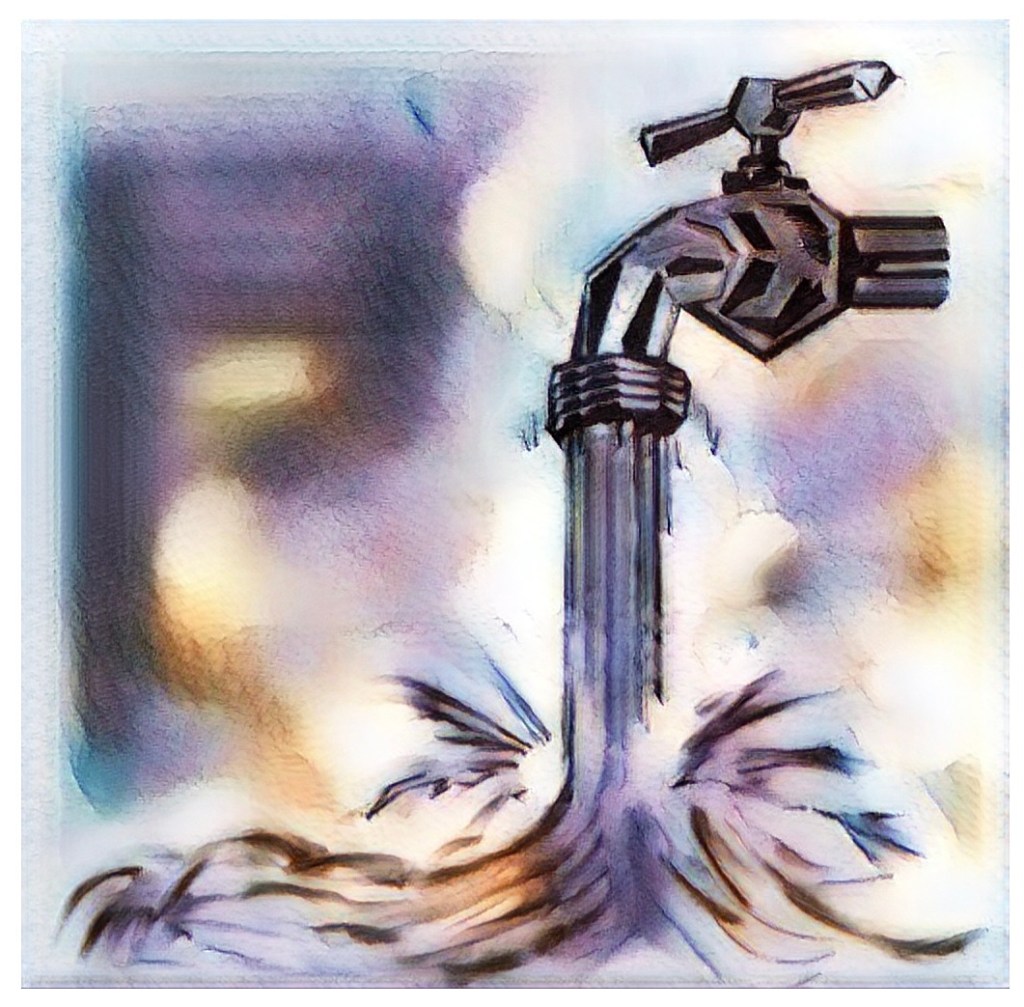
It occurs to me that the flow may be spiritual, in which case the gates can be very small spiritual issues that open very large spiritual reservoirs. An example: going to prayer for others can eliminate the rage within you. Or, said another way, prayer is the tap (gate) that causes flow from great reservoirs of peace.
A friend is currently reading about the Appalachian Mountains, one of the oldest mountain ranges on the planet. It was supposedly formed 480 million years ago, and has been in the process of weathering for quite sometime. In it’s youth it was similar to the Rockies or the Alps, and sealed off the east coast from the interior. This was pretty much true until the mid 1700s, when Daniel Boone opened the Cumberland Gap, which was a flood gate into Kentucky and the Ohio valley.
I had read about the Appalachian\ but in 1971 I was privileged to live in the Blue Ridge mountains for almost two years. I lived in Rouzerville, which was right next to Blue Ridge Summit, and just a few miles from Cascade, where Ft. Ritchie existed. It started as Camp Ritchie and it was a semi-secret post, training interpreters during WWII, over 20,000 were trained in German and Japanese. In 1998 It was one of many installations that were decommissioned, but in the early 1970s it was a busy place, for all the services.
After WWII and during the buildup of nuclear weapons, the military turned its attention to organizational bunkers. The facilities of Adolf Hitler in Europe were well known and that was before atomic bombs. In the 1950s, plans were drawn up to build a bunker deep inside a granite mountain on the east coast. The Blue Ridge Mountains were selected. Camp Ritchie became Fort Ritchie, and was selected to be the organizational support unit on the surface, and the actual underground facility was a few miles away, on the other side of the border in Pennsylvania, at Raven Rock. This was to be the Joint Chiefs Command Center for every branch of the service. It was technically the Underground Pentagon.
When I was not underground, I roamed around the Blue Ridge Summit area, hiking the Appalachian Trail, visiting the small mountain towns that were off the beaten path. The mom and pop stores were often mini versions of Target or Walgreens. They were stocked with a complete variety of products. If something had sold once, they bought three more from various vendors. Rolling ladders were against the wall to reach the shelving that was ceiling high. It may have taken several years to memorize the row, and the height of the stored merchandise.
My favorite was the local items, sold by individual “mountain people” on commission. There were whistles, good luck charms, yarn goods, mostly hand-made with accompanying stories.
I remember a collection of “fairy crosses” being offered, very small stones in the shape of a cross. I had forgotten about them, but was reminded by an article by Charles Fort. He had researched an article that had been published by Harper’s Weekly in the late 1870s. “In parts of the Blue Ridge Mountsins, there have been found small carved ‘fairy crosses’, that attest to a race of small people that crucify cockroaches. The crosses are in the shape of St. Andrews, Roman, and Maltese. The local people believe the collected crosses have a power that will provide good fortune.”
What was published in Harpers Weekly is still true, but things have changed. In Virginia it is now illegal to dig for “fairy crosses”, they are protected from collectors. It is unknown if they are still used to crucify cockroaches.
What is known, is that the “crosses are the result of a natural formation. The stones are staurolite formations of silica, iron and aluminum. Formations created under great heat and pressure, when the Appalachians were rising 480 million years ago. Thomas Edison and Teddy Roosevelt both believed in their mystical properties.
I haven’t been back to see if the local Mom & Pops carry them at the checkout counter, but I suspect some still do. I thought they were cheap trinkets carved by “local mountain folk”, glad to know that they are natural and organic.
It’s all in the title. Why would a Jeep be in a garage? To protect it from the weather? Well, it’s a little late by now. I’ve had garages in every home that I’ve purchased or rented. I’ve never parked my vehicle in the garage of any home. I may have driven it in for a day or two, and some homes not even that. Everything I own is in the garage, except my vehicles.
So why now? I’m trying it out in order to please my wife. There, I’ve said it.
There is nothing wrong with trying new stuff, particularly when it would never cross your mind. The issue is why did this “parking in the garage”, cross my wife’s mind? Husbands know that this line of inquiry is not beneficial to anyone. But there may be an answer. We had an ugly driveway.
We have always had an ugly driveway in every house that we have lived in. It makes perfect sense to cover up ugly driveways with the current vehicles, (even if they as just as ugly).
About a month ago we pulled the trigger on upgrading our driveway. First we painted the house. It looks nice. It made the driveway look even worse. The drive way was not the usual cracked, and earthquake damaged piece of concrete we usually had. It was old, cracked, blotchy, asphalt. It was also the only asphalt driveway for blocks in either direction. Asphalt driveways seem proper if we had twenty acres and a five minute ride to the house. Our driveway was just over twenty feet long and at an angle of about 25 degrees.
Pavers was the dream, concrete was at least the rational option, repaving the asphalt with new asphalt seemed pathetic. In the end it was a financial decision. If $X is asphalt, then concrete was approximately 4$X, and pavers was a whopping 7$X. We are still the only home for miles with a very short asphalt driveway, with room for two cars.
The house has a new coat of paint, we have installed stairs for the steep hill to the right of the driveway, and we have a very black, clean, asphalt paved space for two cars. For the last month we have been parking in the street in front of our house. It’s not bad. We live on a cul-de-sac, I parked in the street for years because our kids had vehicles, and my wife always got the prime spot in the driveway, closest to the front door. Now the kids are gone, yet the driveway is empty.
Yes, the installers did mention to park in the street for a few days. During those days waiting to come back to parking in the driveway, there was a “sea change.” I was planning to take my place on the left side, when my wife suggested that I park in the right side, in the garage.
I looked at her with some amazement. I asked her why. ‘I’ve always wanted at least one of our cars to be in the garage.” That was a new desire, one that had never been expressed before. I thought, okay, I can arrange some things, I can clean out a space for your smaller vehicle. “No, I’ll park in front of the house, your Jeep goes in the garage.”
Wha…?
There are times in every relationship when you know that several futures are on the edge of being very present. It does take some experience and much wisdom to pick a path that is considerate.
My Jeep is big, it took three days to rearrange the various treasures in the space to be used. Once that was done, I drove across the driveway on tippy toes, into the empty space, completely filling the garage like never before. There was a sliver of space to edge out sideways, once I got down from the Jeep. I’m thinking that much of the treasures will have to vacate.
My wife’s car is still in the street, the driveway is still very black, empty, in sharp contrast to the newly painted house. I’m still wrapping my mind around the concept that I have a Jeep in the garage.
Apparently I will have to open the garage door, sweeze sideways to get in the door, back out with only inches to spare on either side, and then reverse the process when I get home after driving. And the benefit?
It’s obvious, to assist in a very long dream of an unvoiced concept. I hope it works out.
I do like finding things, or actively going out to find things. I also like having things brought to me. We have been to Hawaii several times and with very enjoyable results. It was always best to find a good spot and just park there. No packing up, moving to another hotel, find transportation, etc. that’s a fine way to travel but it is quite a production.
One year we flew to Hawaii, and jumped on a cruise ship for eight days.
Obviously this was pre-COVID days, but we spent the extra money to get a suite with a balcony, and it was very nice. It didn’t take long to realize there something different about this trip. We weren’t going to the islands, the islands were coming to us! A wonderful perspective. Each day a new island view from our balcony.
It is this same concept with the internet. I have the complete power of various search engines, I can go anywhere, use Google earth to see anyplace that I’m thinking about. But sometimes, out of the blue, the internet brings me something. I don’t know if it is artificial intelligence that determines what is presented, or if it is just random choice, but today I was presented with the continent of Mu.
The term was first introduced by Augustus Le Plongeon, who used the “Land of Mu” as an alternative name for Atlantis. It was subsequently popularized as an alternative term for the hypothetical land of Lemuria by James Churchward, who said that Mu was located in the Pacific Ocean. I believe he looked at a globe and determined that the Pacific was just too big to be only about water. The place of Mu in literature has been discussed in detail by one of my favorite authors of sword and sorcery novels, L. Sprague de Camp, in Lost Continents.
So Mu could be Atlantis, but now is something different. And Atlantis is still sunk just outside the Mediterranean, and stories are bountiful about other lost lands. It got me thinking.
Where does this concept come from? I propose distant memories, that have the concept being passed on, but the specific details get confused. As people on this planet we have experienced floods. Floods that have displaced us from our homes, forcing us to move to dryer, and safer lands. I’m not sure about sinking continents.
The immediate thought is about Noah. It has been mentioned many times that other cultures in the Middle East have stories similar to Noah, and not because they were influenced by the local Hebrew population. The most logical explanation is that a widespread flooding event occurred and was remembered by those living around it.
The Black Sea can be thought of as a lake where several major rivers drain into it, and then it drains into the Mediterranean, and then it drains into the Atlantic. Atlantic storms rain onto Russian soil, and then it drains into the many rivers going to the Black Sea and the cycle repeats. But it was not always so.
Thousands of years ago, when humans had been in the land for centuries, they had built hundreds of fishing villages on the edge of the Black Sea. The Dneiper, the Don, the Volga, and hundred of other rivers had all drained into the Black Sea, but the balance was that the water evaporated at a steady rate, so the shoreline was relatively stable. There may have been a smal river that drained into the Aegean Sea but the Black Sea was a fresh water lake.
The Mediterranean Sea was connected to the Atlantic Ocean and the level there was also balanced except for the melting of the ice packs covering much of Europe. There was a lot of water involved, so much that the levels rose in the Mediterranean. On the east shore of the Mediterranean, there was a small river that flowed into the Mediterranean coming from the mountains in the east. It’s still there, it flows right past Istanbul, Turkey. When the Mediterranean rose the water went up river to the mountains. Eventually it reversed the flow of water, broke through the ridge, creating a tremendous waterfall down to the Black Sea, estimated at two hundred times the flow of Niagara Falls. This may have occurred 8 to 9000 years ago.
It didn’t take long at that rate to completely engulf the thousands of villages on the shore of the Black Sea. Not like a tsunami, but perhaps a steady few inches a day. But people remembered, and perhaps it rained as well.
So, there is a possibility of remembering cities under water, but what about a land?
There is recent scholarship concerning Doggerland. This was a boggy area between England, Denmark, and Belgium. It is now one of the prime fishing grounds in the North Sea. It used to be slightly above water. It disappeared at roughly the same time as the Black Sea villages. Dredges have picked up bones of mammoths, lions, and deer. Also some Stone Age tools, so people lived or traveled there.
We apparently have real evidence that some of our “cities” have disappeared beneath the waves. But Mu, I’m afraid, is just a good story.







The Good, the Bad, and the Ugly
No, not the 1966 classic Western movie. I’m thinking about the problems of history. I am by no means an expert on how we must understand history. I do declare my love for the subject, and I have collected an eclectic library of historical events. I do not have advanced academic degrees in history, and my written opinions will not shape the opinions of future historians. And yet, I do have opinions, and I am witness to a number of changes that are dramatic, and in some ways refreshing, and in other ways very problematic.
It is quite possible that some of the changes will become an academic standard, and history books will become completely useless, until new books are written with more accurate presentations.
There is a cultural “sea change” in our social fabric. Views that were once on the edge of social acceptance have morphed into center stage opinions. Some of this is based upon the increased concerns of “social justice” in response to events that have become important to current culture.
It is true that some of these events are the end result of many years of beliefs that are basically flawed. Beliefs that have grown from insignificant errors, that have found fertile ground in thoughts, or ideas that have major social errors.
Unfortunately, there are other problems in history that have always been there, or at least obviously apparent from the earliest written records. As historians we try to read these things in context, with the caveat that society had not developed the finer points of civilization. I disagree, I think that much of our problematic history was a societal choice, and that other more ethical choices were available, but rejected.
So now what can we do with the factual history we are left with? For me it will be a constant search for the truth. In most cases it will be a mixture of realities from different parties. The old adage of ‘history is written by the victors’ is something to consider. Another is ‘history is written by the literate at the expense of the illiterate’. Another is ‘history is written by the side that benefits the most from the narrative that is presented’.
It is difficult, but we can research most of these points. It is more difficult to research the opposing sides. In some cases the victors made considerable effort to destroy all records that existed in the defeated culture. This creates the historical problem of “omission”. Often our guesses create a higher standard of ethical positions that are not merited by the actual truth. Historians should not guess.
I’m writing this because I believe humans will always have a choice of “the good, the bad, and the ugly.” And the problem is that all three are subjective and open to debate, and criticism.
One would think that “the good” is a safe bet. What could be wrong in writing about “the good”. This is probably the most dangerous area in history. There are few “good” absolutes. Some folks even say there are none! I’m not that cynical, but I do agree that universal agreement on “good” has a long way to go. Our worst historical events are based upon a disagreement upon what is best, and for who it is best.
The “bad” is actually much easier to isolate and write about accurately, even if technically “bad” is also subjective. There hasn’t been too many cultures where deceit, murder and theft were the highest societal standards. In some cases it may have been okay to treat strangers, or foreigners, as sub species, but not generally.
The “ugly” is where most reasonable histories are found. The higher standards are articulated, and the failures are documented. In general, that creates an “ugly” written account. It is very hard to be proud of the most ugly events. Even the best of the “ugly” is embarrassing, and it seems so unnecessary.
Considering that a lot of history comes from the actions of humans, we have a responsibility to modified our actions, creating more good than bad, and making the “ugly” more beautiful. That does take a stand on moral absolutes, but I’m okay with that, providing there is tremendous effort taken on both sides.
In the meantime, I try not to get trapped in the dungeon of “bad history”, or to ‘cancel our history’ because it is “ugly”. Going down that road is living with opinion makers who create narratives for their own agendas. History is living, history is exciting, and history is always surprising.