


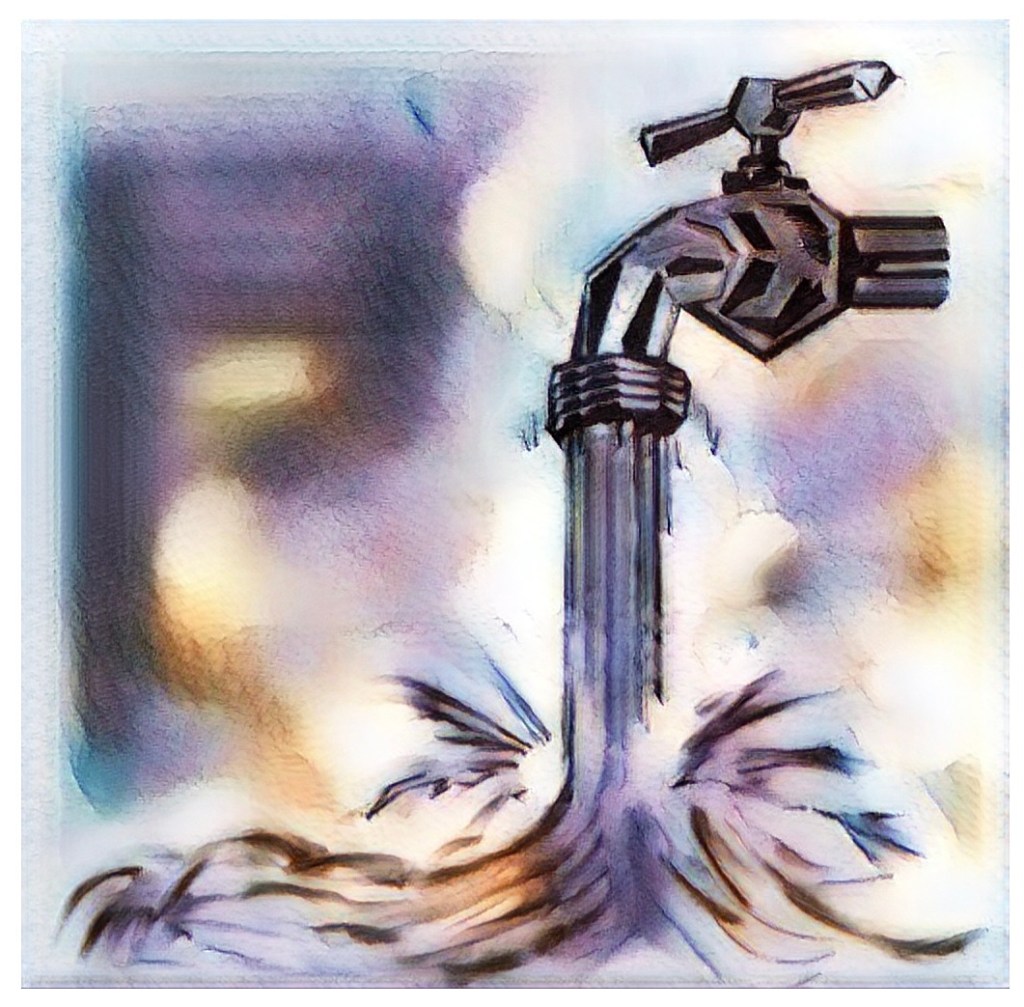
“Just go with the flow”, was a popular saying in the 1960s. I’m not sure that anyone really thought about it in depth. It just seemed a ‘chill’ statement, semi-mystical, with a slight philosophical flavor.
Hopefully it meant that you are floating in a substance, and not tumbling in a rip-tide or undertow. Flowing also implies a current, and the current can be a gravity issue, meaning going from an upper elevation to a lower elevation. Current can also be cause by pressure. The flow created by a squirt gun is caused by a piston compressing in a cylinder, forcing material out of a nozzle or opening.
A flowing current can also be created by a reservoir of a substance that is controlled by a gate. The perfect example is a dam creating a lake, and then the gate in the dam being opened to create the flow. In this example the substance is water, but perhaps the substance can be other things.
‘Going with the flow’ has also been used with social movements, implying that getting onboard with ideas and general consensus creates the flow.
When I was taught about basic electricity the example mentioned is that electricity flows. We were to imagine that the copper wires were replaced by a liquid. In different circuits there were also gates. Some gates were basically on or off, some gates were variable constrainers, some gates were amplifiers. It was important to note that amplifiers didn’t really create more liquid, the amplifier gate simply controlled a larger reservoir that could be dumped into the flow.
It occurs to me that the flow may be spiritual, in which case the gates can be very small spiritual issues that open very large spiritual reservoirs. An example: going to prayer for others can eliminate the rage within you. Or, said another way, prayer is the tap (gate) that causes flow from great reservoirs of peace.
I kinda like that idea…

A friend is currently reading about the Appalachian Mountains, one of the oldest mountain ranges on the planet. It was supposedly formed 480 million years ago, and has been in the process of weathering for quite sometime. In it’s youth it was similar to the Rockies or the Alps, and sealed off the east coast from the interior. This was pretty much true until the mid 1700s, when Daniel Boone opened the Cumberland Gap, which was a flood gate into Kentucky and the Ohio valley.
I had read about the Appalachian\ but in 1971 I was privileged to live in the Blue Ridge mountains for almost two years. I lived in Rouzerville, which was right next to Blue Ridge Summit, and just a few miles from Cascade, where Ft. Ritchie existed. It started as Camp Ritchie and it was a semi-secret post, training interpreters during WWII, over 20,000 were trained in German and Japanese. In 1998 It was one of many installations that were decommissioned, but in the early 1970s it was a busy place, for all the services.
After WWII and during the buildup of nuclear weapons, the military turned its attention to organizational bunkers. The facilities of Adolf Hitler in Europe were well known and that was before atomic bombs. In the 1950s, plans were drawn up to build a bunker deep inside a granite mountain on the east coast. The Blue Ridge Mountains were selected. Camp Ritchie became Fort Ritchie, and was selected to be the organizational support unit on the surface, and the actual underground facility was a few miles away, on the other side of the border in Pennsylvania, at Raven Rock. This was to be the Joint Chiefs Command Center for every branch of the service. It was technically the Underground Pentagon.
When I was not underground, I roamed around the Blue Ridge Summit area, hiking the Appalachian Trail, visiting the small mountain towns that were off the beaten path. The mom and pop stores were often mini versions of Target or Walgreens. They were stocked with a complete variety of products. If something had sold once, they bought three more from various vendors. Rolling ladders were against the wall to reach the shelving that was ceiling high. It may have taken several years to memorize the row, and the height of the stored merchandise.
My favorite was the local items, sold by individual “mountain people” on commission. There were whistles, good luck charms, yarn goods, mostly hand-made with accompanying stories.
I remember a collection of “fairy crosses” being offered, very small stones in the shape of a cross. I had forgotten about them, but was reminded by an article by Charles Fort. He had researched an article that had been published by Harper’s Weekly in the late 1870s. “In parts of the Blue Ridge Mountsins, there have been found small carved ‘fairy crosses’, that attest to a race of small people that crucify cockroaches. The crosses are in the shape of St. Andrews, Roman, and Maltese. The local people believe the collected crosses have a power that will provide good fortune.”
What was published in Harpers Weekly is still true, but things have changed. In Virginia it is now illegal to dig for “fairy crosses”, they are protected from collectors. It is unknown if they are still used to crucify cockroaches.
What is known, is that the “crosses are the result of a natural formation. The stones are staurolite formations of silica, iron and aluminum. Formations created under great heat and pressure, when the Appalachians were rising 480 million years ago. Thomas Edison and Teddy Roosevelt both believed in their mystical properties.
I haven’t been back to see if the local Mom & Pops carry them at the checkout counter, but I suspect some still do. I thought they were cheap trinkets carved by “local mountain folk”, glad to know that they are natural and organic.

It’s all in the title. Why would a Jeep be in a garage? To protect it from the weather? Well, it’s a little late by now. I’ve had garages in every home that I’ve purchased or rented. I’ve never parked my vehicle in the garage of any home. I may have driven it in for a day or two, and some homes not even that. Everything I own is in the garage, except my vehicles.
So why now? I’m trying it out in order to please my wife. There, I’ve said it.
There is nothing wrong with trying new stuff, particularly when it would never cross your mind. The issue is why did this “parking in the garage”, cross my wife’s mind? Husbands know that this line of inquiry is not beneficial to anyone. But there may be an answer. We had an ugly driveway.
We have always had an ugly driveway in every house that we have lived in. It makes perfect sense to cover up ugly driveways with the current vehicles, (even if they as just as ugly).
About a month ago we pulled the trigger on upgrading our driveway. First we painted the house. It looks nice. It made the driveway look even worse. The drive way was not the usual cracked, and earthquake damaged piece of concrete we usually had. It was old, cracked, blotchy, asphalt. It was also the only asphalt driveway for blocks in either direction. Asphalt driveways seem proper if we had twenty acres and a five minute ride to the house. Our driveway was just over twenty feet long and at an angle of about 25 degrees.
Pavers was the dream, concrete was at least the rational option, repaving the asphalt with new asphalt seemed pathetic. In the end it was a financial decision. If $X is asphalt, then concrete was approximately 4$X, and pavers was a whopping 7$X. We are still the only home for miles with a very short asphalt driveway, with room for two cars.
The house has a new coat of paint, we have installed stairs for the steep hill to the right of the driveway, and we have a very black, clean, asphalt paved space for two cars. For the last month we have been parking in the street in front of our house. It’s not bad. We live on a cul-de-sac, I parked in the street for years because our kids had vehicles, and my wife always got the prime spot in the driveway, closest to the front door. Now the kids are gone, yet the driveway is empty.
Yes, the installers did mention to park in the street for a few days. During those days waiting to come back to parking in the driveway, there was a “sea change.” I was planning to take my place on the left side, when my wife suggested that I park in the right side, in the garage.
I looked at her with some amazement. I asked her why. ‘I’ve always wanted at least one of our cars to be in the garage.” That was a new desire, one that had never been expressed before. I thought, okay, I can arrange some things, I can clean out a space for your smaller vehicle. “No, I’ll park in front of the house, your Jeep goes in the garage.”
Wha…?
There are times in every relationship when you know that several futures are on the edge of being very present. It does take some experience and much wisdom to pick a path that is considerate.
My Jeep is big, it took three days to rearrange the various treasures in the space to be used. Once that was done, I drove across the driveway on tippy toes, into the empty space, completely filling the garage like never before. There was a sliver of space to edge out sideways, once I got down from the Jeep. I’m thinking that much of the treasures will have to vacate.
My wife’s car is still in the street, the driveway is still very black, empty, in sharp contrast to the newly painted house. I’m still wrapping my mind around the concept that I have a Jeep in the garage.
Apparently I will have to open the garage door, sweeze sideways to get in the door, back out with only inches to spare on either side, and then reverse the process when I get home after driving. And the benefit?
It’s obvious, to assist in a very long dream of an unvoiced concept. I hope it works out.

I do like finding things, or actively going out to find things. I also like having things brought to me. We have been to Hawaii several times and with very enjoyable results. It was always best to find a good spot and just park there. No packing up, moving to another hotel, find transportation, etc. that’s a fine way to travel but it is quite a production.
One year we flew to Hawaii, and jumped on a cruise ship for eight days.
Obviously this was pre-COVID days, but we spent the extra money to get a suite with a balcony, and it was very nice. It didn’t take long to realize there something different about this trip. We weren’t going to the islands, the islands were coming to us! A wonderful perspective. Each day a new island view from our balcony.
It is this same concept with the internet. I have the complete power of various search engines, I can go anywhere, use Google earth to see anyplace that I’m thinking about. But sometimes, out of the blue, the internet brings me something. I don’t know if it is artificial intelligence that determines what is presented, or if it is just random choice, but today I was presented with the continent of Mu.
The term was first introduced by Augustus Le Plongeon, who used the “Land of Mu” as an alternative name for Atlantis. It was subsequently popularized as an alternative term for the hypothetical land of Lemuria by James Churchward, who said that Mu was located in the Pacific Ocean. I believe he looked at a globe and determined that the Pacific was just too big to be only about water. The place of Mu in literature has been discussed in detail by one of my favorite authors of sword and sorcery novels, L. Sprague de Camp, in Lost Continents.
So Mu could be Atlantis, but now is something different. And Atlantis is still sunk just outside the Mediterranean, and stories are bountiful about other lost lands. It got me thinking.
Where does this concept come from? I propose distant memories, that have the concept being passed on, but the specific details get confused. As people on this planet we have experienced floods. Floods that have displaced us from our homes, forcing us to move to dryer, and safer lands. I’m not sure about sinking continents.
The immediate thought is about Noah. It has been mentioned many times that other cultures in the Middle East have stories similar to Noah, and not because they were influenced by the local Hebrew population. The most logical explanation is that a widespread flooding event occurred and was remembered by those living around it.
The Black Sea can be thought of as a lake where several major rivers drain into it, and then it drains into the Mediterranean, and then it drains into the Atlantic. Atlantic storms rain onto Russian soil, and then it drains into the many rivers going to the Black Sea and the cycle repeats. But it was not always so.
Thousands of years ago, when humans had been in the land for centuries, they had built hundreds of fishing villages on the edge of the Black Sea. The Dneiper, the Don, the Volga, and hundred of other rivers had all drained into the Black Sea, but the balance was that the water evaporated at a steady rate, so the shoreline was relatively stable. There may have been a smal river that drained into the Aegean Sea but the Black Sea was a fresh water lake.
The Mediterranean Sea was connected to the Atlantic Ocean and the level there was also balanced except for the melting of the ice packs covering much of Europe. There was a lot of water involved, so much that the levels rose in the Mediterranean. On the east shore of the Mediterranean, there was a small river that flowed into the Mediterranean coming from the mountains in the east. It’s still there, it flows right past Istanbul, Turkey. When the Mediterranean rose the water went up river to the mountains. Eventually it reversed the flow of water, broke through the ridge, creating a tremendous waterfall down to the Black Sea, estimated at two hundred times the flow of Niagara Falls. This may have occurred 8 to 9000 years ago.
It didn’t take long at that rate to completely engulf the thousands of villages on the shore of the Black Sea. Not like a tsunami, but perhaps a steady few inches a day. But people remembered, and perhaps it rained as well.
So, there is a possibility of remembering cities under water, but what about a land?
There is recent scholarship concerning Doggerland. This was a boggy area between England, Denmark, and Belgium. It is now one of the prime fishing grounds in the North Sea. It used to be slightly above water. It disappeared at roughly the same time as the Black Sea villages. Dredges have picked up bones of mammoths, lions, and deer. Also some Stone Age tools, so people lived or traveled there.
We apparently have real evidence that some of our “cities” have disappeared beneath the waves. But Mu, I’m afraid, is just a good story.

Something was found in 1836 near Edinburgh that has remained a mystery for well over 250 years. Naturally, we tend to end mystery with speculation, and you can imagine where the different storylines have gone. But first the known facts.
A group of boys found these “coffins” on a hillside near Edinburgh, Scotland known as “Arthur’s Seat”. They found a large piece of slate partially buried, and when they removed it, there was a small opening in the earth. In it there were 17 tiny wooden coffins, in three tiers. Two tiers of eight coffins, and one tier of one coffin. It appeared as if the coffins were placed one at a time with some interval between. The oldest coffins seemed to have suffered damage, the last coffin seemed much less damaged. Of course this might be due to the dampness & weathering.
What becomes interesting is that each coffin contained a small wooden doll, male, eyes open, 3 or 4 inches tall, dressed in common weavers cloth. 17 figurines placed with care in a hillside “cave” above Edinburgh.
This is not a natural occurrence, it is not successive natural tree root formations. It is not ginseng grown in the shape of a human. It is a human construct, constructed for a purpose, carefully planned, and possibly maintained over several years. The similarities seem to suggest that one person one responsibility, but left no written reason for the “dolls”.
It is also fairly clear that the coffins were not expected to be found, so the reason for their construction appears to be personal. Over the years it has been suggested the dolls were the work of witches, or represent the bodies of sailors lost at sea.
It has also been suggested that they are a memorial to the victims of the notorious and murderous bodysnatchers William Burke and William Hare, who carried out their gruesome deeds in the capital during a 10-month spree in 1820. Several movies have been made detailing with the business of providing fresh cadavers for the use of future doctors. The problem is that Burke and Hare have the right dates, but most of the victims were women, and all the dolls were men.
An on-going shrine for sailors lost a sea seemed like the most likely reason, based upon the style of clothing and common material.
Eight of these coffins are on display in the national museum of Scotland, and remain a very popular exhibit.
Recently a new theory has been proposed, referencing a long forgotten rebellion that was severely repressed by the British government. In Edinburgh there were factories as part of the Industrial Revolution. Weavers of cloth had moved from small local looms, to great buildings with looms run by a collection of belts powered by water wheels. The conditions in these factories were horrific, with hundreds of children working the looms. The workers protested and struck.
The authority rounded up the leaders of the protest and hanged a number of them. The rest were placed on ships that sailed for Australia. For the out of work weavers, Sir Walter Scott recommended that they should be put to work making a road around “Arthur’s Seat”. Not a very fit thing for weaver’s to do. But perhaps the coffins were a memory of those hanged or sent to Australia.
In either case, the Rebellion was forgotten, Britain lost control of Scotland’s governance, and the little coffins are displayed in the National museum, still a mystery, but honored.
(Inspired by a story written by Charles Fort)
I’m getting philosophical again, pondering the word “doubt”. Is this a good thing? After all, there is something absolutely the same for people who believe nothing, and people who believe everything. They do not think! Thinking requires doubt, or at least doubt kickstarts thinking. Presuming that with enough thinking, doubt will disappear, and certainty will reign. Or, with enough thinking we can be certain that we do not know. The question might be whether doubt will actually motivate thinking. Perhaps doubt is perfectly fine being static.
Rene Descartes had a thought about thinking, and he used the technique of “methodic doubt”. He looked at three different categories of knowing: authoritative, empirical, and mathematical. Each category had serious issues of being fallible, thus dubious.
He found knowledge from tradition to be dubitable because authorities disagree; empirical knowledge dubitable because of illusions, hallucinations, and dreams; and mathematical knowledge dubitable because people make errors in calculating.
He proposed an all-powerful, deceiving demon as a way of invoking universal doubt. Although the demon could deceive men regarding which sensations and ideas are truly of the world, or could give them sensations and ideas none of which are of the true world, or could even make them think that there is an external world when there is none. The one thing the demon could not make men think is that they exist, when they do not. Thus, “I think, therefore I am.”
Doubt appears to be a “way station”, a good thing for a time, but a place to gather facts and feelings. It is not a place to plant roots and stay. How long can we linger in doubt? Ahh, there’s the rub, too short of a time and you are lazy, too long of a time and you are indecisive. It may be similar to buying fruit, too soon and it may be green. Too late, and it’s well on the way to rot. Again there is no hint of what that timing is in hours, days, weeks, or years.
In some circles “doubting Thomas” is a negative stereotype. In other circles he is proof that reality can be tested.
I think “doubt” is fungible, in some cases it is necessary to decide in seconds or parts of a second. This may mean the difference of life or death. In most cases doubt has timing that is appropriate to the importance. The “lifetime” doubt is only a problem if it isn’t resolved by the time of death.
Descartes envisioned a demon to explain his view of knowledge. I’m envisioning an individual walking around full of certainty. This is an individual that I would actively avoid. Give me a portion of doubt, periodically.
 | Anonymous on The Key |
| Anonymous on The Cocoon |
 | johndiestler on What About the Andes? |
| Anonymous on What About the Andes? |
| johndiestler on The Edge Theory of Learni… |


 A Work Progressing
New Tribute Versions of Albrecht