One of the biggest improvements to photography is the development of smartphone cameras. This also has created tremendous challenges.
The first challenge may seem odd, but it is a hard problem to solve. There are well over 2 billion smartphones in the world. The goal of placing a camera within the immediate reach of individuals is almost achieved. The difficulty is that we generally forget that we have it.
Clearly, many folks are very aware of the camera function, but it is not the same as slinging a DSLR around your neck in order to take a photo. The phone connection is the primary tool, and the camera is a nice secondary option.
The first thing to learn in taking better photos is that you have a camera with you! It may seem like a silly exercise, but practice taking photos with your phone in the same way that you do when you break out your larger DSLR. Developing that sense of image making at your fingertips will lead your desire to improve the images.
What are the next few issues that smartphone photos have that need improving? Basically there are three general problems that I commonly see.
1. Fuzzy. Images are blurry.
2. Light. A better understanding of light is needed.
3. Framing. Too much sky, ceilings/wall, background.
The cameras are generally producing images that are remarkably good. Wait, change that, they are amazing! The automatic focusing and exposure issues are a thing of the past. So why are photos blurry?
The most common reason is answered by asking the question, “Where do you commonly keep your smartphone?” It is probably not in a lint-free container, carefully sealed from the greasy world. It may actually be in the same jacket pocket with yesterday’s half eaten snack!
We have gotten used to the idea of cleaning our camera’s lens, but recognizing that our smartphones have a lens is the issue. Swiping a greasy thumb across the surface is not the solution.
This is also one of the most difficult issues to resolve. In many cases the actual case is the culprit. In the attempt to weatherizing the smartphone the case manufacturers have placed a clear lens over the hole where the camera is located. This lens often is not optic quality. It also traps particles on the actual lens. Cleaning the lens by removing the case doesn’t clean the case.
I don’t recommend enclosed cases, and I also don’t recommend cases with a deep recess for the camera to look through. The best case has a very tight fit around the edge of the camera, and a beveled opening that would allow a cleaning tissue to access the lens.
Use a dry, soft cloth or tissue. Once the lens is clean that will solve most of the blurry images, but not all. Fuzzy or blurry images also occur when movement occurs while the image is being taken. Check the image carefully. If the subject is blurry but the background is crisp, then you have done your best, but the subject moved. If the background is also blurry then you moved.
The smartphone camera has an electronic shutter. It is similar to a standard camera shutter. If the subject is not well lit, then the shutter stays open to let in move light and you can’t move while that is happening. Learn to hold the smartphone steady!
Cleaning the lens, and holding steady, can remove nearly all the blurred images. The next issue is understanding light.
Light is either natural or artificial. In either case it comes from a direction. Try your best by having the light come from behind you, and slightly to one side or the other. It’s also good if it is a few feet above your head.
With natural light this can be an issue because you can’t adjust the light. It is the Sun and we are stuck with where it is. The biggest thing to remember is to avoid shooting into the sun, or have a brightly lit background, when your subject is in the shade. You will have to do your best to move people around. The great thing about digital is that you can immediately see if there is a light problem.
I love taking photos outside with cloud cover. It removes most of the harsh shadows. I also like “long light”, taken in the early morning or later in the afternoon. The worst light for me is noon on a bright sunny day. Time for a siesta!
If you are dealing with artificial light then you might have a chance of adjusting the light, or at least moving to an area that has better light.
Lastly, the camera flash is truly the worst option. The flash on a smartphone is not the same quality as a flash on a regular camera. It does not reach far, and is only good for close portraits, and even then has issues. I have found that turning the flash off is actually my best move in getting the image I want.
Finally, the framing problem comes from the lack of a standard lens. The smartphone is basically a wide angle lens. The zoom feature is not the same as a typical zoom lens with moving optics. Besides, we rarely pinch/spread to create the zoom when we take the shot.
Framing the photo takes an extra second but it is well worth the effort, and we have an extraordinary zoom feature that we don’t generally use. Walk closer!
If the framing with a wide angle gives too much background, then move closer to the subject. If you a taking a landscape, then drop the image to reduce the sky. If the foreground is too messy then you can crop it off later.
Addressing these three issues will vastly improve your images. I would also consider downloading several different camera apps that give you the ability to manually control your camera. You will learn about shutter speeds, aperture and even ISO sensitivity. Manual control can be lot of fun and will give you more control over your potential images.

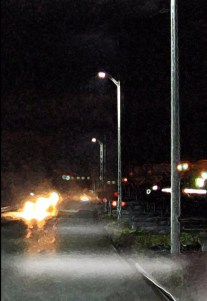 Eric and I were barely speaking, not that we were angry with each other; it was just that we had no room for communication. We had shriveled up, lost our vital fluids in the heat of the desert. Spiritually shrunken, physically desiccated, yet still walking, still moving forward. The universe reduced to moving from one streetlamp to another. All I knew, all I could see, was contained in the bright circles of light, thirty feet across, illuminating a deserted street. To either side there were shadows of some other reality. Uncertain and unimportant, they faded in the distance. My goal was the next spot of light, and then the next beyond that.





More Murmurations
I have now spent several hours watching YouTube murmurations. I am enthralled! I desperately want to experience this first hand. I can remember once, while my family fished from the levee on the Sacramento River, early in the morning, a dense black river of starlings going east, flying just yards above the water.
It was continuous and it must have taken an hour with very few gaps in the cloud of feathers. They didn’t break and create spirals in the sky, they were directed and linear. They had some place to go!
The funny thing was that later in the afternoon they came back, just as dense, and just as directed. Black feathers blotting out the sky!
I remember reading stories about herds of bison that took days crossing a particular river. Then, a few short years, and mountains of bones later, they were mostly gone. Murdered almost as successfully as the dodo. Hmm, man can change the environment, and he has!
Back to murmurations, I just can’t imagine how signals are communicated so quickly, and accurately. “Wait, you want me to follow you? Where are we going? What do you mean it’s partly up to me?” It’s beyond human understanding.
An instantaneous collective thought, maybe the patterns are three dimensional thoughts, written above the fields, murmurations disappearing as thoughts fade. Someday perhaps our recordings of these patterns may be deciphered, and we will understand the language of the flocks. Will they say something profound? Or will it be “I’m cold and hungry!”