
 I’m very happy with how the songs stood on their own, without the melodies.
Voetica Poetry Spoken
— Read on voetica.com/voetica.php
I’m very happy with how the songs stood on their own, without the melodies.
Voetica Poetry Spoken
— Read on voetica.com/voetica.php
(After Ferlinghetti Turned 100)
I used to know things.
Not in a boastful way, but with the certitude of youth. The kind that leans into unpopular truths just to test the echo. I was, perhaps, popular for being unpopular—a familiar arrangement for the young. And maybe I carried that longer than most. Into middle age, certainly.
But now? Well, hell—I’m long past middle age. I just didn’t notice until recently.
I read an interview with Lawrence Ferlinghetti, conducted when he turned 100. The reporter, fishing for some final wisdom from the old Beat, was met with this:
“There’s a serious error that gets passed around—something about the older you get, the wiser you are. Well, it’s just not true. When you grow older, you grow stupider.”
There’s a truth tucked inside that quip—beyond just mental decline. Knowing things takes passion. Passion burns energy. These days, I conserve energy for the important things. And knowing what’s expected—socially, morally, politically—takes a lot of energy.
It takes energy to say the right things.
It takes even more to oppose them.
I’m no longer a firebrand. Not even a burning ember.
Take capital punishment. I once knew it was barbaric. Then I knew it was just—deterrent, revenge, equilibrium. Now? I don’t know anything.
What about torture? Easy: it doesn’t work. People will say anything under pressure. I’m against torture.
And yet…
I believe in the fear of torture. I believe that the idea of impalement might coax the truth out faster than gentle suggestion. I know, I know—I’ve gone medieval. But I’m too tired to defend the nuance.
So I’m glad no one asks my opinion anymore.
Because the truth is—I don’t know what I think. Not until just before I speak.
And sometimes, not even then.
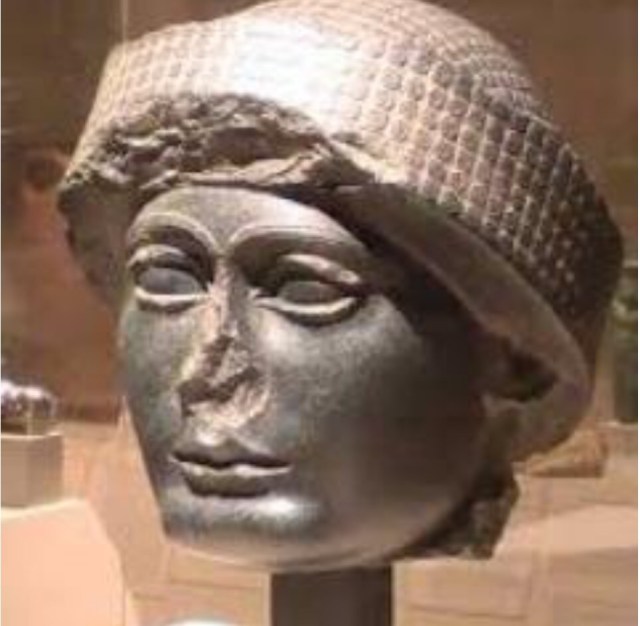
I’ve never really stopped to consider who the first author was. I suppose I always knew it was knowable—I just didn’t know it.Hmm. Knowable. That implies some things are unknowable. And that seems true enough. But now I’m wondering: what even is a fact? And are facts just stabilized opinions? Can a world run on opinion?
Worthy questions—but let me step back. Back to knowing and not knowing. Everything that can be known splits into two camps: the knowing of a thing, and the not knowing of it. Which camp we fall into depends entirely on the subject. Take, for instance, Christopher Columbus. Who knows he discovered America in 1492? Some people don’t. Some once knew and forgot. Some heard it but never registered it. Some never heard it at all.
And some know because they read it—in textbooks, biographies, or archives. They trust the source. We call those sources primary when they’re close to the original. I trust my sources. I fall into the camp that knows Columbus landed in the Americas on October 12, 1492. I believe that because experts who studied his original logbooks say so. Except—uh oh—those logbooks were given to Spanish royalty in 1493, and they’ve never been seen since.
But before they vanished, a copy was made—called the Barcelona Copy. Columbus carried that copy on future voyages, and it stayed with him until his death in 1506. It passed to his son Fernando, who used it to write a biography in 1538. In 1530, Bartolomé de las Casas used it to compose the Diario. That’s the earliest surviving text that describes the discovery. Uh oh again—the Barcelona Copy hasn’t been seen since 1584. Which means: all modern experts reference Las Casas’ Diario.
And all history teachers reference other teachers, who reference teachers, who reference that one source. This, apparently, is how we know things. Except… Columbus didn’t really discover America. The Vikings beat him by centuries. They landed in Nova Scotia. There’s literature and archaeological evidence for that. Some even suggest the Phoenicians—swept off course while rounding Africa—may have reached Central America, bringing pyramids and myth. That’s not confirmed, but it’s a theory.
So what do we know? Knowing is tenuous. And at any given time, the number of people who truly know something may be much smaller than we assume.
—
Today, I revisited a site I admire: The Electronic Text Corpus of Sumerian Literature. It contains primary source translations from Sumer, often considered the first known civilization—because they left writing behind. I’ve studied cuneiform. I can recognize the letter shapes. But when those signs become words, I’m lost. I rely on scholars who can read it. And the good news? Multiple translations say basically the same thing. I trust their expertise. I accept their conclusions as… fact.
One of my most popular blog posts is a collection of Sumerian Proverbs. It draws readers every year. Today, I was browsing new translations when one line arrested me: “My king, something has been created that no one has created before.” That line stopped me. It was composed from 37 tablets found in Ur, written by a woman named Enheduanna, around 2350–2270 BC.
She was the daughter of Sargon of Akkad (2340–2284 BC)—not the one mentioned in Isaiah 20:1 (that’s Sargon II, 722–705 BC), but likely the original Šarru-kin, meaning “true king” or “king established.” Probably a title more than a name. Sargon married Taslultum and had five children: Manishtusu, Rimush, Enheduanna, Ibarum (Shu-Enlil), and Abaish-Takal.Each was given power. They stayed in power across generations. Rimush took the throne after Sargon and ruled for 9 years. Then Manishtusu, for 15. His son Naram-Sin ruled for 56 years. Enheduanna served them all—her father, her brothers, and her nephew. She was appointed High Priestess of Inanna and Nanna, exiled for a time, but reinstated.
She’s credited with standardizing temple hymns across the empire—a practical and theological unification. That book of hymns, the Sumerian Temple Hymns, may be what she meant when she wrote: “I have created something that no one has created before.” That line—written on tablets, duplicated across temples, preserved in translation—makes her the first known author in human history. And she didn’t just write for the job. She wrote for the heart.
Her other work, The Exaltation of Inanna, is a personal devotion—a song of awe and divine power. These are its first lines:
Lady of all the divine powers, resplendent light, righteous woman clothed in radiance, beloved of An and Uraš! Mistress of heaven, with the great diadem, who loves the good headdress befitting the office of en priestess, who has seized all seven of its divine powers! My lady, you are the guardian of the great divine powers!…
Today, I know a new thing. And it’s old. And it matters.

My intrepation
1. My friends are gone, my hair is gray, I ache in the places where I used to play- Leonard Cohen, Tower of Song
2. I wanna be safe, safer than I am now- Ilya Anderson, Personal
3. Second floor living without a yard- Feist, Mushaboom,
4. Beneath the stars came fallin’ on our heads, But they’re just old light, they’re just old light. Regina Specter, Samson
5. There are heroes in the seaweed, There are children in the morning. Leonard Cohen, Suzanne
6. Driving away from the wreck of the day, And the light’s always red in the rear-view. Anna Nalick, Wreck of the Day
7. Remember to let her into your heart, Then you can start to make it better. Beatles, Hey Jude
8. Six no-good men took her shine and more, Left her youth near Sausalito. Brooke Fraser, Jack Kerouac
9. Will you still need me, will you still feed me, When I’m sixty-four? Beatles, When I’m Sixty-Four
10. It’s not even light out, Suddenly, suddenly, Oh, you’ve somewhere to be. Imogene Heap, The Moment I Said It
11. I got no plans I ain’t going nowhere
So take your fast car and keep on driving. Tracy Chapman, Fast Car
12. And so you see I have come to doubt,?All that I once held as true
I stand alone without beliefs
The only truth I know is you. Paul Simon, Kathy’s Song
13. Jimmy as if you didn’t know by now, Let me tell you a thing or two
Everybody might have someone
But everyone falls in love with you…Shawn Colvin, The Facts About Jimmy
14. If you hear something late at night, Some kind of trouble, some kind of fight, Just don’t ask me what it was. Tori Amos, Luka
15. It’s like ten thousand spoons when all you need is a knife
It’s meeting the man of my dreams
And then meeting his beautiful wife. Alanis Morissette, Ironic
16. Look at the stars
Look how they shine for you
And all the things that you do. Coldplay, Yellow
Humans are remarkable. We have the ability to observe reality and document its existence by writing it down, freezing it for all time. This includes the things we see in the physical world, and also things in the emotional world.
This ability can also be seen as something unchecked. We can “document” things that don’t exist! Or another way of saying it, “the only evidence of existence is in the content of our words”.
Examples? Hmm… All of scripture tells us that God cannot lie. Yet I can write that “God lies”. I suppose that is proof that I am not God.
Another example is when I write, “that thing is entirely hopeless”. It is not true! Hopelessness is not loosed in the world! But we can create the concept, we can deceive others into thinking that it is hopeless, by using words.
The more that I ponder the concept, I see that hopelessness is a false reality entirely created by man, either in frozen words or live action. Hopelessness is not in nature, it is a pessimistic view of reality.
How often are reactions based upon things that don’t exist, or more accurately, only exist in the construction of our thoughts and words? Truly, we are challenged to use discernment far more often than should be necessary.
What can we do about this? We can make a conscious effort to not be a party of the creation of things that do not exist. Ha, if only I had a good list to remind me.
Okay, the first thing is to make your own list.
1. In every challenge there is a seed of hope and encouragement.
2. Is it true? Or is it an opinion?
3. What is the evidence?
4. Is this something that I can know, or must I trust others?
5. My desire for truth is greater than my ego.
6. I practice to know the difference of when I am open or when I am closed. My desire is to remain open.
7. Our public posture should be positive, there is enough natural negative to go around.
8. Even the immoral can choose good.
9. Do not wait to be perfect.
10. It’s not about me.
11. Learn to yield.
Such a simple word, and everything about it is complex.
The most famous of the Greek myths is the story of Pandora’s Box, or more accurately, Pandora’s Jar. (Jar was mistranslated to box). Hesiod is credited with telling the story of Pandora, who was given by Zeus to Epimetheus, the brother of Prometheus. It seems that Zeus was still miffed that Prometheus had given humanity the gift of fire. Zeus had reasoned that a vessel that Epimetheus had would be compromised by the curiosity of Pandora.
The Earth was pretty much a heavenly place. Now that they had fire, people were quite comfortable. All the evils of the world were safely locked away in the jar watched over by Epimetheus. Pandora changed all that. She removed the lid and in an instant everything escaped the jar, except hope. Pandora replaced the lid, keeping hope contained within.
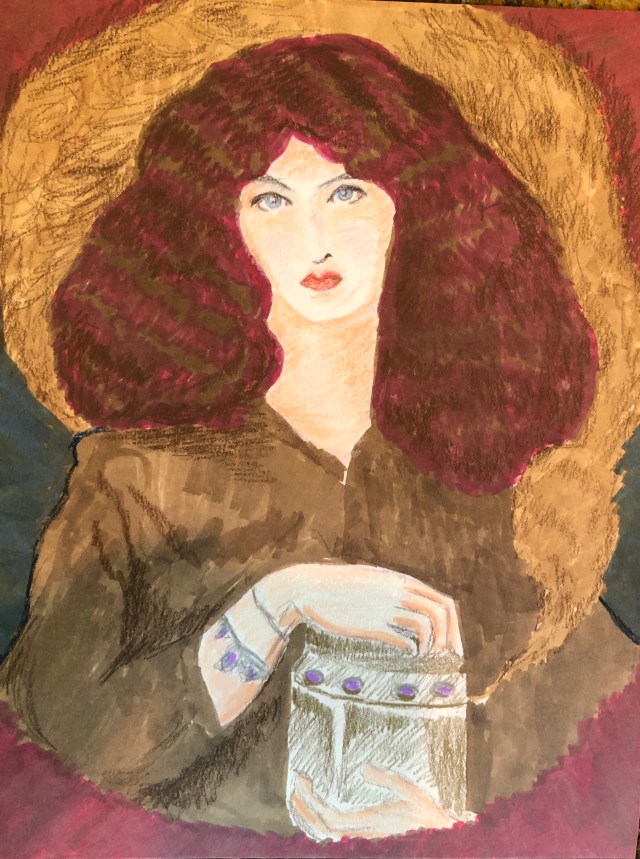 my take on Rossetti’s Pandora
When you look at this story it doesn’t make sense that hope was living in the jar with a ton of evil. In fact, there was a ton of debate in Ancient Greece about this myth.
Hope is also translated as expectation. There was the belief that containing expectation meant that humanity still had access to it because is wasn’t flying around the world. It does not explain why hope was in the jar with evil.
Another suggestion was that it wasn’t expectation, it was deceptive expectation! Now that makes some sense. It wasn’t hope trapped in the jar, it was hopelessness. If all the evils were loose in the world, at least hopelessness wasn’t with them.
The Greeks also represented hope as a young woman named Elpis. Often the hope she represented was related to some kind of suffering. If we suffer, then at least we have hope. Thank you Elpis!
Where do we find hope? It isn’t lost, it isn’t locked away in a jar (that was hopelessness). So where is it?
Many find it within their family and friends. The practical expression of hope is solace. Your family and friends are great sources of solace. They know your story, they know your challenges. Words and expressions from your family and friends are a great source of comfort.
Hope can also be found in the printed word. Reading scripture is obviously a wonderful resource. It is a good idea to know those passages that are already familiar. There are thousands that speak directly to hope, even if the word isn’t directly mentioned. This is a particularly powerful tool because it can be accessed by choice.
Another great source of hope is found in the printed word of your own journals. You may have to bring discernment, but reading your past thoughts can be either supporting, or a message of encouragement. I have always believed that journaling is the most powerful tool for positive change. And in that there is hope!
1. Establish a family tradition of prayer aloud when hearing sirens. People gather hope when there is evidence that there is caring for others.
2. Establish a family tradition of publicly offering a blessing over meals, not loudly, but not under your breath. People gather hope when they see that believers surround them.
3. Be positive! Notice how much that you choose to see, or feel, the negative. The truth is yet to be reveled but you choose to think the negative for defensive reasons. Don’t over correct and risk being delusional, but don’t create a negative reality out of fear. Our hope is our refuge, and we choose it first.
4. I am a customer at a coffee shop not because it is the best coffee (it’s still pretty good!). I go there because I am guaranteed to receive multiple smiles. Not enough genuine smiling going on in public. I am encouraged and hopeful because of a genuine smile.
Summertime filing, sanding, and polishing.
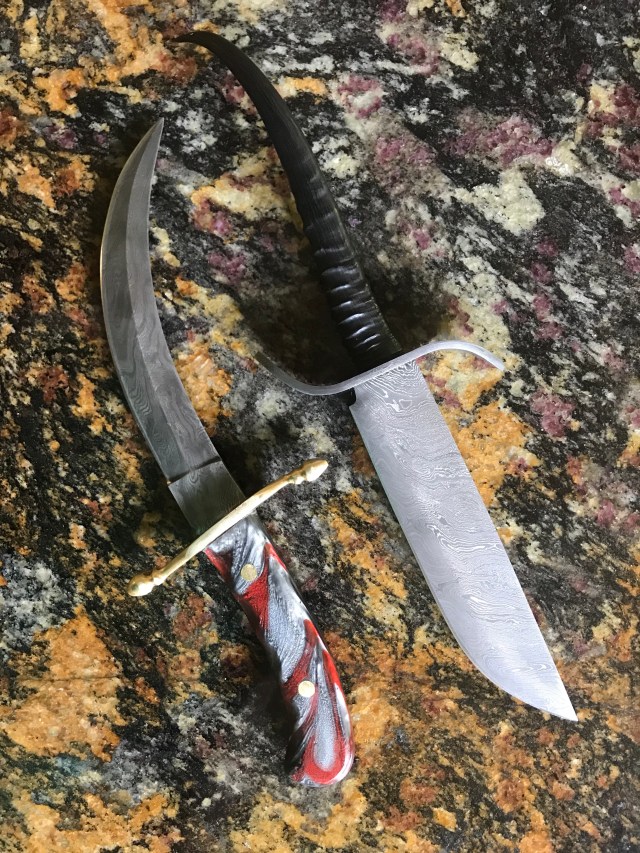
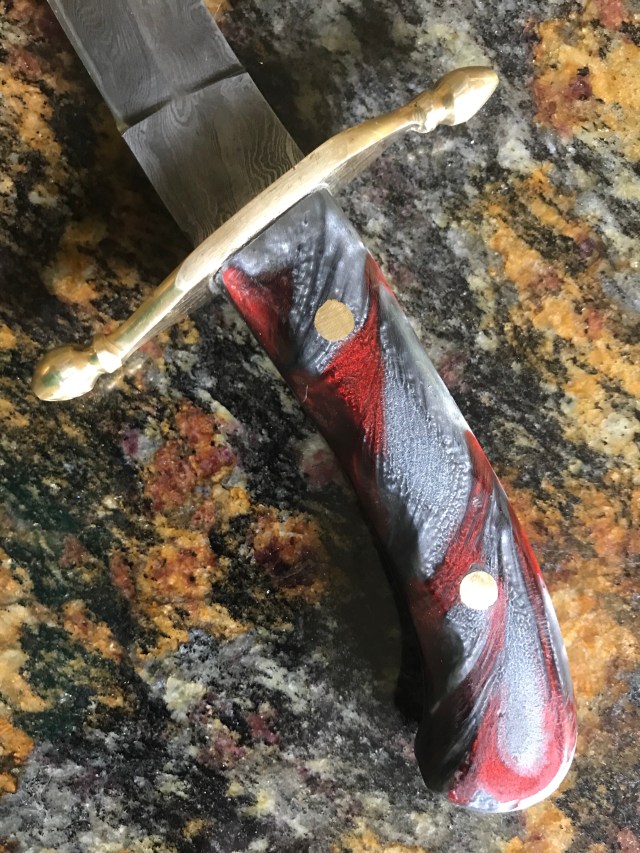
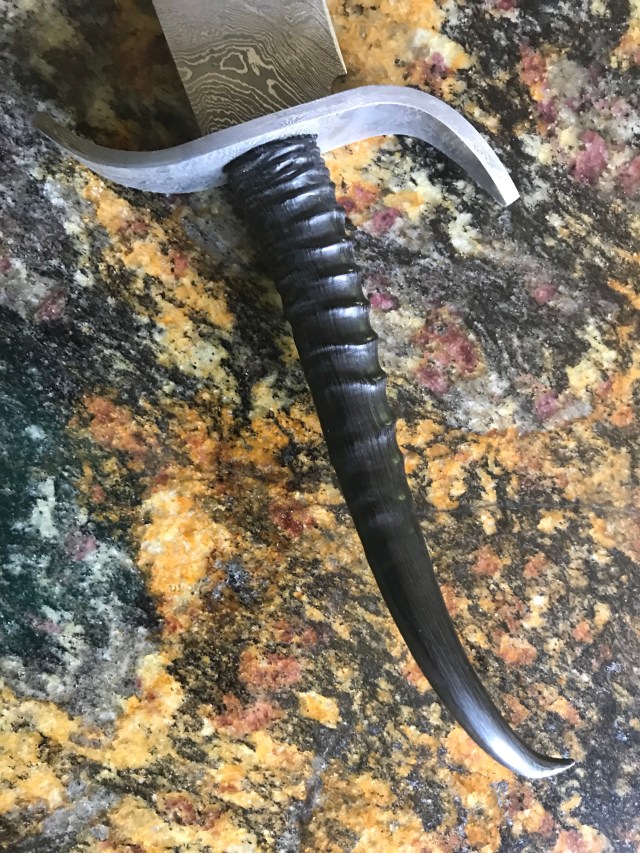
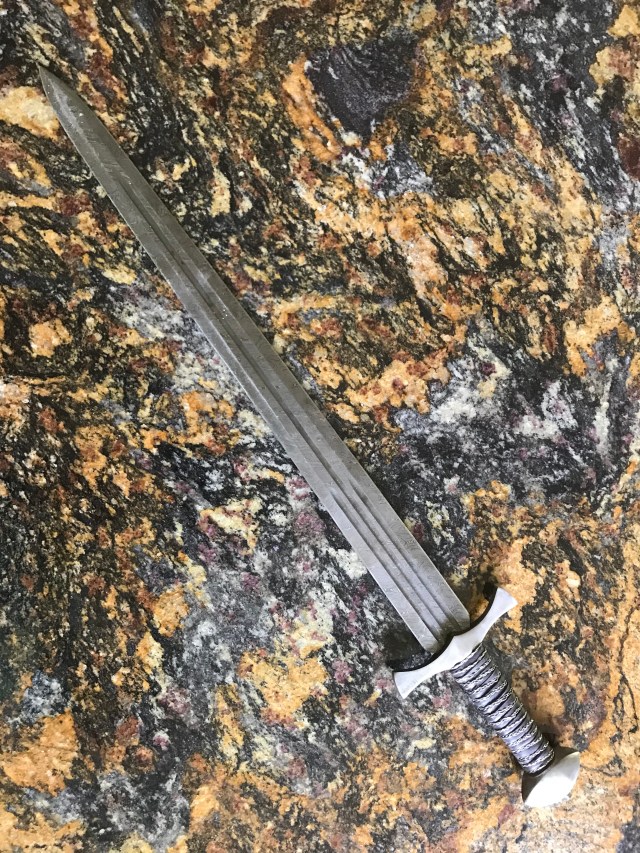
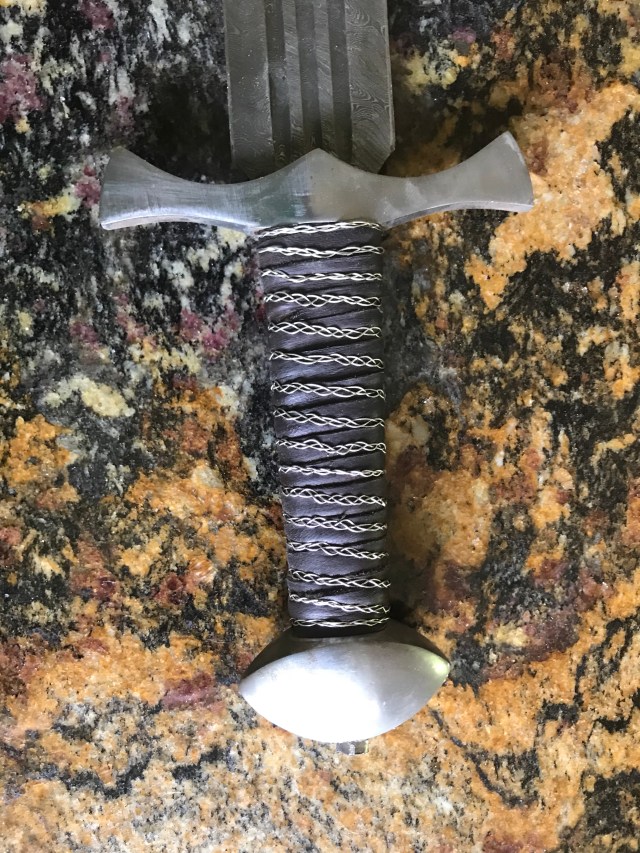
Braided wire wrapped over leather, solid grip in wet circumstances.
Multitasking
We have all heard that the secret to life’s success is to do a lot of multitasking. Meaning, I suppose, that whatever you are doing, learn to do two or three things simultaneously, in order to get ahead and be successful. It doesn’t matter that there are studies that show that humans can’t multitask, and never have.
Certainly we can see and hear at the same time, and we can walk and breathe at the same time. But it doesn’t mean that we can process two different sets of data in order to create action. What we are very good at is “fast switching”.
I didn’t say that we can walk and chew gum at the same time, but we can, because both walking and chewing have certain aspects of “automatic mode” in terms of thinking. A drummer can beat out a rhythm with her left hand while steadily beating another rhythm with the right, but they are in automatic mode with thought controlling only the beginning and the end.
The classic teenage response is that “I can listen to music and study at the same thine.” This is only true if one action becomes automatic with no thought behind it. If the music becomes “background noise”, then perhaps study can occur. But if a lyric catches your ear, then suddenly you are pulled out of your text or essay, and you are listening and not studying.
I don’t know if any study of schizophrenia shows the ability to multitask, but at least the theory that it takes two minds to have two thoughts simultaneously is correct.
So, how fast is our “switching” ability? How many eggs can we juggle before the entire cartoon is destroyed?
Well, it depends. Most nerve signals travel at roughly .3 seconds from brain to extreme limb. However, most can blink an eye in .1 of a second. That’s three times faster, (however, brain and eye are considerably closer together). We are now only talking about the signal to move, not the assessment and calculations that are necessary to consider the action. All that takes additional time.
My wife and I enjoy playing cards together, generally with another couple. I should say that the enjoyment is not equally and consistently shared. It has evolved from playing games of clever strategy, with bidding, or calculating odds- to games of action and stress, as the situation is fast paced and in constant flux.
One particular game requires that you play a solitaire situation in front of you, turning three cards from the deck in order to see what can be played. That can be stressful if there is a time element in order to beat the other players. They have their own decks and their own game of solitaire. Add to that stress by playing the aces on piles in front of you along with all the other players, collectively.
I have my solitaire game in front of me but the aces piles are constantly changing. If I concentrate on my hand, looking to play cards, I am aware of the cards I need, except on the ace pike everyone else is playing and what is needed is in flux.
My neurons are firing, but often they are firing on old information. I’m looking for a two of clubs and the pile is now at the seven of clubs.
The hand must be faster, but the data behind the movement has to be even faster, and keep track of the changes.
What is curious to me is that often my wife is holding a card in her playing hand, waiting for me to recognize that I have a play, then tenths of a second after I play she puts hers down. Spooky! How does she know what I am going to play before I even turn my cards?
I can understand how someone is faster. Both are ready, the shot is fired and one person crosses the line first. But she crosses the finish line before I can tie my track shoes.
I used to play racquetball. When I played younger faster players I would win only if I played smarter. But what I f they are faster, smarter, and have psychic powers?
Multitasking? Apparently I can chew gum and walk. But I cannot rotate through a deck of cards three at a time, play solitaire, and watch as everyone keeps playing in the ace piles.
We call the game “Squeal”, maybe because of the joy of winning, maybe because of the sound of my losing.
 | rangerdon on Poverty Hill |
 | johndiestler on Fruit Whisperer |
 | Anonymous on Fruit Whisperer |
| rangerdon on Doubles |
| Anonymous on The Key |




Colleagues
I’ve been thinking again.
Always a potentially dangerous activity.
A friend of mine is considering retiring from the same college I retired from. He’s putting in forty years, if you count his time as a student. I did the same. No wonder we were—and are—friends.
It would be easy to define the job by what we did. The titles. The tasks. And when someone asks me what I did at the college, I usually do just that—I pick and choose a few details. But then I remember my mother.
I had at least a dozen job titles over the years. Some were connected, some wildly different. But when I’d ask her, “Do you know what I’m doing now, Mom?”—she always said the same thing:
“You’re working at the college!”
And that was truer than any title.
If I’d had the money, I might’ve paid my own salary—just for the privilege of staying. I probably should’ve told financial services that.
So what was the college?
Sure, it was a place. A set of buildings. But buildings change. They grow old. Sometimes they get torn down. My high school is now shattered brick in a landfill somewhere. What’s left is the memory of people—classmates, teachers. The college is no different.
Here’s where it gets hard: when longtime staff forget the shoulders they first stood on. Because the college isn’t stone and glass.
It’s people.
First, it’s students. But they come and go—fast. That’s as it should be. They’re the river—always water, but never the same water. You only cross it once, even if you cross it a hundred times.
Then there are the colleagues. They last longer than the students. They’re the soul. They’re the ones in the foxholes with you. They stay for decades, and then—like everyone—they leave. They grow tired, or bitter, or quietly disappear into retirement.
When I think of the college, I don’t think of departments or renovations. I think of:
Sam Chapman, Pat Anania, Paul Pernish, Wolterbeek, Robert Pence (always in an ascot), Tarp, Orr, Horner, Oberst…
and so many others.
They’re all gone now.
The college I knew is gone.
And now, one more will be gone soon.
I miss them all.