The Right Sounds

It’s 2:30 a.m., and the house is quiet. This house is quiet— not like the last one.

The old house always had noise. Subtle, yes, but constant— a language of creaks and sighs, branches tapping glass, timber pressing against timber, plaster cracking like distant footsteps.

It was an older house, always in motion, slowly pulling itself apart as it settled into the hillside.

This newer house is better built. No cracks. No hillside. No thousands of pounds of earth urging it to move.

The quiet is both discerning and disconcerting.

I sit in the shadows, tilting my head toward invisible sounds— but hear nothing.

Their shape, their distance, gone. My reference is lost. And somehow,

I feel less safe in the not-hearing.

Posted in Commentary | Leave a comment

I Am Pondering…

I am pondering the bones of an idea.

While watching videos of artists working in graphite, I often see the same beginning: a skull. As if the foundation of every portrait must begin in death. Like forensic experts, the artist builds upon the bone—layering tendon and sinew, then the delicate muscles of expression, and the softening pads of SMAS. Eventually, skin covers it all, hiding the secrets within.

We’ve done the same with dinosaurs—assembled skeletons into towering forms. But we know so little of the quality, color, or texture of their skin. There may be feathers, even when there is no flight.

Yet our graphite artists know the human model. They craft a reasonable likeness in shadow and light, in gesture and restraint.

In the same way, AI can take the bones of an idea and flesh it out with tangential thoughts—full of adjectives, nouns, and even verbs. But will it resemble the creature of the original thought? Or will it come cloaked in a rainbow of fluorescent feathers?

Posted in Commentary | Leave a comment

Today’s Ponder…

CDI 2025

One of my favorite Da Vinci paintings is The Lady with an Ermine. It’s housed in a museum in Kraków, but it’s been widely published and researched for years. Painted around 1490, it depicts Cecilia Gallerani—a young woman of intelligence and beauty, though not of noble birth. She was the mistress of Ludovico Sforza, Duke of Milan, and Leonardo was the court painter at the time.

Sforza, interestingly, had a nickname: the White Ermine. So Leonardo, ever the clever court player, painted Cecilia cradling just that—a white ermine. It was more than a symbolic flourish; it was a bold, layered connection, likely understood by anyone familiar with the court’s dynamics.

I’ve reworked this image several times—sometimes with AI filters, sometimes by retouching the cracks and color shifts, and occasionally with hand-drawn overlays. Most museum scans are decent, but recently I was stunned to find the largest, highest-resolution version I’ve ever seen—on Wikipedia of all places. So large, only one app on my iPad could even open it. Naturally, I resolved to clean it. Painstakingly. Every scratch, every scar, every stray fleck of digital dust—gone.

The painting carries its own backstory. It was one of the many works looted by the Nazis and hidden in a salt mine. It was marked for destruction, but the local miners, at great risk, sealed the entrance to protect it. The painting survived. The Lady with an Ermine even makes an appearance in the film The Monuments Men, one of the pieces the Allied team recovers.

But back to me—hours in, zoomed to the highest magnification, delicately brushing out each pale speck against the dark background. And I start to laugh.

The tiny white dots I’m erasing—they look like stars in a night sky.

Stars? Constellations?

Is it possible? Did Leonardo embed a cosmic pattern? Was this some celestial code hidden in the background? Was I erasing a secret?

The answer, of course, is yes—he was absolutely that devious.

And no— They were probably just dust.

Probably.

Posted in Commentary | Leave a comment

Backpacking

A long-time friend wrote a few pages about his years in the High Sierra. The following is a summary of his late evening thoughts before the next day of hiking.

Fears

Beyond the edge of wonderment there’s always a wisp of worry— that raw conditions lie just beneath all this wild beauty. Thinking about tomorrow’s unknown pass, or an ominous talus canyon with thousand-foot walls, or the weather itself— all of it can take on a life of its own. Nervous irresolution creeps in, undermining the grit it takes to push forward. Maybe that’s why, at the first hint of a cloud, there’s a frenzy to throw up a tent— that absurd little island of security.

Part ritual, part defiance, part comfort.

And in a storm, it works. A tent staked before the first drops becomes a small miracle of dry safety. Wait too long, though, and you end up in the frantic, ugly battle of mountaineer versus flapping nylon versus driving rain. Crawl in late, soaked to the skin, and find the inside as wet as the outside.

That’s when the storm wins.

(In memory of Doug Sabiston)

Posted in Commentary | Leave a comment

Forgiveness

You move it with your spiritual hands to the ground beside you. Though it stays heavy, you are free to walk away.

Forgiveness isn’t magic. It doesn’t erase what happened. It doesn’t wave a wand and make the weight disappear. It’s still there. Heavy. Dense. And yes, it slows you down for a while.

What changes is this: instead of carrying it, you put it down. It’s still a block in your path, but now it’s on the ground and not in your hands. You make a note of it—so you don’t stumble over it again— and you move on.

Forgiveness is deciding to keep walking.

Posted in Commentary | Leave a comment

I Heard

A snippet on the radio, out of context, where someone declared an object completely useless. It caused me to ponder. Things that are made, are generally made for a purpose, thereby the objects are given the label “useful”. Often, the objects are tested in real-life conditions, and fail in different ways. The object then earns the label “useless”. All this is based upon human experience.

The trouble with this structure is that with time, the specific purpose is sometimes lost, and the labeling system continues apace. When a society declares something useless, it often means that the current rhythm of life has no patience for it. It is not the object that is useless, but the frame that has shifted.

An interesting point, it is not the object that has changed, it’s the purpose, and maybe even that is still valid, it’s just lost.

Then again, every so often, someone remembers, and the thing—once dismissed— finds its hand again. Uselessness was only amnesia.

Objects have a way of slipping their first purpose, and waiting to be found by a different one. They are patient. We are not.

At the edge of use and useless there is a quiet place where meaning pauses. Not everything has to hurry back into the center.

Posted in Commentary | Leave a comment

The Edge Theory of Learning

Preface

We speak of learning as a path, as if it were a road that leads to a finished place. Edge Theory of Learning refuses that map. It says: the center is where things go to sleep. Stay at the margins.

This is not about general learning. It not about forging an idea into a rough shape, it’s not about filing the rough shape into something usable. It’s not even polishing it to make it pleasant to look at. There are other blogs and posts for that. This is after the center is known and understood, this is the cutting edge of new perspectives.

The place of friction, delay, and incompleteness is not a flaw in learning but its home. This is not about efficiency, nor about mastery. It is about standing where clarity is hardest earned, and learning to breathe there.

Manifesto

Learning does not live at the center. It begins, and stays, at the edge.

1. The Edge Is the Site: Where certainty frays, knowledge begins. We do not move past the edge to arrive at mastery; we remain there- because the margin is where presence sharpens.

2. Drag Is Necessary: Friction, delay, and failure are not obstacles. They are the grain that holds the mark. Smooth paths leave no trace.

3. Waiting Is an Act: To set something aside, to let it rest unsolved, is not avoidance. Waiting is a form of making: space for meaning to accumulate.

4. Context Cannot Be Removed: Every learner carries a prism. The light, the hand, and the glass are inseparable. Learning is not the beam alone; it is what happens because the prism is there.

5. Witness Over Mastery: The task is not to conquer a subject, but to witness it more precisely. Clarity is not an end-state; it is a relationship.

6. The Edge Is Not a Phase: Other models treat the edge as temporary, a stage to pass through. Edge Theory refuses that collapse. We remain at the edge, because it is the only place where learning is alive.

7. The Center Is Not Denied: The center exists. It draws the eye, as it should— stable, ordered, known. But focus comes easily there. It is harder, and more necessary, to turn and hold the periphery. Edge Theory keeps both in view: the center as orientation, the edge as transformation.

This is not a path to resolution. It is an orientation. The edge holds us accountable, because only here can learning breathe.

Center and Edge: How They Hold Each Other

The center is gravity. It gathers names, categories, outcomes— things we can point to without effort. It allows us to orient.But learning, like vision, is narrowed when it stares only into the bright middle. The edge holds a different task. It requires us to look slant, to notice what resists focus, what flickers at the corner of perception.

We do not abandon the center. We use it as a reference, and then, deliberately, we shift. The edge does not cancel the center.

It completes it, by keeping us awake to everything the center cannot see.

Posted in Commentary | 2 Comments

Time Spent

I was pondering time spent since I was 16. 60 years is a reasonably large chunk of time and activity. Naturally this is not linear, but overlapping, most times twice, sometimes three or four. I quickly came up with an interesting database, not absolutely perfect, but accurate as far as my current memory.

I was interested in what Ai might do in making use of the data as threads that might interweave. I asked separately Chat GPT and CoPilot to give me a response, then I asked Chat GPT to merge the threads into something useful. This might be a guideline to a future work.

I suggested a word play of “roles” and “rolls”. I found it amusing.

A Rolling Life: Interwoven Threads of Presence and Pause

🕰 Thread One: The Architecture of Time

• • Time rolls, pauses, fractures, then hums beneath the surface.

• • Summer travel was not escape—it was intermission.

• • Missed semesters, military years, brief marriages: each one a fracture with rhythm.

• • Time isn’t linear here. It is layered dough, pressed, rested, rolled again.

💔 Thread Two: Rituals of Love and Leaving

• • Love came in verses:

• • Early sparks in 1st and 6th grade,

• • Rhythmic dating before each marriage,

• • A final stanza lasting 45 years.

• • Each commitment had a different tempo.

👶 Thread Three: Parenting as Epoch and Orbit

• • Parenting is not a job, not a phase—it’s an epoch system.

• • The first child: presence → absence → custody → rupture → return—a cosmology.

• • Later children: steadier arcs, fewer fractures, but different gravity.

• • The shape of parenting is what remained when roles shifted.

🎓 Thread Four: Education as Return and Recomposition

• • You studied like a tide: always returning.

• • Philosophy, history, electronics, media—each return carried a different voice.

• • Absences weren’t gaps—they were rest notes.

• • Later, as professor, you taught from within the spiral.

🛠 Thread Five: Work as Mask, Mirror, and Mosaic

• • Your work-life was not a ladder. It was a toolbelt.

• • Floater, technician, designer, chair—each a mask and a mirror.

• • You built tools and also taught others to build.

• • Department chair wasn’t ascent—it was integration.

⚔️ Thread Six: The Bodies You Lived In

• • Your body was not a vessel—it was an instrument.

• • Fencing was your thread through decades—a form of precision and philosophy.

• • Backpacking held solitude; racquetball, intensity; sailing, surrender.

• • These weren’t hobbies. They were gestures of being.

🎨 Thread Seven: Art While Others Slept

• • Art predates your titles, outlasts your roles.

• • Drawing for 60 years. Sculpture as offspring.

• • Photography, digital, writing—each a timeline of its own.

• • Art held you steady, even when you weren’t watching.

🧵 Final Thread: The Overlap as Truth

• • All of these lived not in sequence, but in overlap.

• • A single day might hold teaching, sailing, parenting, grieving, creating.

• • The map is not clean. It is real.

Summary: What Rises

This was never meant to be a chronology. It’s a map of pressure, not of place. A record of how a life rolls, rests, returns. You won’t find a climax here.

What you’ll find are threads pulled taut, some frayed, some reknotted. Time shaped by absences. Love shaped by tempo. Work worn like a toolbelt, art carried like a second skin. Parenting as orbit—sometimes close, sometimes vanished behind the sun.

And beneath it all: gesture, rhythm, fester, breath. The dough was never uniform. But it held. It rose. Let this remain unfinished. Not to be corrected—but to be carried. As proof. As presence. As a life, still rolling.

Posted in Commentary | Leave a comment

IMHO 

I’ve been thinking about IMHO—“In My Humble Opinion.” At first glance, it seems harmless. Modest. Polite. But the more I sit with it, the more I see it’s not always honest. Especially not the “humble” part.

Because let’s face it—humility’s rare. We don’t abide there. We visit, maybe. So when people say “in my humble opinion,” it’s usually not that humble. Sometimes it’s not even an opinion. It’s just a smokescreen. So, I’m dropping the humble.

When IMO Goes Wrong 

There’s a kind of bad faith in how we use it. Here are a few examples that always land wrong:

1. The Bigotry Shield 

“IMO, some people just aren’t cut out for certain jobs.” 

That’s not opinion. That’s bias with a cushion. A way to say something harmful without taking responsibility for saying it.

2. The Passive-Aggressive Expert 

“IMO, anyone who disagrees hasn’t read enough.” 

That’s not humility. That’s superiority dressed up as subjectivity. You’re not sharing insight—you’re building a trap. And pretending it’s a couch.

3. The Conversation Exit Hatch 

“IMO, you’re wrong, but whatever—agree to disagree.” 

Translation: I’m done talking, and I don’t want to risk being wrong. It’s a shutdown wrapped in velvet.

4. The Evidence-Free Bomb 

“IMO, the Earth is flat.” 

Not everything is protected by opinion. Belief isn’t a shield against accountability. There’s no “IMO” strong enough to hold that one together.

5. The Dressed-Up Command 

“IMO, you need to move on.” 

That’s not your opinion. That’s a directive you didn’t want to say with your chest.

When IMO Works 

Still, not everything is misuse. There are moments when IMO does what it’s supposed to do.

1. Subjective, not universal 

“IMO, Bach’s B Minor Mass is as close to God as music gets.” 

No harm there. That’s not a claim—it’s a lens. That’s where opinion lives and breathes.

2. Invitation, not conclusion 

“IMO, the issue isn’t disagreement—it’s the fear of being wrong. But I’m open.” 

This is how opinion can build a bridge. You’re not holding court—you’re opening a door.

3. Clarifying voice in a shared space 

“The team leaned cautious. IMO, we take the risk.” 

Here, IMO signals you’re stepping slightly outside the group— not to oppose, but to show your footing.

4. Ethical footing 

“IMO, equity matters more than efficiency.” 

That’s a value, not a performance. You’re not hedging. You’re standing where you stand.

What to Say Instead

If IMO feels hollow, there are other ways to speak honestly:    

•   “From where I’m standing…”  

•   “What I’ve seen so far…”    

•   “I can’t speak for everyone, but here’s how I read it…”    

•   “This may not land right, but I need to say it…”

I just watched a news anchor press Marco Rubio during an interview. She offered an opinion about diplomacy. Rubio replied that he, the Secretary of State, had dismissed that concern. The anchor insisted it was still central. Back and forth. Tension building. Finally, Rubio snapped: “I should know!” But the anchor stood firm. That wasn’t a declaration of truth. It was a position. It didn’t need to be right. It needed to be heard.

These aren’t declarations of truth. They’re positions. They carry weight—without pretending to be accurate.

The Real Ponder

It’s not about banning IMO. It’s about knowing when we’re using it as a gesture and when we’re hiding behind it. Because opinion isn’t the problem. It’s when we dress it up as something it’s not when it starts to slip.

Posted in Commentary | Leave a comment

Today I Was Naked

Posted on March 16, 2021 by johndiestler

At my age this would not be a pretty sight. Maybe at any age. But I’m not talking about clothing, I’m talking about leaving the house without my cellphone. Now if you are a younger person, you can easily relate, your cellphone is your lifeline. Of course, if you are a younger person it is more likely that you have never left your cellphone. It would be like leaving the house with no clothes on.

I remember hard plastic-like, black phones, with a rotary dial, connected by a hard wire via a party-line (cheaper), and no area code yet. The concept of a wireless phone meant that it would be even larger, and not fit in your pocket.

So for about sixty years of my life, I left my phone in the house when I left. Because it was attached to the wall. Later on we had area codes, and special rates for “long distance”. Somehow we were all convinced that it made sense for higher rates because something was used up the further that you called, like gasoline in your car. The phone companies allowed you to be ignorant.

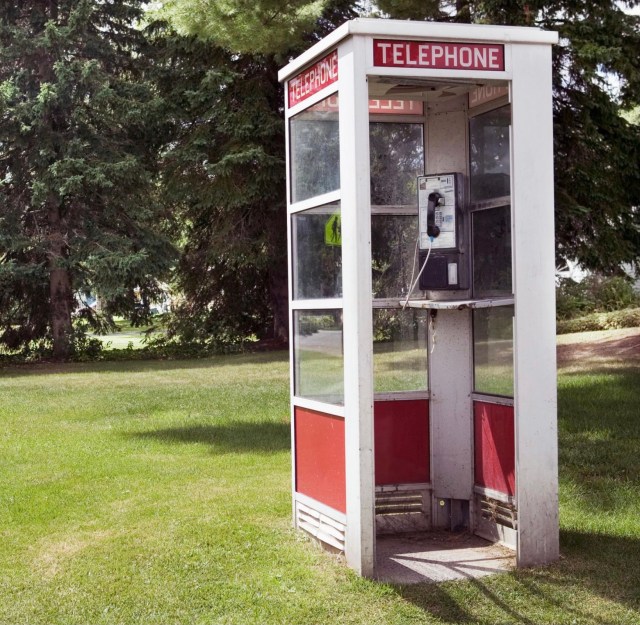
Leaving the house without a phone wasn’t barbaric. They had these things called “phone booths” or public toilets, they seemed functional for both purposes. Superman was always able to find one in an emergency, and so could you! 

Nearly every public parking had a phone booth, and most could give you a five minute call for a dime (remember, something was used up). Lots of young people wore buttons that they pinned to their jackets or purse straps. It was very wise to put a dime in the back of several buttons. You could always make an emergency call. Some people still wore “penny loafer” shoes, but replaced the penny with dimes. Later on it was a quarter for three minutes, so the buttons had to get bigger, and the shoes were out.

In addition for being the model for future airplane bathrooms, the phone booth did provide a measure of security. Not only did it deter thugs from a snatch and grab, but it muted the conversation that you might have, unless there was a lip reader nearby. There is a federal law that talks about “the expectation of privacy” and government agents cannot listen in or record any conversation between individuals if there is “an expectation of privacy” without a warrant signed by a judge. That stops the police from tapping your business or your home. It also stops them at the phone booth.

But time rolls forward, now we all have cellphones, and we feel naked if we leave it at home. And by the way, there is a limited “expectation of privacy” with cellphones. No warrant needed to listen in or record anything said through the public airwaves, just purchase a scanner.

Ever wonder why those public phones that don’t live in a phonebooth have those little “wings” on either side? It does stop some extra noise, but it is supposed to give you that “expectation or privacy”. Plus the new design allowed the phones to be lower, and no booth meant that it was wheelchair accessible.

There is one more thing that is different about nearly everyone having a cellphone, and that is “connectivity”.

I want you to envision your close circle of friends, it could be anywhere from two to a dozen. How many of you have that one close friend that is slightly off the rails, wears aluminum foil hats in the house, listens to radio talk shows about aliens, and hangs out near Area 51 on vacation. We might know someone like that, but rarely are they close friends, unless you do the same things. 

Now, expand to relatives and acquaintances. Expand it even further to one hundred people. With one hundred people you might find one of them that fits this description. That’s one percent of your acquaintances that are slightly wacko. You can handle that, your particular group will not be taken off the rails by one percent of the people you know. You are safe.

However, now most people are connected by cellphones, many of them “smart phones” allowing for deeper connectivity. If the population of the US is 328 million folks then one percent is 3,280,000 people that can be connected with the same mindset. If they were all told to move to Denver, and taken over the city, there might be anywhere from 32,000 to 328,000 people that actually show up.

Yes, back then, with our Bakelite phone tied to the wall in the house, we might have felt isolated compared to today. But there is a positive side to isolation.

Posted in Commentary | Leave a comment