I’ve also spent years helping students make stronger, more intentional images. I say “helping” because most of the real learning is self-driven. Students learn by doing—in the field, in the studio, and in conversation with each other.
But I also love words. Over time, I’ve noticed that many of the most important concepts in photography also matter deeply in thought, writing, and communication.
Some words carry a double life: one in image-making, the other in reflection and judgment.
Here are twelve that have stayed with me for years.
1. Contrast
In photography, contrast is essential. A snowball on a snowfield without it simply disappears. We need contrast to define edges.
The same is true in thought. Without contrast, we struggle to isolate an idea, an argument, or a choice. Edges give shape. Shape gives meaning.
2. Perspective
Not every image depends on perspective, but when it appears—converging lines, a vanishing point—it adds depth and force.
In life, perspective is critical. We need a place to stand in order to see clearly. A shift in perspective can bring clarity, distance, or empathy. Sometimes all three.
3. Framing
Framing in photography is artificial—but necessary. There are no literal frames in nature. The photographer decides what to include and what to leave out.
Life works the same way. We frame arguments, situations, and stories. Frames shape understanding.
But framing can also manipulate. The way a problem is framed may leave no real alternatives. Be careful who holds the frame.
4. Focus
An out-of-focus image is little more than a contrast blob. No detail. No line. No shape.
In thought, lack of focus produces the same blur. What is pleasing in a background may be useless in an argument. Focus lets us trace a path. The sharper the focus, the more efficient the journey.
5. Depth of Field
A shallow depth of field isolates the subject. It says: look here. Ignore the rest. A deep depth of field brings more of the scene into view.
In thought, depth of field is a form of control. Sometimes we need to isolate the essential. Sometimes we need to see the whole field. Wisdom may depend on knowing which kind of clarity the moment requires.
6. F-Stop
F-stop controls light. Too wide, and the image may burn out. Too narrow, and the sensor is starved.
Life has similar demands. Sometimes we need to narrow the aperture—reduce noise, block distraction, limit input. Other times we need to open wider—let in uncertainty, possibility, or surprise. Balance matters.
7. Time
Exposure time matters. Too short, and too little appears. Too long, and the image washes out.
In life, timing is just as delicate. Some things need time to emerge. Others demand immediate action. Knowing how long to wait—or when to stop waiting—is part of the craft.
8. Sensitivity (ISO)
ISO controls how sensitive the camera is to light. Low ISO gives finer detail and less noise. High ISO works faster, but at a cost.
Human sensitivity also needs calibration. Too much, and we overreact. Too little, and we miss what matters. Awareness is not simply feeling more. It is knowing how to set the dial.
9. Negative Space
In a composition, negative space is the area around and between the subjects. It gives the eye a place to rest. Without it, a photo feels claustrophobic.
In thought, silence and pauses are our intellectual negative space. Constant noise—data, notifications, chatter—clutters the mind. We need “empty” time to define the solid ideas. Wisdom often emerges not from what we add to our lives, but from what we leave out.
10. Resolution
Technically, resolution is the amount of detail a system can hold. Higher resolution allows us to see the texture of a leaf or the grain of a stone.
In thought, we often settle for low-resolution opinions—broad generalizations and pixelated logic. High-resolution thinking requires looking closer, past the first impression, to see nuance, contradiction, and fine detail. It’s the difference between seeing a crowd and seeing what it is made of.
11. Latent Image
In film photography, the latent image exists on the reel after the shutter clicks but before the chemicals reveal it. It is present, but not yet visible.
In thought, this is the space of intuition and incubation. We often carry the image in our heads—a solution, a direction, a form—but it has not yet developed. It requires time and process before it becomes visible to others.
12. Saturation
Saturation is the intensity of color. Over-saturation can make an image feel artificial; under-saturation can drain it of life.
In thought, this is our emotional register. Too much intensity distorts judgment. Too little leaves us detached. The right level allows the colors of an experience to come through without overwhelming the structure.
These ideas belong to photography, but they also belong to the way we think.
The longer I work with photographs, the more I suspect that image-making and thought share the same fundamental problem: how to see clearly, and how to decide what deserves to be seen.
The reactions are real—raw, immediate—but there’s something else underneath them. A kind of surprise, as if this moment arrived without precedent. As if we haven’t been here before.
We don’t always declare war anymore, but we still place people in harm’s way. And behind each of them is a familiar structure—families waiting, watching, carrying the quiet weight of not knowing. That part hasn’t changed. It never has.
What has changed is the lens. Each generation meets this moment as if it were the first. And in a way, it is. Not historically—but personally. No one inherits the weight. It must be learned again.
Wow! The song was from the Chambers Brothers, first played in 1967. I remember it well, but I did not think it was on a shelf so close to the front of my mind.
I’m in my Monday morning regular Bible Study and we are in t he gospel of John 12. Very interesting read and discussion, then the verse has Yeshua say, ‘The time has come…’, and I disappear from the conversation.
It was like the family dog that is trained to ear when the gate swings to lock or not lock. The gate is not locked and the dog hits it full force racing down the driveway.
I read that verse, ‘time has come…’, and suddenly it’s 1967, and I’m hitchhiking across the Nevada desert, or maybe Big Sur in the search for Hieronymus Bosch.
I’m still at the table, people are speaking, I’m nodding my head, but my thoughts are miles away in distance and almost 60 years in time.
In Truckee there sits a remnant from the age of glaciers—a broad, smoothed stone surface, polished flat by ice long gone. At its center rests an immense boulder, improbably balanced.
For thousands of years it held there. Not fixed—balanced.
Most days still, but under a strong wind or a passing storm, it would move.
Not fall. Not shift. Just… rock.
It came to be known as the Rocking Stone.
The native residents knew it well. They told stories about it. They touched it. A careful push with a thumb was enough to set it in motion. That small act—contact, response—held for generations.
Then came the settlers. They noticed it too. A Veteran’s Hall was built nearby. A pavilion rose, framing the stone, containing it without quite touching it. The boulder remained at the center, still rocking.
You can still find it today, just off Interstate 80. You can walk up to it. You can see the balance, the placement, the improbable stillness.
But it no longer moves.
Concerned about safety, it was fixed in place—cemented. Stabilized. Secured. It is still called the Rocking Stone. But the rocking is gone.
There’s something precise in the loss.
For thousands of years, the stone held a tension—weight and motion, gravity and release. It required almost nothing to reveal it. A thumb. A moment. A willingness to touch and see. Now it offers only appearance.
The name remains.
The form remains.
The behavior—the thing itself—is gone.
It’s a small story, but it doesn’t stay small.
We have a habit of preserving things by removing the very condition that made them worth preserving. Movement becomes risk. Risk becomes liability. Liability becomes policy.
And policy has no interest in balance—only in permanence.
The Rocking Stone still sits in Truckee. It just no longer answers when touched.
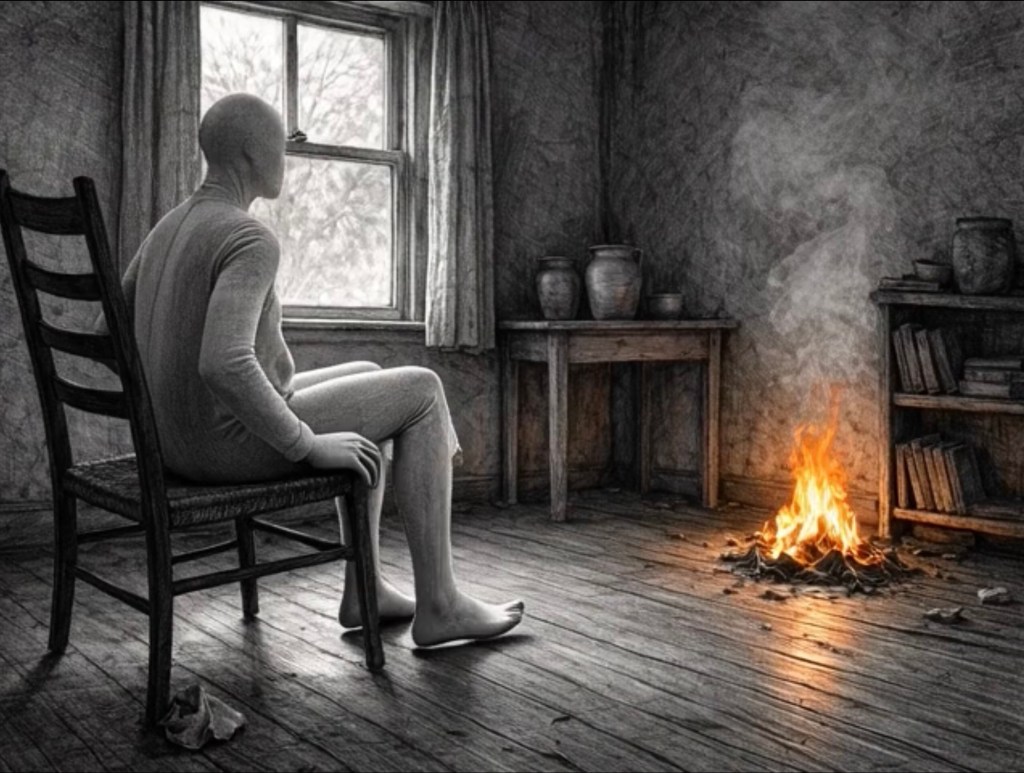
There is a room with a chair. It sits three-quarters along the far wall, next to the table, near the front window. It is well worn, wooden, and in the style of ladder-backed. The front legs are straight and narrow. One of the front legs has a small wad of paper taped to the bottom. The chair used to tip a bit, but no more.
The room is spare. It has other furniture, but none shows care like the chair. The chair does not match the table. It is a stranger to the others.
When a person is in the room, the chair is used. Its position allows someone to see out the window to the courtyard, and to the other windows facing the courtyard.
The chair, and the window, are on the third floor of a six-story apartment building. The apartment is perfectly placed to look across, to look down, and to look up. The window panes sometimes vibrate with the noise outside.
There is a small fire on the wooden floor.
The chair does not see. But it feels.
It has learned the language of weight:
• a child is a brief landing
• a lover is a settling-in
• guilt is a hover
• grief is a collapse
• fear barely touches the seat
• certainty is a full downward surrender.
The chair has never spoken, but it has judged more honestly than any mirror. It knows the difference between:
• someone who sits to rest
• someone who sits to think
• someone who sits to listen
• someone who sits because they do not dare to stand
It feels direction, too. Weight shifts north when someone steels themselves. Weight shifts east when someone hides something. Weight shifts west when someone waits for an answer that will not come. Weight shifts south when someone gives up.
Some people treat a chair like an object. Others treat it like a confessional. The chair remembers the difference.
‘Someone’ enters the room. Not abruptly — but with the kind of pause at the threshold that the chair recognizes.
A pause that has weight. A pause that decides whether to sit or not. The chair feels the air shift first.
It always does.
The floorboard gives the faintest complaint beneath the first step.
It is a careful step — not timid, not tired, but measured. The step of someone carrying a thought not yet decided.
The ‘someone’ crosses the room, not looking at the chair, but walking the perimeter the way people do when they are making deals with themselves.
‘Someone’ glances toward the window. The window gives back the courtyard, the other windows, the stacked lives.
But the ‘someone’ does not look at the view long — only long enough to confirm what they already knew was there.
Then they turn toward the chair.
The chair can tell immediately:
• this is not a visitor
• not a person passing through
• not someone lost
• not someone afraid of the room
The ‘someone’ sits — not fully, not finally, but enough for the chair to judge: They have returned to make a decision, they do not yet want to name it.
The ‘someone’ does not settle. Not yet. Their gaze drops.
This is ‘someone’ who has been here before but is not sure they belong here now.
The weight that settles into the chair is familiar and changed.
A shift that says something is being held in instead of sinking down. The chair feels the uncertainty in the thighs, the hesitation in the spine, the way one palm rests on the table as if bracing for news that has not arrived yet.
A slow, precise glance finds the front leg — the one with the small taped wad of paper stabilizing the chair.
The look is not inquisitive. It is confirming. The wad is there.
The chair, though perfectly steady, feels the necessity of the check.
Their back stays an inch from the chair’s full support. The weight tilts forward — toward possibility, toward interruption.
They sit the way a person holds a question on their tongue — present, but not spoken.
The chair feels the tension running down one thigh, the way the heel does not quite rest on the floor.
This is a posture with direction. The ‘someone’ is not waiting for time to pass. They are waiting for a signal.
A faint shift in the hallway’s air. A shadow sliding under the door. A hinge complaining at the far end.
Someone else moving through the building with a purpose that intersects this room.
The chair senses the alertness.
It knows this type:
• poised
• listening
• braced
• too still to be calm
• too quiet to be at peace
Then — a sound.
Not loud.
Just the familiar syncopation of shoes on the third-floor boards. Measured steps. Not running, not hesitant. The tempo of someone who has come here before. The ‘someone’ closes their eyes for a breath.
Their weight shifts slightly back, as if deciding whether to stand before the steps arrive at the door. The chair absorbs the choice. The footsteps continue. Unbroken. Approaching.
The ‘someone’ does not move. Not forward. Not away. Just waits. More tightly than before.
The chair feels all of it. The footsteps stop.
Not abruptly — not with that impatient halt that means knocking is next — but with a quiet, deliberate stillness. A stillness long enough to make the ‘someone’ in the chair tighten their grip on the front edge of the seat.
The chair feels the pressure of fingertips pressing meaning into the wood. Seconds pass. Enough to count. Enough to miscount. Enough to wonder if the footsteps were imagined.
If the hallway held only echoes. If the building was shifting its old bones again.
The ‘someone’ in the chair leans forward a fraction of an inch. Not enough to rise. Just enough to surrender to the doubt:
Were those steps real?
The pause stretches. The air holds.
The chair cannot see — but it knows when a person’s weight tilts toward the door.
It knows the subtle forward slide of anticipation, the breath held just past comfort.
Then — soft, unmistakable: A pivot. Not a retreating panic step. Not a misdirection. Just a careful turn of the body. Facing away from the door. A decision not to enter.
The steps begin again, moving down the hall, fading toward a stairwell or another door, or nowhere at all. And in the chair, the ‘someone’ finally exhales. Not relief. Not disappointment.
Just the sound of a person who has waited for something that chose not to arrive. ‘Someone’ rises from the chair.
Not quickly — but with that slow lift where the weight stays behind a moment, as if the body is negotiating with the room.
The chair remembers their shape, and releases them without complaint. The ‘someone’ steps toward the window, close enough for the glass to catch their breath and fog the courtyard into a soft, trembling blur.
Outside, the building across the way keeps its usual posture — curtain, shutter, balcony, rail — all the small architectures of other lives.
The courtyard: a stroller, a dog, a neighbor leaning on a railing, two bicycles against a wall, an absence where someone should be. ‘Someone’ tilts their head, scanning the patterns of arrival and departure, the flicker of figures through other windows, the rise and fall of motion on all six floors.
Then, barely above breath — quiet enough that the word falls into the windowpane instead of the room —
“Why?”
Not spoken to the courtyard. Not to the vanished footsteps.
Not to the chair.
Just released — like a question with no direction, looking for a place to land. Time shifts. The room remains. The chair remains. The wad of paper remains. The window stays tethered to the courtyard’s small, indifferent pulse.
Only the light changes. Another someone enters — different gait, different tension, carrying a different question. They walk the same perimeter. They pause at the same threshold between settling and fleeing. They place the same hand on the table. The chair feels the same hesitation in the spine, the same weight held back, the same almost-sitting that becomes sitting.
Everything echoes. But the whisper, when it finally comes — soft against the same pane of glass, caught in the same breath — is not
“Why?”
It is…
“Who?”
The word lands without answer. The room absorbs it. The chair holds it. The courtyard does not respond.
Lights fade.
For several months I have returned to this one-act, I have pondered several changes. Not to make it better, but maybe to make it different. It was important that the chair was not “humanized,” like the objects in Beauty and the Beast. Not in appearance, and not in thought. The chair remains a chair. It does not move or speak, but it does feel, and it waits.
I placed it in a room with “someone.’ I did not identify the someone as human, man, or woman, although the probability is high it’s human. The ‘someone’ sits, moves the chair, moves around the room, comes and goes. The room is one of many, something like a small studio apartment with a hallway entrance and a window to a shared courtyard.
I set up a storyline of two or three days of action from the chair’s perspective. It was an consuming project. Later, I added a few more characters to the script and began to consider the logical consequences.
I imagined a fire in the apartment. A small obscure fire that grows by finding combustible material. Even the fire has some quality of sentience. It is rapacious. It seeks food, grows in order to seek more food. It prepares its combustible food by heating it first, consuming, and leaving ash behind. It takes in non-combustible material as well, material that is then altered by heat, sometimes in dramatic ways. It keeps growing until it begins to starve, taking all the oxygen, and then it dies out.
The chair in the room senses the change in temperature as the floor begins to warm.
The ‘someone’ does not notice the growth at first. But soon the ‘someone’ hears a different sound and smells something odd.
The ‘someone’ bolts out of the room, entering the hallway. The chair does not. The chair waits.
It waits either for the ‘someone’ to return and move it… or for the fire to consume it.
The point of the story is that we share existence in this world, in this universe. We may occupy different positions. We may even share some ideas. But we operate within our own agencies.
The chair will always allow someone to sit.
Someone might carry the chair to safety.
Or not.
Seeing a pattern, I looked at the current state of AI development. It’s currently in chaos, like the room with the chair. There are characters with their own agencies, and characters that are completely controlled by “someone.” It is also completely unsafe.
I have just read an article about caterpillars and butterflies. Naturally the cocoon is an important feature, where metamorphosis takes place. The aspect that struck me anew is that the caterpillar does not grow wings, or legs, or a new paint job. The caterpillar dissolves into a cellular soup and reforms into the butterfly.
The cocoon is the perfect place for this to happen. It is not a sealed environment, but it is safe and protected.
I thought perhaps that most of the arguments about AI concern “the soup,” and that AI will metamorphose into something brand new, and currently unknown.
What happens when a culture no longer has the freedom to have fads? That might seem like a bold statement. Who took that freedom away? More importantly, why would anyone take that particular thing away? Is it possible the answer is an algorithm?
And what is the evidence that fads are no longer allowed? I suppose I’m basing that on the absence of news stories about a ‘fad sweeping the nation.’ That particular slug line lived in newspapers for decades. I don’t recall seeing it in recent years.
What happens when a culture partially institutionalizes a fad? It interrupts the natural life cycle. Institutionalized fads are no longer fads. They are infrastructure.
A culture without dissolving fads doesn’t lose its silliness—it loses its ability to forget together.
By losing that headline, we haven’t found eternal trendiness—we’ve lost our exit strategy.
In the Midwest, a blizzard is swallowing highways. In California, someone is ordering a Blizzard to cool off.
We move through weather whether we’re prepared or not — wind, heat, stillness, the sudden cold that makes you reconsider your own judgment. I once thought about buying all the technology to become a “weather person.” There are thousands of them now, broadcasting from garages and spare bedrooms. It’s the new CB radio club, only with better antennas.
These days, I measure the seasons by simpler things.
Whether I take my jacket, or whether I leave the door ajar at night.
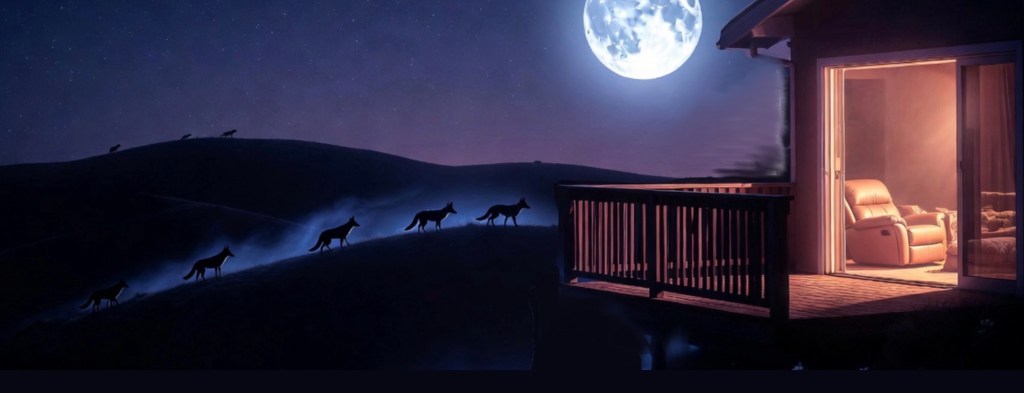
Out here, the city noise barely reaches me. Traffic dissolves into the distance. What remains is nature, and nature does not whisper. The coyotes conduct the darkness, tracing ridgelines, calling across creek beds. It sounds melodic until you realize it’s a map — and a hunt.
I woke from a dream just now.
Not chased, not threatened.
Just listening.
A soft cry, a shuddering moan — like a puppy punished for barking but unable to silence itself. The sound was so faint it felt like only the creature itself could hear it.
But it wasn’t a puppy.
And not yet food.
It was hiding under my deck, only yards from my open door. Yards from where I slept in the recliner. In the dream, I heard it clearly. And now, the sound thinned, retreated, became harder to understand.
And that’s the season too —
the way the world speaks plainly in dreams, but awake it becomes almost too soft to hear.
A few months back, I wrote a one-act about a chair. I was partly inspired by Sarah Bernhardt, but mostly by the imagined possibility that common objects might carry some faint aspect of sentience. It was important that the chair was not “humanized,” like the objects in Beauty and the Beast. Not in appearance, and not in thought. The chair remains a chair.
It does not move or speak, but it does feel, and it waits.
I placed it in a room with “someone.” I did not identify the someone as human, man, or woman, although the probability is high. The someone sits, moves the chair, moves around the room, comes and goes. The room is one of many, something like a small studio apartment with a hallway entrance and a window to a shared courtyard.
I set up a storyline of two or three days of action from the chair’s perspective. It was an entertaining project. Later, I added a few more characters to the script and began to consider the logical consequences.
I imagined a fire in the apartment below. A small electrical fire that grows by finding combustible material. Even the fire has some quality of sentience. It seeks food, grows in order to seek more food. It keeps growing until it begins to starve, and then it dies out. It prepares its combustible food by heating it first, leaving ash behind. It takes in non-combustible material as well, material that is then altered by heat, sometimes in dramatic ways.
The chair in the room senses the change in temperature as the floor begins to warm.
The someone does not at first. But soon the someone smells something odd.
The someone bolts out of the chair and leaves the room, stepping into the hallway.
The chair does not.
The chair waits.
It waits either for the someone to return and move it… or for the fire to consume it.
The point of the story is that we share existence in this world, in this universe. We may occupy different positions. We may even share some ideas. But we operate within our own agencies.
The chair will always allow someone to sit.
Someone might carry the chair to safety.
Or not.
From this I looked at the current state of AI development. It’s currently in chaos, like the room with the chair. There are characters with their own agencies, and characters that are completely controlled by “someone.” It is also completely unsafe.
I have just read an article about caterpillars and butterflies. Naturally the cocoon is an important feature where metamorphosis takes place. The aspect that struck me anew is that the caterpillar does not grow wings, or legs, or a new paint job. The caterpillar dissolves into a cellular soup and reforms into the butterfly.
The cocoon is the perfect place for this to happen. It is not a sealed environment, but it is safe and protected.
I thought perhaps that most of the arguments about AI concern “the soup,” and that AI will metamorphose into something brand new, and currently unknown.
I’ve been having this feeling more and more. Maybe it’s age, or simply the accumulation of years. There are things I once knew without thinking that now sit like dust bunnies under the couch.
“Yeah… that seems familiar.”
This isn’t about dementia. What struck me instead was the root of the word familiar—and how even that word has been bent into new shapes.
There was a time when the boundary felt clearer: when something was “family,” and when it wasn’t. Of course, that clarity carried its own distortions—rigid obligations, unspoken tensions, fractures softened by memory.
You could have friends, and they mattered. They were mostly chosen. And then there was family, mostly unchosen—and not always meaningful.
Still, there were families where a kind of continuity held.
A grandchild knew a grandmother.
That grandmother knew her grandmother.
And she had known hers.
Not just known them, but honored them. Kept them close. Felt them. Everything about them was familiar.
Was that common? Probably not. But perhaps it was more common than it is now.
Some of the change wasn’t intentional. People began having children later. Grandparents were gone before a child could know them. And once transportation made distance easy, families scattered. In the United States especially, moving far away became normal.
In many lives, the disruptions were so great that entirely new “families” formed—around religion, sports, identity, hobbies, or even chance. These chosen kinships can be deep, sometimes sturdier than blood, though they lack the inherited familiarity of old.
So what does family mean today?
Is it still familiar?
Or have we traded one kind of closeness for another—quietly weaving our own bonds in a world that no longer holds still.
Not because anyone asked. These are unbidden keychains, capable of gaining a key, capable of organizing many keys. But no one has asked me for them. So, naturally, I plan to give them away.
I didn’t exactly decide to make them either. I was making a parka for my wife and wanted to add a waist drawstring, so I ordered a roll of black paracord from Amazon.
When it arrived, I’d ordered wrong—too thin, even doubled. So I ordered more, in colors. I braided four microcords into three bundles, then flat-braided those into a single drawstring. Colorful. Successful. And now I had excess cord and restless hands.
I braided more. I liked that they were quiet fidgets—easy to roll, twist, knot, and unknot. So I ordered more colors, despite having only two hands and no evidence that anyone else wanted a corded fidget.
Then it occurred to me: a short, colorful flat braid would make a good keychain. I wove the remaining microcord into different braids. Another order—this time carabiners—and the keychains were finished.
What is a key?
A key implies a lock. A lock implies something worth protecting—or something worth hiding. A locked house might shelter treasure. Or prisoners. Or nothing at all.
You can lock others in: jail, prison, cage.
Or you can lock yourself in.
Build the cell. Close the door. Throw away the key. Call it safety. Call it principle. Call it whatever you refuse to question.
A friend of mine sold everything—car, house, belongings—to enter ministry overseas. At the airport, the metal detector went off. The agent asked if he had any keys.
My friend froze, briefly. He had none. Nothing to secure. No locks. No obligations clinking in his pocket.
It only took a second. He reached in, pulled out loose change, set it in the tray, and walked through.
Now I’m making keychains for mythical keys. Perhaps there will be no keys at all. Just color and braid. Just readiness, waiting in someone’s pocket.
The carabiner would still set off the detector. The agent might ask: why carry a keychain with no keys?
Most of us already carry keys. We’ve organized them somehow. Offering a new keychain means asking someone to reorganize—to exchange what works for what might work better. Or differently. Or not at all.



Doubles
(this is an updated post from a few years ago.)
It’s true—I love photography.
I’ve also spent years helping students make stronger, more intentional images. I say “helping” because most of the real learning is self-driven. Students learn by doing—in the field, in the studio, and in conversation with each other.
But I also love words. Over time, I’ve noticed that many of the most important concepts in photography also matter deeply in thought, writing, and communication.
Some words carry a double life: one in image-making, the other in reflection and judgment.
Here are twelve that have stayed with me for years.
1. Contrast
In photography, contrast is essential. A snowball on a snowfield without it simply disappears. We need contrast to define edges.
The same is true in thought. Without contrast, we struggle to isolate an idea, an argument, or a choice. Edges give shape. Shape gives meaning.
2. Perspective
Not every image depends on perspective, but when it appears—converging lines, a vanishing point—it adds depth and force.
In life, perspective is critical. We need a place to stand in order to see clearly. A shift in perspective can bring clarity, distance, or empathy. Sometimes all three.
3. Framing
Framing in photography is artificial—but necessary. There are no literal frames in nature. The photographer decides what to include and what to leave out.
Life works the same way. We frame arguments, situations, and stories. Frames shape understanding.
But framing can also manipulate. The way a problem is framed may leave no real alternatives. Be careful who holds the frame.
4. Focus
An out-of-focus image is little more than a contrast blob. No detail. No line. No shape.
In thought, lack of focus produces the same blur. What is pleasing in a background may be useless in an argument. Focus lets us trace a path. The sharper the focus, the more efficient the journey.
5. Depth of Field
A shallow depth of field isolates the subject. It says: look here. Ignore the rest. A deep depth of field brings more of the scene into view.
In thought, depth of field is a form of control. Sometimes we need to isolate the essential. Sometimes we need to see the whole field. Wisdom may depend on knowing which kind of clarity the moment requires.
6. F-Stop
F-stop controls light. Too wide, and the image may burn out. Too narrow, and the sensor is starved.
Life has similar demands. Sometimes we need to narrow the aperture—reduce noise, block distraction, limit input. Other times we need to open wider—let in uncertainty, possibility, or surprise. Balance matters.
7. Time
Exposure time matters. Too short, and too little appears. Too long, and the image washes out.
In life, timing is just as delicate. Some things need time to emerge. Others demand immediate action. Knowing how long to wait—or when to stop waiting—is part of the craft.
8. Sensitivity (ISO)
ISO controls how sensitive the camera is to light. Low ISO gives finer detail and less noise. High ISO works faster, but at a cost.
Human sensitivity also needs calibration. Too much, and we overreact. Too little, and we miss what matters. Awareness is not simply feeling more. It is knowing how to set the dial.
9. Negative Space
In a composition, negative space is the area around and between the subjects. It gives the eye a place to rest. Without it, a photo feels claustrophobic.
In thought, silence and pauses are our intellectual negative space. Constant noise—data, notifications, chatter—clutters the mind. We need “empty” time to define the solid ideas. Wisdom often emerges not from what we add to our lives, but from what we leave out.
10. Resolution
Technically, resolution is the amount of detail a system can hold. Higher resolution allows us to see the texture of a leaf or the grain of a stone.
In thought, we often settle for low-resolution opinions—broad generalizations and pixelated logic. High-resolution thinking requires looking closer, past the first impression, to see nuance, contradiction, and fine detail. It’s the difference between seeing a crowd and seeing what it is made of.
11. Latent Image
In film photography, the latent image exists on the reel after the shutter clicks but before the chemicals reveal it. It is present, but not yet visible.
In thought, this is the space of intuition and incubation. We often carry the image in our heads—a solution, a direction, a form—but it has not yet developed. It requires time and process before it becomes visible to others.
12. Saturation
Saturation is the intensity of color. Over-saturation can make an image feel artificial; under-saturation can drain it of life.
In thought, this is our emotional register. Too much intensity distorts judgment. Too little leaves us detached. The right level allows the colors of an experience to come through without overwhelming the structure.
These ideas belong to photography, but they also belong to the way we think.
The longer I work with photographs, the more I suspect that image-making and thought share the same fundamental problem: how to see clearly, and how to decide what deserves to be seen.