He has been known as Charlemagne, or Charles the Great, since the Norman invasion of 1066. Before that he was called Charles I, even though his grandfather was also a Charles. The leaders of the Franks were not so quick about declaring themselves kings. The previous Frankish dynasty were the Merovingian Kings, better known at the time as the “Do Nothing” kings. Perhaps the title of king had lost its luster. Charlemagne is also my 34th great grandfather.
Charlemagne’s grandfather was known as “Charles the Hammer”, it almost sounds like a pro-wrestler’s name. He was a very successful warrior. The ruling title was actually called “the Mayor of the Palace” the king might live in it, but Charles the Hammer ruled as mayor. For some reason the Carolingian dynasty also liked the family name of Pepin. Charlemagne’s father, son and uncle had that name. Maybe it sounds better in French.
So far, all of my royal ancestors have been connected through my mother’s Norwegian roots. But today I made a breakthrough, after years of collecting data on poor German farmers, and perhaps better off city burghers, I found a marriage to a minor count. A minor count can lead to a Duke, and generations of counts and dukes. I haven’t found any German kings or princes yet, but I’m sure they are there.
One of the counts had marriage connections to the Franks and suddenly I was related to Charles the Hammer, Pepin, and Charlemagne. I love the sudden explosion of data. I’ve taken it back even further than the Franks. I’ve found a direct connection to a Roman Senator of Gaul, around 300 AD. That’s 150 years before Rome fell.
So why was Charlemagne so great? Well, the first rule is that the victors get to write the history. They call Charlemagne the father of Europe. The shape of the countries in Europe has been based on the provinces of his empire. But he was also a great reformer. He actually passed laws on education and literacy, he provided guidelines on how to run a business and keep standardized records, he promoted the use of lowercase letters, he ruled for almost 50 years and he was not a “do nothing” king.
It would be somewhat of an error to think of him as French, he was Frankish, and that tribe had come from western Germany, and pushed the native Celts further west. And the Celts had pushed the Bronze Age Picts in the same manner. When the Romans came over the Alps and up from the coast, they ruled for over 600 years, creating a blended population. But the Romans rarely crossed the Danube, on the other side was barbaric Germans, dense forest, and death to their Legions. Charlemagne crossed the Danube easily and united much of even Eastern Europe.
It’s no wonder that the Pope crowned him the first Holy Roman Emperor in over 300 years. Charlemagne didn’t know it, but the Pope even expected him to rule over Constantinople. He didn’t go there.
We don’t know where he was born, but we know he died in Aachen and was placed in his tomb in Aachen Cathedral. Apparently he was entombed sitting on a throne for the first 200 years. Then they opened the tomb and laid him flat. Years later they put him in an elaborate casket where he remains. At one point they took measurements. He was between 6 foot and 6 foot 5. Above the 99 percentile of the time.
My 34th great grandfather died on Jan. 28, 814. I really do think he was great.
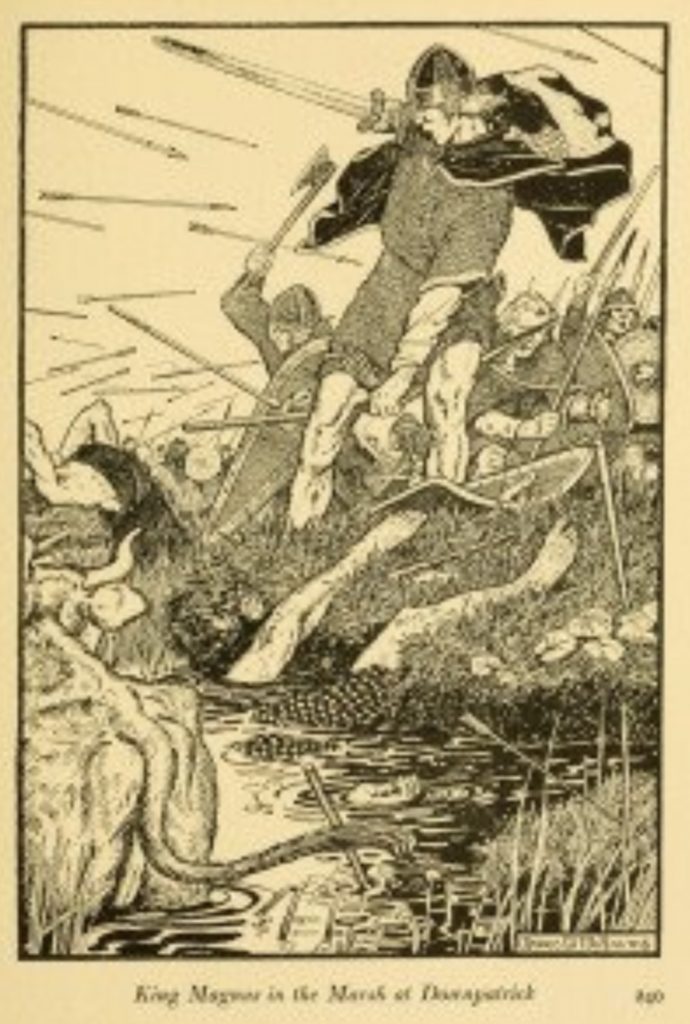
Magnus was the son of Olaf, and the grandson of Harald Hardrada. Harald was the famous Warrior King who fought in Italy, Sicily, Syria, Constantinople, Crimea, and Kiev. Then he went back to Norway to fight and become king. Later, he dies while trying to become king of England. His son Olaf was sixteen when his father died in 1066. When Olaf became king of Norway he was soon called Olaf the Peaceful because he mostly focused on making improvement in the country, instead of conquests.
Well, Magnus did not take after his father, Magnus most definitely took after his grandfather and was known as a military leader bent on increasing the kingdom of Norway. He was my 22nd great grandfather.
Magnus recognized his greatest strength was based upon his navy and the very seaworthy longships. While he did fuss with Sweden about some border areas, he mostly renegotiated treaties with Sweden, Denmark and Norman England. What he felt strongly about were the islands in the Irish Sea. He established a base on the Isle of Mann and set forth bringing Irish and Scottish islands into the Norwegian kingdom. There were even peace treaties that agreed that the islands were his.
One story was that a very nice chunk of land was connected to the main body by an isthmus, so technically it wasn’t an island and Magnus could not claim it. Magnus went there, sat at the helm of his boat and had his men tow him across the isthmus to the water on the other side. Technically he had “sailed” around the “island”, so he claimed it. No one argued.
Magnus could have been known as the Warrior, or as the Conqueror, but instead he was known as the Barefoot. This was a slight mistranslation, he may have been barefoot some of the time, but he was always “bare legged”. It seems that when he left Norway he was very impressed with the clothing styles of Scotland and Ireland, and took up the wearing of “kilts”.
While campaigning in Ireland, Magnus led a small party that was foraging for food for the trip back to Norway (stealing from farmers), when he was ambushed by a band of Ulaid (Ulster men). He died in the battle in 1103.
Magnus Barefoot, a stylish kilt wearing Viking, was my 22nd great grandfather.
I was spending a little time blog cruising today, farming snippets of thought here and there. I must apologize in advance because I don’t really read for content, and certainly not carefully. When I’m “farming” I’m looking for ideas that unlock some sort of thought process. The trouble is that the idea ferments for a time, then explodes like active yeast hours later. I can’t even give credit for the fruit that I picked, because I only remember the idea, not the blog page.
So if you wrote about, “we are not in the same boat, but we maybe we are in the same storm.” , thank you for that.
I know about boats, I’ve been around them most of my life. At one point I owned four of them at once, a dinghy, a Cal20 sailboat, a Yankee30 sailboat, and a 1948 Ed Monk 41 foot power cruiser. It was nearly a navy.
We have a habit of using commonly understood objects in our analogies, and in most cases that is understandable, until it gets tiresome. “We are all in the same boat”, is meant that we are altogether, going in the same direction, and on an equal footing. Apparently no one has ever heard of “the Raft of the Medusa”, or seen the movie “Lifeboat”. The passengers are on the same vessel, but their futures are different, and their experiences can be remarkably different, like eating or being eaten.
In the past, when I have heard the phrase “We are all in the same boat”, I most always think, (but rarely say), “but your end of the boat is sinking!”
This COVID business has generated a lot of the same boat comments. Yet, some people will end up with a very nice tan as they sun themselves on the fly-bridge, while others will have ulcers on their feet as they stand in the bilge, manning the pump.
I’ve been entertained by musicians playing from their homes, bringing their music to us from their mansions. I don’t begrudge them for their wealth, “Hey, good on you!”, but don’t try to convince me that we are all in the same boat.
Some folks don’t even have boats, they are making do with floaters, and life -preservers. I’m aware that I do not have a yacht with a crew, but I’m not in a dinghy either. I’d like to think I’m in the equivalent of my long gone 30 ft Yankee sailboat. Big enough to take on the storm, small enough that I’m know ever square inch in case something goes wrong.
I know about boats, I just don’t know that much about storms.
Softly we sing, We
Voice the innermost thoughts that Are
Hidden behind the furniture of our mental rooms, As
Guests relax on the sofas, Blind
To the melody that clings in the air like Vines
The world is madly Spinning
Forces are pulling Ourselves
Moving from one orbit, going Around
Yet another shiny thing, And
Not satisfied here, we spin Around
And search for other bright Objects
That attract the eyes And
The egos with Thoughts
Greedy and self-serving Not
Because we intend so, Truly
We are thoughtless in Our
Action, it’s just the nature that we Own.
My brother is older and has some first hand knowledge of the White Witch. Often, a group of his friends would be driving around, usually “dragging the main”. For a diversion they would drive out to Wildcat Canyon and park in the mansion’s driveway backwards in order to leave quickly. Then they would wait until a light would come on, or movement in the window, and they would take off with the girls screaming. A version of ring the doorbell and run.
One time they brought a “newbie”, a big football type guy, no girls. The “witch” flung the front door open, and stood there silhouetted in the doorlight. He screamed and fell on the floor of the car. They drove off quickly. That was a real event. The other White Witch stories may have some fiction about them, some appear to be adapted from other disconnected stories.
1. She approached parked cars with couples that were making out, then scratched the window with her nails.
2. People were parked and making out when they heard a dripping sound. Then there was blood on the windshield.
3. She was seen walking on the road by her house, then she disappeared.
4. One of the patients at her sanitarium escaped, and she knocked on cars to find him.
5. She is seen walking around in the park at night.
6. She used a shotgun loaded with rock salt to shoot at teenaged trespassers.
7. Scathing music was played for the patients in the sanitarium, it can still be heard late at night, coming from no known source.
8. A young man could not start his car after making out with his girlfriend. He left her in the locked car while he walked to the front of the park to use the pay phone. When he returned he found his girlfriend dead, scared to death by the White Witch. Now the girlfriend’s ghost haunts the park looking for the boyfriend that left her.
9. She has long, wild, white hair and is in a long black dress. She has long, wild, white hair and is sometimes dressed in a wedding gown.
10. One of the White Witch’s patients in the sanitarium had a hook instead of a right hand. The patient had a history of violence. While parked and making out, a couple hears on the radio that the police are looking for someone who had escaped from the sanitarium. The couple heard light scratching on the car. They knew that the White Witch liked to scratch on the cars that were parked. The young man quickly backed out and sped out of the park. He took his girlfriend home, got out of the car to go to the passenger’s side to open the door for his girlfriend. There, hanging on the door handle was a bloody hook, ripped from someone’s arm.
If you grew up in the late 1950s, early 1960s you heard the stories of the White Witch of Wildcat Canyon. She lived in a haunted mansion behind Alvarado Park in Richmond, CA. There was a “speculation” highway built with the idea to develop the land during Richmond’s growth after WWII.
The driving teenagers of the area called it the Deadend Highway, there were very few roads or driveways that connected. One of the driveways was to the Tewksbury Mansion. The mansion was originally built by Richmond pioneer Dr. Jacob M. Tewksbury for his daughter, Eugenia, and her second husband William Mintzer, early President of Bank of America in Point Richmond.
In 1914 it was purchased by Dr. Hendrik Belgum, a native of Norway who had lived in Wisconsin. Dr. Belgum turned the two story mansion into a small private sanitarium, called the Grande Vista Sanitarium. It was popular with the wealthy in Piedmont and Berkeley. It was off the beaten path but still accessible for visiting families.
By the 1940s it seemed that Dr. Belgum was distancing himself from regular outside contact. He preferred the company of the few patients that he had, along with his two spinster sisters that also lived at the Sanitarium, Inga Belgum and Ida Ruth Belgum. Dr Belgum died fighting a fire that was threatening the house in 1948.
The house passed to Dr. Belgum’s brother Bernard Belgum. In 1959 another sister, Christine Heimann, was widowed, and moved from Wisconsin. Bernard tried to keep running the Sanitarium for a few years but he didn’t have a medical degree and there were fewer patients. Only Ida Ruth lived on in the mansion to help maintain the property.
Bernard died in 1963,leaving everything to Christine and Ida. Ida Ruth was a noted local artist, and led a solitary life. She died in 1964. The mansion was empty. Christine, or Kristine, died in 1971 and during the estate sale it was discovered that the abandoned property had been vandalized and eventually burnt to the ground. The property eventually passed to the East Bay Regional Parks.
My guess is that the White Witch of Wildcat Canyon was not a witch at all, but instead, she was the last care giver of the Grande Vista Sanitarium, the artist Ida Ruth Belgum.
The Grande Vista Sanitarium
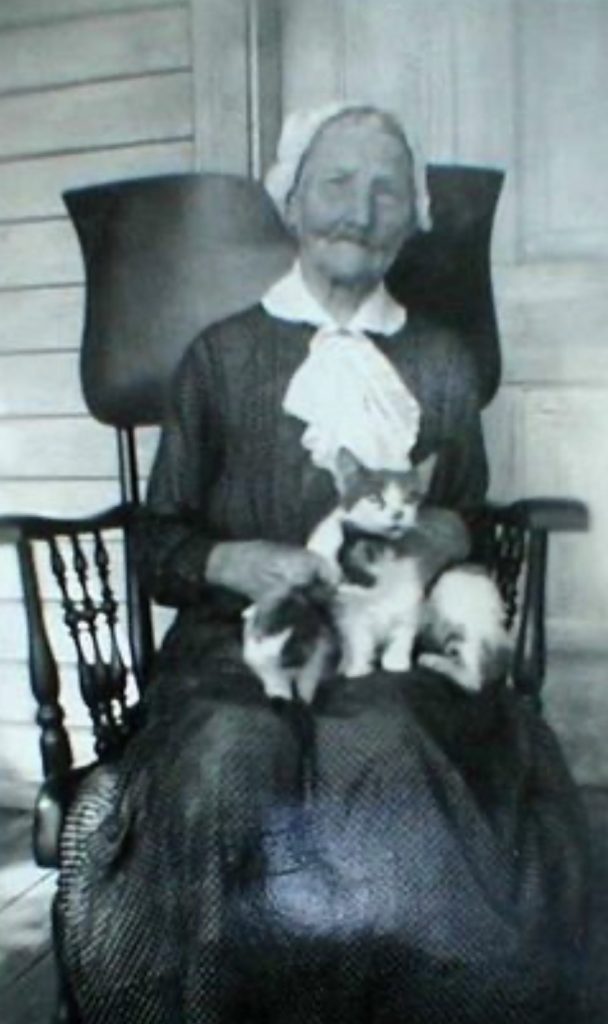
Not the White Witch. This is Kristi Belgum, Ida Belgium’s mother.
This is my attempt to justify the hours of research into genealogy. I have been on an interesting path, at first I was just collecting names, dates, and places. I would quickly gather then move on for more. It was a little bit like “notches on a gun”, or maybe less dramatically, “nice pieces of Depression Glass”. I had wished that there was more, but the data didn’t provide stories. They were for the most part farmers. Kind of ordinary farmers.
Then I underwent a change. Using the data, I tried to piece together the reason for moving. Using historical events to explain why the dramatic shift. I found that a lot of moves came right after a significant death in the family, most times it was children. Sometimes it was the death of an older family member that had been cared for. Without being able to find diaries or letters, I can’t prove the reasons, but there had to be reasons.
Sometimes I found newspaper articles or obituaries that gave more clues. Collecting data morphed into collecting stories, or conditional stories. I found a distant cousin in Germany that told me the story of over 100 families that wanted to migrate to the USA in order to avoid the constant threat of war. They were right on the French/German border. The Siegfried Line ran right through their village. They had to apply to the emperor for permission. Apparently they had heard about the Hessians going to Pennsylvania.
The emperor said no, but he promised some wonderful newly opened land on the other side of the country, on the border with Poland. It was free, newly drained swampland, lots of water, they spoke German, and he said he would not draft their sons for war. The 100+ families packed up and founded the city of Gros Fahlenwerder, Kreis Soldin, Newmark. Still barely in Prussia. This was around 1800. Apparently the Mayor’s house had a name carved into the lintel, “Diestler”.
Part barn, part house, part official residence.
Well, this was very interesting stuff, and I thank Manfred for his hard work, travel to Poland to dig out the information. Oh yeah, they left one border on one side of the country to go to another border with the same problems. During WWII the place was overrun, many were killed, the rest were driven out. The entire county was given to Poland after the war. Fortunately for my family, they saw the writing on the wall, and had made plans to individually go to the US about 100 years earlier.
Like I said, there are reasons for things, some can be found out by other data, some by reason, and some by a good hunch.
Well, I was pretty happy with my research. I had small, very small, victories, the further back in time, the less data is found. Unless of course you get lucky and have someone famous pop up. No such luck, just farmers, no horse thieves, no bank robbers, no movie stars. And gosh, the holy grail would be to tap into some royalty.
The big reason this would be cool is because so many people have worked to tighten the accuracy of the data. They spend years of the hobby in finding the missing lineage. In the US we have the Daughters of the American Revolution, in Europe there are hundreds of official, and thousands of unofficial data compilers. And it is mostly on the Internet.
Well, I had a bunch of Norwegian farmers on my mother’s side, and German farmers on my fathers side. No gold mine of data to be found.
I was plugging away, going back to the 1600 and 1500s where the data tapers to zero. To add to mix I was using Google to search a few names in addition to the usual family history sites. Then I found a “countess”. A young woman that had married a well-to-do farmer. Bringing her lineage in exchange for a nice house. Suddenly I had a royal connection! I began to search the other families around the same time, and found two or three other connections to the same royal line. It appears times were tough even for blue bloods.
In short order I was connected to most of the royal houses in Northern Europe, particularly of the Scandinavian countries. Royals marry other royals, so the line goes on. There was almost to much data, so I found that I was focusing on direct lineage. Grandparents! I was looking for direct ancestors, not removed cousins or uncles. How many grandparents could I find? On one royal line I went back to 60th great grandparents. Not all were kings and queens. Sometimes the house fell on hard times, wars, revolutions… But the data was there, and some interesting stories to be documented.
I am borrowing heavily from Wikipedia because is it so easy. My hope is to get an interesting list of characters, then find out more from additional sources. So this part of my blog is dedicated to great grandparents..






Charlemagne
He has been known as Charlemagne, or Charles the Great, since the Norman invasion of 1066. Before that he was called Charles I, even though his grandfather was also a Charles. The leaders of the Franks were not so quick about declaring themselves kings. The previous Frankish dynasty were the Merovingian Kings, better known at the time as the “Do Nothing” kings. Perhaps the title of king had lost its luster. Charlemagne is also my 34th great grandfather.
Charlemagne’s grandfather was known as “Charles the Hammer”, it almost sounds like a pro-wrestler’s name. He was a very successful warrior. The ruling title was actually called “the Mayor of the Palace” the king might live in it, but Charles the Hammer ruled as mayor. For some reason the Carolingian dynasty also liked the family name of Pepin. Charlemagne’s father, son and uncle had that name. Maybe it sounds better in French.
So far, all of my royal ancestors have been connected through my mother’s Norwegian roots. But today I made a breakthrough, after years of collecting data on poor German farmers, and perhaps better off city burghers, I found a marriage to a minor count. A minor count can lead to a Duke, and generations of counts and dukes. I haven’t found any German kings or princes yet, but I’m sure they are there.
One of the counts had marriage connections to the Franks and suddenly I was related to Charles the Hammer, Pepin, and Charlemagne. I love the sudden explosion of data. I’ve taken it back even further than the Franks. I’ve found a direct connection to a Roman Senator of Gaul, around 300 AD. That’s 150 years before Rome fell.
So why was Charlemagne so great? Well, the first rule is that the victors get to write the history. They call Charlemagne the father of Europe. The shape of the countries in Europe has been based on the provinces of his empire. But he was also a great reformer. He actually passed laws on education and literacy, he provided guidelines on how to run a business and keep standardized records, he promoted the use of lowercase letters, he ruled for almost 50 years and he was not a “do nothing” king.
It would be somewhat of an error to think of him as French, he was Frankish, and that tribe had come from western Germany, and pushed the native Celts further west. And the Celts had pushed the Bronze Age Picts in the same manner. When the Romans came over the Alps and up from the coast, they ruled for over 600 years, creating a blended population. But the Romans rarely crossed the Danube, on the other side was barbaric Germans, dense forest, and death to their Legions. Charlemagne crossed the Danube easily and united much of even Eastern Europe.
It’s no wonder that the Pope crowned him the first Holy Roman Emperor in over 300 years. Charlemagne didn’t know it, but the Pope even expected him to rule over Constantinople. He didn’t go there.
We don’t know where he was born, but we know he died in Aachen and was placed in his tomb in Aachen Cathedral. Apparently he was entombed sitting on a throne for the first 200 years. Then they opened the tomb and laid him flat. Years later they put him in an elaborate casket where he remains. At one point they took measurements. He was between 6 foot and 6 foot 5. Above the 99 percentile of the time.
My 34th great grandfather died on Jan. 28, 814. I really do think he was great.