My Latest Ponder

“Praxis”, interesting word, not used in common speech. In writing, it turns up in articles about social change, theories of politics, and very deep insights into how mankind organizes their social/political/philosophical mess.

I must admit that I was unfamiliar with the term. A friend asked me to read an article that referenced some authors connected to the Frankfort School, studying social research and philosophy in particular to Western Culture.

The article was structured in the classical outline style, most paragraphs beginning with a citation introducing an author with specific ideas. The intention is that the concluding summary would be supported by a collection of brilliant thoughts.

My problem with the article is that I was completely distracted by each citation because of the complexity of their contribution. The author tried to connect them all, but I was unconvinced by the effort.

What I did learn was an accidental understanding of the word “praxis” as it is used in writing about societal change. It disturbed me.

Definition:  doing (Greek)

Aristotle held that there were three basic activities of humans: theoria(thinking), poiesis (making), and praxis (doing).

 Factory Records owner Tony Wilson describes praxis as “doing something, and then only afterwards, finding out why you did it”.

Praxis may be described as a form of critical thinking and comprises the combination of reflection and action. Praxis can be viewed as a progression of cognitive and physical actions:

  • Taking the action
  • Considering the impacts of the action
  • Analysing the results of the action by reflecting upon it
  • Altering and revising conceptions and planning following reflection
  • Implementing these plans in further actions

This creates a cycle which can be viewed in terms of educational settings, learners and educational facilitators.

By definition, praxis implies “doing”, and when used in the current climate of social change, it is done sometimes without much prior thought or analysis. A good example is Congress voting on a massive healthcare bill, without reading it, then analyses the impact after it has already passed.

Going back to what Wilson said,  things are done first upon the public, then thought about later. Making essential changes later is nearly impossible.

The process is only helpful if the full cycle is implemented. As it is, the action (doing) is done first, analysis later. What happens if something in the “action” attracts attention?

I’m thinking that potentially helpful ideas are placed into action (praxis), then the theories theories are highjacked along the way by the impacts that meet different needs, and then never analyzed or changed.

I have to think about this more, but it’s too complicated at 1:30 in the morning.

Posted in Commentary | Leave a comment

I Haven’t Written

I haven’t written any pondering for a while. It’s not that I haven’t been pondering—it’s just that I haven’t been organized. Writing, after all, is just organizing thoughts. Even stream-of-consciousness writing follows a path, though sometimes you don’t know where that path is going until you’re halfway down it.

Lately, though, I’ve been reluctant to commit to the process. Maybe it’s health-related. Probably it’s sloth. Writing, for me, has become tied to the idea of work, and I’ve been avoiding work like it’s a chore I don’t want to face.

But here’s the thing: the pressure to ponder builds. It’s like a pot of boiling water—cover it too long, and eventually, it’ll explode.

What’s been simmering for me is the concept of “legacy.” It’s a simple idea, really: the story of you, told by others, after you’re no longer around to screw it up. For most people, this happens when they’re dead—passed on, taken a dirt nap, keeled over. You get the idea.

There are exceptions, of course. People who vanish, go monastic, or just disappear from public view can’t change their legacy either. In either case, the story stops evolving because you’re no longer involved in it.

In a moment of clarity, I realized that legacy isn’t really your story—it’s the story of you as seen and told by others. Sure, you have influence over it—the things you say and do shape the narrative—but you don’t have complete control. And here’s the kicker: one careless moment can destroy the whole thing. That’s why “legacy” only really comes into focus after you’re gone.

Some people, near the end, see their legacy taking shape and try to tweak it—adopting puppies, making grand gestures of redemption, or showing up at family dinners after decades of absence. It rarely works. People cling to the stories they’ve already written about you, and no amount of puppy adoption will change that.

What’s fascinating is this: if you’re not known, you don’t have to worry about a legacy. But if you’re known for one defining moment—good or bad—that moment is your legacy. The reasons behind it, the context, the nuance? Those are usually lost. People will create their own rationale for your actions, and once they do, it’s hard to shake.

Having pondered this, I have turned my focus towards myself. What have I done to create “legacy”, intentional or not?

I have many chapters in my “book”, some overlapping, and some, only for a time (but deeply impactful). I have chapters on backpacking and sailing, which are no longer active. I have chapters on parenting which continues. And then there are chapters of making things, that comes and goes. 

What will be said of that? Curious or peripatetic? A collection of disjointed events, or a meaningful conclusion?

My life is not a three act play, it is not scripted. And only vaguely directional. My blog is titled “A Work Progressing…”. Towards what? And for what reason? I’m not sure I’ve communicated that clearly, certainly not clear enough for other people use as a foundation for the story they may tell.

Am I honest enough about wanting stories to be told about me? Am I satisfied with one or two words? Or do I want volumes? I have thousands of words in this blog… why?

In the end, it is always about meaning and desire, both nearly unknowable without a deep ponder.

Posted in Commentary | Leave a comment

I Am Not Dead… Yet!

This morning!

Periodically, I assess the abyss. Sometimes it’s closer, looming at the edge of my vision. Other times, it’s far off on the horizon, not even in the direction I’m traveling—a distant and vaguely interesting formation, but not my destination… yet.

And that’s the rub. Some choices steer me toward it, sending me hurtling forward as if I were Evil Knievel revving up to leap a canyon.

That might even be preferable to the alternative: being dragged unwillingly toward the edge, my fingernails scraping at the sand in a futile effort to slow the pull. In the end, I’d still be flung over, arms spread wide, flapping desperately like wings that will never lift me.

The third option, and the one I suspect is most likely, is that I wander a vast plain, gazing idly toward the horizon. Eventually, I reach the edge, startled to find myself falling over—as if I had walked into a fountain while staring at my cellphone.

To avoid that embarrassment, it seems wise to look up now and then. Maybe it helps, allowing a chance to change course. Or maybe the fall is inevitable, and all you gain is the knowledge of what’s coming, ankle deep in the fountain. But at least you’re not surprised.

Recently, I spoke with someone who felt it was their time to go. Each day felt pointless, marked by sharp nerve pain that turned every step into torment. They had been active until recently, but a steep decline left them stranded in misery. In the same way we can build dungeons out of our thoughts, we can carve pathways straight to the abyss.

I know this is possible, but I would rather wander and let the fall take me by surprise.

Posted in Commentary | Leave a comment

Potpourri

 (This is from a talk I recently gave at a Senior Luncheon)

Hello again,

Jackie asked me once more to speak to you. I could have made it easy and given a little historical overview of the Thanksgiving holiday. But then that would be old news, you have heard it all before.

The holiday we adore comes from the Pilgrims being thankful for the new life, thankful for the indigenous natives helping them, everyone gathering at the festive table to eat together. I like that Hallmark vision. Historically we know that it didn’t last, conflict erupted, and wars were fought, the world took over.

Yet we hang on to the thought of gathering yearly to give thanks to G-d and thanks to those who have helped us this year. We need to honor that tradition in spite of the history.

So today, thats all I will say about Thanksgiving. What I want to do is to briefly tell you about my current thinking on a variety of subjects. It has been a season of pondering.

The first thing to address is the search for truth. Ever since the philosophers asked “What is truth?” the answer has been vague. A wise man responds with “Depends!” That can’t be allowed. Truth should be clear and solid. Truth that wanders around the universe creates only chaos. There is a theory that actually points this out.

The trouble ends up in the transfer of a truth from one person to another. Different people have different experiences, different mindsets, different ethics… How can we bridge this to pass on truths?

Look at the current US election. Each candidate offered a set of truths that did not live together. Did someone lie? Did they both lie? The problem, as I see it, is that they labeled these things as “truths”, when they were only opinions, or ideas.

  1. We need to spend time considering what we know as “truth”.

Another ponder is based upon how much we are filled with ourselves. For the last few years I have started to react to certain phrases like “fingernails on a chalkboard”. The first one to come to mind is the set up phrase “I think…”. Normally, this is just passed over. Of course I want to know what you think. We’re friendly, I want to understand where you are coming from. And it’s reciprocated because you want to know what I think. But maybe not in all cases.

Example, I’m listening to an expert at a lecture, after years of study and she has formulated a new idea. She has finished the speech and has asked if there are any questions. Someone stands up and begins to speak, “I think…”

I shudder, this person is not a colleague who has studied the same issues. This person just has an opinion and feels the need to share it. 

2.  Beware the phrase “I think… “, even if you are the one saying it.

We are so full of ourselves that we can take on a posture, or a facial expression showing our distain for others. Several times in scripture we hear of G-d’s condemnation of “haughty eyes”. What is that? I’m thinking it must be very apparent, so I vote for the “rolling of eyes”. Have you seen that in person? It’s very revealing.

3.  Don’t ever roll your eyes

We are so full of ourselves that we often just “go our own way”. Why not? We are masters of the universe. We are totally free to pick a direction and a speed to travel. Except on the roads. There are signs on the road to tell you a truth. This is where you are going, and this is how you can go. Mostly we accept these signs, we understand that it is not “advice”. And there are penalties if you don’t obey.

The sign I want to focus on is the “Yield” sign. We don’t know how to yield, at best we think it is advice, at worst we just ignore it. There is something threatening to our ego to be ordered to yield. “Hey, I’m walking here.”

There is a trend to replace crossroad stop signs with roundabouts or “circles”. This only works if we understand how to yield. We are failing at this in driving, we are failing this in life. It takes being humble to yield. It’s important to understand it’s not a compromise. It’s yielding

4. Try very hard every day to be more humble. Yield every now and then.

And lastly, do not wait in a waiting room. I am so opposed to this concept. Life is movement, that’s one of the keys factors in describing life! Being patient is beneficial, but waiting should not be going “on hold”.

We are not machines, we can’t pause ourselves. All “waiting rooms” should be renamed “living rooms”. Wait, that’s already been taken. Something else then.

5.  While you wait, life goes on.

One more personal thing, technology is not all bad. Ha! This reminds me of my promise to bring you even more historical facts. Sabotage! Do you know the meaning? If you look at the French origin you might get a clue.

During the Industrial Revolution there were job replacement issues. In the French linen factories water powered belts were replacing manual workers. The looms were driven by gears connected water power, and workers were laid off. There were protests, workers broke into the factories and threw their wooden shoes into the looms, causing a breakdown of the machines. Wooden shoes in French are called “sabots”, hence “sabotage”.

We often react to the misuse of technology. The truth is that technology is an unbiased tool. It can be used for good, it can be used for bad.

I bought an Apple Watch, it lasted for years and I learned to rely on the features. While in the process of selling, and moving to a new house, my watch died. I didn’t want to buy a new one, so I went to Amazon to buy a used reconditioned one for much less. It came in a week and I tried to sync it to my phone.

It failed, my iPhone was years too old. See, technology is bad, you have to always keep up! Sure, my phone worked, the battery was horrible, the screen was cracked, mostly it was dead in my pocket.

So I bought a used/reconditioned iPhone. The watch synced, everyone was happy. I was moving heavy boxes upstairs, reinstalling shutters and doors, basically killing my back. Then I looked at the new apps that the watch had installed.

There was one new I hadn’t seen,the EGC test for heart health. I tried the app. It said I was showing signs for AFib. What???

The watch was obviously still broken. I put it on my wife and she is fine. I put back on and I was in AFib. I went to my doctor and he said his experience is that the watch was pretty accurate, he recommended going to the local ER.

Spent the evening in the ER, had a $30,000 machine tell me that I’m in AFib, but not how long. I don’t have many symptoms, I’m old and I’m tired with moving. I don’t know what is normal.

I’m on blood thinners for a month, then I will get shocked to a normal rhythm.

6.  Trust technology, it’s your friend

That’s my potpourri, G-d bless all of you!

Posted in Commentary | Leave a comment

The Starters

It was 1964, and I was a tall, skinny kid in my first year of high school—awkward, shy, and trying to figure out stuff. 

That summer, I had decided to stop cutting my hair. It grew shaggy, a bit unruly. I started wearing sandals, though I wasn’t bold enough to go without socks. My corduroys were my attempt at being different. Beatniks had already come and gone, so I wasn’t following any specific trend. I was just trying to be “nonconformist.”

There was a tall girl in my grade who fascinated me. She moved through the halls with so much confidence, it was impossible not to notice. She wore knee-high boots, walking with a stride that almost felt military—sharp, purposeful. The sound of her heels clicking against the floor echoed in my mind long after she had passed. There was something about her, something magnetic.

One day, she noticed me. She stopped, looked directly at me, and asked, “Do you write poetry?”

I had barely read poetry, much less written any, but in that instant, I felt something. “Yes,” I said, as if it had always been true. In that moment, I felt like a poet. I hadn’t written anything down yet, but suddenly, the words were there, waiting to be expressed.

She smiled. “I’d like to read it sometime. Do you draw?”

“Yes!” I answered, this time more truthfully. I had always sketched and doodled, though I wouldn’t have called myself an artist just yet. But at that moment, it didn’t matter. I could feel something shift in me. I thought of all the drawings I had done, imagining that she could see them, too.

She nodded, satisfied with my answer, and then walked away, her boots echoing down the hallway. That short exchange lingered in my mind for days. It was as though she had unlocked something inside me—something I had to develop.

That brief encounter changed the course of my life. Just a few years later, an instructor at Contra Costa College named Patrick Brunelle asked me if I took photographs, and if I could illustrate. I could barely manage either at the time, but for him, I would learn. I would get better. He saw potential in me, much like the girl had in that hallway. And because of that, I grew.

Thank you, Patrick Brunelle, a master of biology, for helping me start a journey I am still on today.

Posted in Commentary | Leave a comment

Rubens Rubens

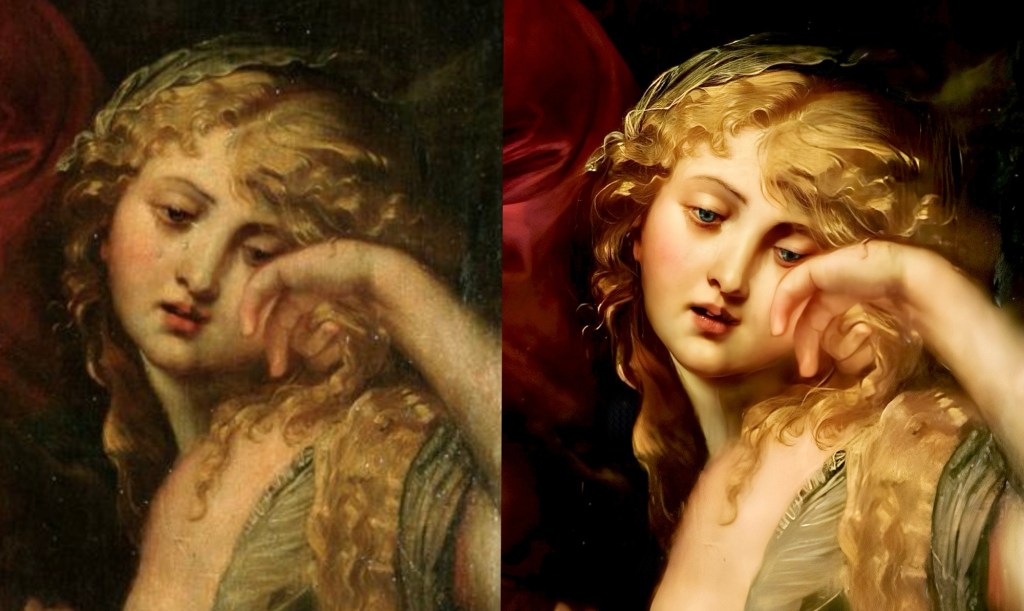
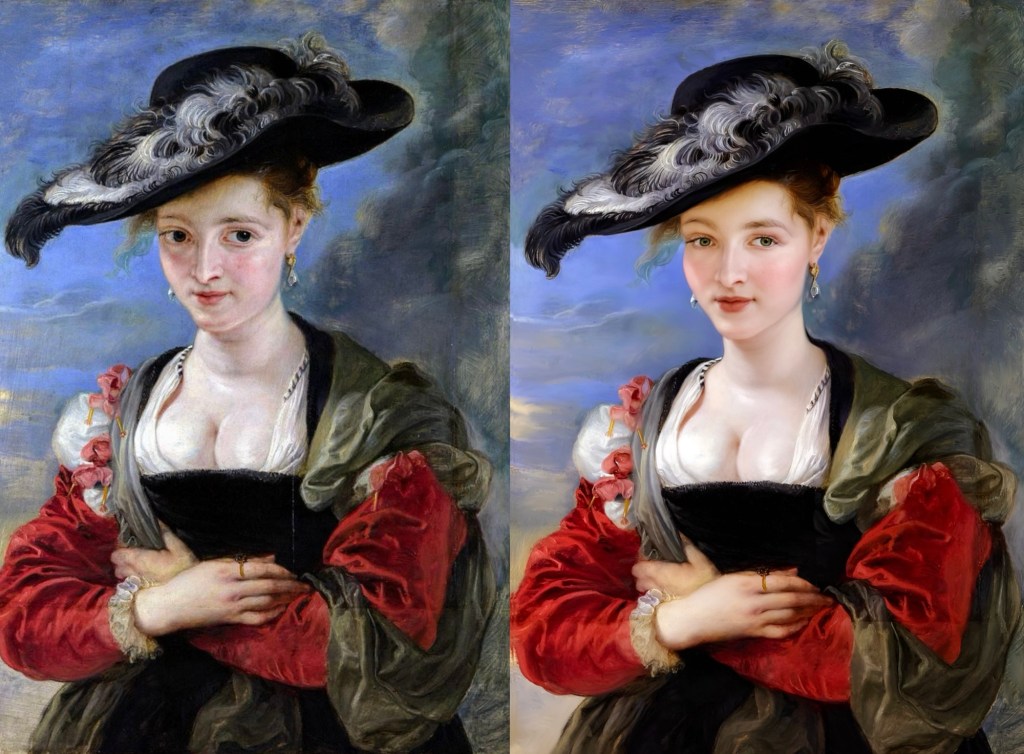
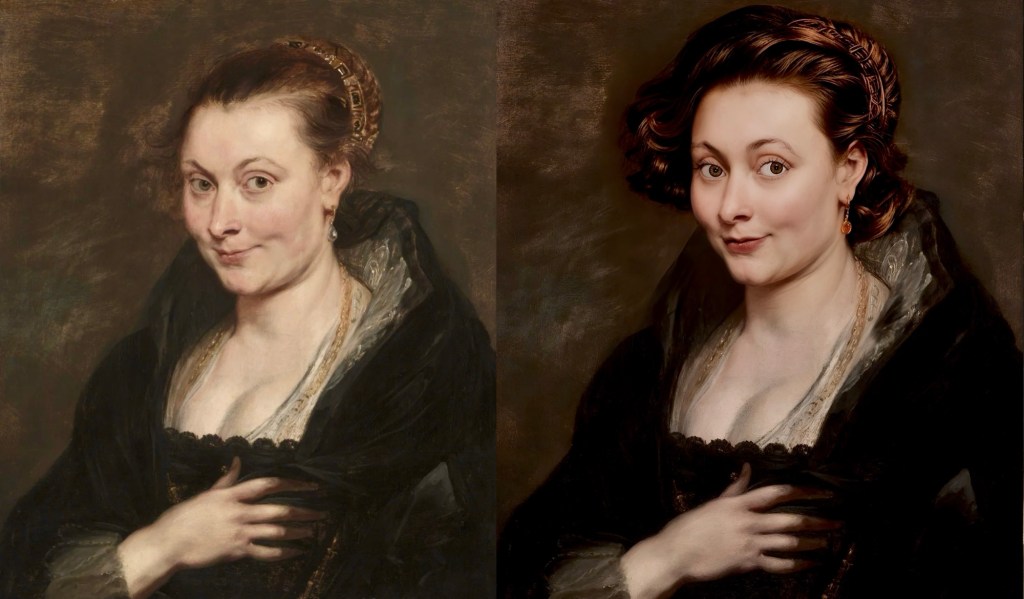
I’ve been looking at Rubens lately, obviously a master. Very accurate depictions, but with plenty of tricks up his sleeve in color, composition, and position.

You might wonder what is the difference between composition and position? This is strictly my position, but it may also be in some book that I haven’t read. Position is the fine tuning of a composition, the tilt of the head, the wideness of the eyes, the slight touch of the fingertips. Position is so intentional, yet if it is done well you rarely notice it. Composition is blatant, large, obvious, yet it also strives to hide.

Making an image allows all sorts of subtle moves, much more complex than, “the eyes follow me around the room”.

Here are a few of my tributes to Rubens…

The Disposition, detail
Portrait of Susanna Lunden
Madame Henriot
Woman Smiling
Isabella Brant, wife

You might notice that in the original there is a tendency to position “chin down”, also the eyebrows are lowered. Rubens also magnified the eyes in my opinion, unless he happened to only paint women with large eyes.

Some critics have said that Rubens added a few pounds to his models, and preferred a softie form. This also tends to round the face in portraits.

In addition to other choices for these “tributes” I have raised the gaze, shortened the nose, reduced the orbits and eyes, and trimmed the jewels.

Not to make it better, different perhaps. What I really want to know is what are his decisions when making an image.

Posted in Commentary | 1 Comment

Dreaming

Tribute to Jesse Allen

It was the summer of 1967, I had no specific plans. I had graduated but I had made no plans to go to college. It didn’t cost much to go to college in California, it was free at all the state schools. You did have to apply, you had to see a counselor, you had to ask.

I’m the guy that took the bus but never transferred, because I didn’t know how that worked, and I didn’t know how to ask.

For years I took the No. 72 line bus to Berkeley, but then walked up University to Telegraph Ave, I didn’t know the right bus, or the right fare, or how to transfer. I also knew the L line to the San Francisco Terminal, but I had to walk from there.

Getting to the admissions office at any college was impossible without help, because I never asked.

So when fall came, I went to the library to “study” for six hours. I went to the last stack, and pulled each book, skimmed the contents and then read about a third of the shelf. Then I went to next shelf, 12 shelves to a stack, eight stacks to a row.

That fall I finished two rows, that was about 360 books. In between I looked at current magazines. I found a Gallery magazines that promoted new up and up coming artists. One article featured Jesse Allen. I was mesmerized. I was certain he was going to be great, because I knew what great art was, I had been to museums in San Francisco, I had seen books. Jesse Allen was new and on the edge to be important.

It was the first time that I considered that it was possible for me to have a career making images. Of course I had to start making them seriously. I had only sketched a few things on butcher paper, and colored them with chalk and Indian ink.

And I was still making them very small, almost as if my arm was paralyzed, even my hand paralyzed, so that only my fingers moved.

I knew something was not right, but I didn’t know what it was, and I didn’t know how to ask.

Where was YouTube?

So I would copy Jesse Allen’s creatures and plants, out of context, very small, and detached, like floating in space. I liked them!

Life went on and every now and then I would check in on Jesse Allen. People stopped writing about him, but he was selling enough to keep going. He never became super famous, but he made a living make images and selling prints.

The span of time increased between my investigations. Evently I even got a job making images.

I had almost forgotten his name, and had to play the alphabet game to come up with Jesse. It’s probably been twenty years since I last looked at his work.

He is still doing the same work with more care and maybe with more detail.

I found a copy of his piece that he did in 1968 that had stirred something in me.

I decided to do a tribute piece of that work.

Posted in Commentary | 1 Comment

Da Vinci

My DaVinci Doodling

I’ve been reluctant to redraw/repaint DaVinci. I wasn’t confident that it would turn out well. And it’s such a cliche to do a bad Mona Lisa.

So I worked my way up and around, and had a few successes. I’m kinda satisfied!

Tribute
Tribute
Tribute
Tribute
Tribute
Posted in Commentary | Leave a comment

Fix it?

Tyson and Dent

Lately, driving around the neighborhood has become a real chore. It’s not like I have a lot of choices; there are only three roads in, and they’re all twisting two-lane roads at that. There are four or five developments connected by these roads, and each has its own series of “road humps” to slow the flow of traffic.

In a traditional grid layout of a city, if a road is closed for repair, a quick detour of two or three blocks is an easy solution. Not in my case. Of the three “arteries,” one was closed in both lanes, and another was semi-closed with a wait of about half an hour.

Of course, this meant that the third road was completely full, crawling along like the Bay Bridge in commuter traffic. Worse yet, these people weren’t professional commuters; it was brutal.

I was making a right turn to avoid some “speed humps” directly ahead. It helps to have local knowledge. A newer white pickup slowed to let me in. I silently thanked him and raised my hand.

Suddenly, the road widened, and he was directly to my left, yelling at me. I slowed down; he slowed down. I thought he might have misinterpreted my gesture, then he yelled, “I can fix that!”

I was confused; I didn’t know what he was yelling about. My 18 lb. Maltipoo Tyson was looking out the window at him. So I thought, “Tyson is already fixed, except for some obnoxious behavior that he can’t know about.” So, I verbally responded, “What do you mean?”

“That dent in the quarter panel, below the door. I can fix it; pull over and I’ll give you a quote.”

Pulling over for strangers is not something I like to do. On top of that, I was still very confused because I couldn’t quite let go of the idea that he was talking about my dog. Does he have an operating room in his basement? Perhaps he’s taking an online class to be a veterinarian, and is willing to pay me to fix my dog?

I think that last thought was still fresh in my mind even after he said he was asking about the dent in my quarter-panel. So, I waved him off, letting him know I wasn’t going to pull over for him. I yelled, perhaps too loudly, “Besides, I don’t know why you want to pay me to fix my dented quarter-panel!”

His face changed dramatically as he hit his brakes, letting me zoom forward. I can see now that my confusion was viral and spreading quickly.

I checked my rear-view mirrors and saw that he was in the process of a tight U-turn. He didn’t want the risk of being behind me as the road was getting very twisty and rural. 

A wise move!

Posted in Commentary | Leave a comment

On Vacation

Vancouver BC

Hmm, I’m vacating, the act of being on vacation. Not vacating everything, I’m vacating with family/kids/grandkids. We are all vacating something.

We all had agendas, things to do, requirements, responsibilities, busyness. Hmm, I never saw the connection between busyness and business until I tried to spell it.

We left the country, we used our passports. That’s how we know we vacated. We left with permission, then we entered with permission, leaving our homes.

It’s a curious fact that we are required to leave something, in order to refresh ourselves, to be on “vacation”. If you are retired- vacation seems ongoing. It’s not, people simply replace the work responsibilities with other responsibilities.

But now we are vacating everything, except being here now!

In a few days we will vacate to board a boat to Alaska.

Posted in Commentary | Leave a comment