A Political Plan

I’m a politician and I want to do something. I want to have as much support as I can get, in order to handle any negative issues about my actions.

I can’t ask for blind support, as this will stiffen the opposition. It is a very polarized political situation.

I will not do what I want, so that the opposition begins to demand that I do, what I really want to do, even if they don’t know that I want to do it.

I do not act, or respond, for over a week to an event. I let the opposition form opinions about my inaction. My inaction creates no real danger, but the rhetoric builds.

Then, at the very next event that is remotely similar, I can reverse myself, and act without danger. I can do what I wanted to do in the first place, not only once, but as often as once a day for three days, without opposition.

Yep, that’s a plan.

I have a “fall guy” to confuse things. I have multiple statements from the opposition to validate my actions. If there was a mistake, I can shift the blame.

Never pull a weapon unless you are prepared to use it. Never use it unless you know exactly what you are using it against, unless you have a plan for that.

Posted in Commentary | Leave a comment

A Bright Light

I saw a notice in our neighborhood blog about a noise, and a bright light at 12:00 am. The neighbor wanted to know if anyone else had seen it. Dozens of people responded that they had, and suggested that it was fireworks.

Sixty years ago, my close friend said that he had discovered the formula for gunpowder, he didn’t do this by trial and error, he found the proportions listed in some old textbook. He then told me that it was some common chemicals, that were easily obtainable. The hardest to find could actually be purchased at the local drugstore. We enlisted a friend to buy some, and we bought the rest.

What trouble could three teenagers get into with a pound of homemade gunpowder? Our first idea was to buy a pound of caramel chews, melt them in a pan, replacing the sugar in the formula. We could then pour the liquid it into a tube, let it cool to a solid, then we would have a solid fuel rocket… if we added wings.

One of us, with more safety consciousness, said that it probably wasn’t safe to have gunpowder around a flame. We agreed to mix the ingredients dry. All we had was the large coffee can, from my father’s morning brew, Folgers.

It was all about proportions, one half of this, one third of that, etc. by some miracle we added every thing and it filled the can to the brim. We put the lid on it, taped it shut, grabbed some matches, some sparklers, and waited till dark.

The sun was down but we had a problem, at first we thought we would set it off in the alley behind our houses. But we weren’t sure about the end result. It could be a flare, it could be an explosion. We didn’t want to blow up our neighborhood, plus we would certainly be found to have been the ones buying chemicals from the drugstore.

There was the asphalt field at the junior high, but it was ringed by houses, so that was out. We didn’t want to use our bikes to go out into the country. We were lazy, and didn’t want to start a fire. We settled on the local high school football field, 50 yard line, on the school logo.

We had been there before, so we knew it was surrounded by a high chain link fence. I mean very high, three times the height near the stands, and twice the height near the end zones. We quietly climbed the three story fence near the stands.

We managed to carry over the coffee can, the matches, and a few sparklers we had from July 4th to act as a fuse. It was very dark, which was good for us, but we had to take a few moments to find centerfield. We placed the can on the logo, took the lid off, and prepared to light the sparklers.

We first thought to light the sparklers, then toss them into the can from several yards away. We didn’t get remotely close enough. Then we thought about dropping it in as we ran fast beside it. We didn’t even try that. We ended up lighting the sparkler near the can, dropping it in, then running to a safe distance.

I don’t know how we knew a safe distance for one pound of gunpowder. Was it ten yards, fifteen yards? I think we opted for twenty yards. We looked back into the darkness and we could barely see the faint flicker of the sparkler inside the can. It hadn’t ignited. We waited a full five minutes until the sparkler was nearly out, then there was a whoosh!

It wasn’t a bang, it didn’t explode. If it had, I probably wouldn’t be able to write about it sixty years later. The whoosh came from gases being thrown out of the can into the dark sky. From my memory it was as if a moon rocket had buried it self into the earth, with flames going thirty to forty feet into the air. It was so amazing that it didn’t explode, and that we were safe and watching this wonderful light. I could see the laughter of my friends, I could see every freckle on their faces. It was so bright!

We were at least 60 yards from the closest fence, it was like daylight everywhere on the football field. We stood out so plainly that everyone could see what color of clothes we were wearing.

It wasn’t going to be long before neighbors were going to ask questions. It wasn’t going to be long before the police would be looking for us.

It took so long to get to the fence that I thought we would be caught coming down the other side. It was quiet here and some trees had hid the light so that neighbors were not standing it the street wondering.

We hid in some bushes to formulate a plan. Something that we hadn’t conceived earlier. We thought about splitting up and going three different ways on the five block run to our homes.

We didn’t like that, the odds were that at least one of us would be caught and tortured. So we kept together, sending one person out to find the next hiding spot. We took at least two hours leap frogging from one spot into the next. We got home safe.

The following day we heard about a bright light on the football field. They said it was fireworks.

Posted in Commentary | 1 Comment

The Vandal

Genseric “the Lame”, king of the Vandals. He was my 42nd great grandfather, he ruled over the Germanic tribe of the Vandals for over fifty years, from approximately 425 to January 25, 477.

He was born in Pannonia, which is now in Hungary, and died in Carthage, Zeugitana, which is now in Tunesia, North Africa. How that happened is one of the strangest stories in history.

Rome was still the premiere civilized country during the 400s. Earlier on the descendants of the Phoenicians had built a decent empire around the city of Carthage in North African. The Romans didn’t like that, and a series of wars occurred. It wasn’t all a Roman victory, the Punic Wars were back and forth, and a Carthaginian general named Hannibal nearly destroyed Rome.

In the end, the Romans vanquished Carthage, but feared that it would return, so they did something unusual for even Rome. They carted hundreds of wagons of salt, to spread over the city, and its fields for miles around. They wanted the city to starve and never be able to grow crops again.

Then Rome went on it’s way to conquer the world. They were stopped in a few places, the Medes and the Parthians caused some trouble, but they were so far East that it was another world.

The main problem for Rome was up north. The Germanic tribes lived in a dark forest, and resisted being civilized. And they fought like wild men.

Eventually the Romans stopped trying to make the north into provinces, and used the rivers as a natural border. Keep them on the other side, and we can trade with them now and again.

The Romans didn’t know what was on the other side of the Germans, and that was a problem. The Romans had gone to Gaul (France), and even up to Belgium and Britain, but they kept the Germans in their dark forests.

In the Germanic East the forest thinned to fertile grasslands. The Germanic tribes that were there enjoyed good farming, with rich harvests. The rich harvests attracted tribes that were even farther East. The Hunnish invaders made regular incursions, and some brought horses and carts with the intention to stay. They were fierce fighters, so the Germanic tribes were being pushed to the West.

The problem was the the West already had people living there, and they didn’t want to be replaced. It wasn’t going to be a domino game. The Ostrogoths and the Visigoth tribes decided to keep together and move as a unit through the Eastern part of Germany, or Allemania as it was called.

When they came to a border with Rome, there was conflict, so they continued West. The Visigoths ended up all the way in Spain. The Ostrogoths moved from Romania to Northern Italy and Switzerland. The Vandals were relatives to the Visigoths so the went to Spain as well.

The Vandals were good fighters but everybody was on the move, and they needed to change in order to find their “place”. When they got to the end of the road in Spain, they could see Africa beyond the Gibraltar Strait. They could see the water.

The tribal leaders said, “Let us became sailors, it can’t be that hard!”

Maybe no one said it, but that is what happened. The German tribe called the Vandals, left the plains and the forests, and they became fighters in boats, cruising the shore that was mostly desert.

There had always been pirates, but they were individual thieves sneaking up on travelers or cities. Thousands of years ago there were the “Sea Peoples”, that bought an end to the Bronze Age, but nothing since. This was a tribe, an entire nation that changed there lifestyle. They were very successful.

They continued going East, hugging the coast of Africa until they hit a very attractive area that had harbors and some small villages. It was the ancient site of Carthage. It had recovered to some extent, and the Romans had left it alone for centuries, Spain and Egypt were the breadbaskets.

Using Carthage as a base the Vandals traveled everywhere in the Mediterranean, and they kept bumping into the Romans. By now they knew a little history, and they even knew how Attila the Hun was pressing down from the north.

Rome had even hired German generals to fight back the Germans. A select few tribes were invite to live on the Roman side of the river, to act as a buffer. Some tribes even joined the Roman army.

The Vandals attacked and conquered nearly all the islands off the coast of Europe. The Mediterranean was their lake, Sardinia, Sicily and the Baleric islands were their empire.

From bases in Sardinia and Sicily it was easy to an attack on The City of Rome. Thirty years earlier it was beaten by Alaric and his Ostrogoths.

Genseric threatened Rome but the Emperor Valentinian III had offered his daughter in marriage to Genseric’s son. This was a typical royal bribe with a bride.

Rome had remembered the horror of Alaric breaching the walls of Rome, but they had a Roman general Aetius that was very good about keeping the Germans off guard, and away from Rome.

The Senate grew afraid, with many senators making plans to flee Rone with their wealth, one Senate leader thought that he would be a better Emperorand used his money to buy influence.

Petronius Maximus knew that he could never remove Valentinian as long as Aetius was around, so he made a plan to get rid of Aetius.

At every opportunity he whispered to Emperor Valentinian that Aetius was getting too popular. The Army followed him, the people cheered his victories. Even the Senate had shown extreme thanks.

After months, it finally worked. Aetius had a meeting with Valentinian to discuss the budget for the military, when Valentinian drew a sword and hit the unarmed Aetius in the head. For weeks he bragged that he had killed the “traitor” Aetius.

One senator remarked, “Yes, the Emperor had used his left hand, to cut off his right hand.” Without Aetius, the tribes attacked the border. Without Aetius, the Army was leaderless. More Senators fled the city.

Eventually Valentinian planned to leave the city as well. His personal guards were two centurions that had served with Aetius. The Emperor Valentinian III was killed as he left the city.

Petronius Maximus was thrilled, he immediately made himself Emperor and started his plan to control the country. Petronius Maximus married the Emperor’s widow Licinia, then he cancelled the wedding of the daughter of to Genseric’s son, and made her marry his own son.

This was the last straw for Genseric so he attacked Rome, broke through the walls and the Vandals sacked the City for two weeks. In the end we still remember this when we use the term “vandalized”.

Petronius Maximus fled as the Vandals arrived, became detached from his retinue and bodyguard in the confusion, and was killed.

After the two weeks, Genseric left with the Empress Licinia Eudoxia and her daughters Placidia and Eudocia.

Eudocia did marry Genseric’s son after all.

Posted in Commentary | Leave a comment

My Father

He was born Jan. 7, 1909. He died on April 27, 1998 of respiratory failure due to a cerbravascular accident, and had asbestos related lung disease. Today he would have been 114 years old.

My father had no official birth certificate. On June 15, 1942 he self applied for a delayed registration birth certificate, signed by his mother and filed with the District Court, Cass County, ND.

The certificate states that Edwin Robert Diesler was born in Bingham Township, Barnes County, ND. on January 7, 1909. She states she does not remember the doctor or his address. The reason for the delayed request is that Edwin wish to work for a construction company in South Dakota.

Edwin started first grade at Wilson house in Fingal, ND. Second grade in Jamestown, ND. 4th grade in Fargo, 10 years old. His father was not stable and often drank too much. One time he chased Ed around the house until Ed jumped in the flour barrel to hide. Frederick and Amelia divorced that summer. Amelia lived with Mr. Busch in 1920. Edwin was 12 years old and said “Busch or me”, in the house on First Street. Amelia said “Busch”. Edwin left for his sister Girlie’s house in Fargo.

Edwin traveled with his father Frederick that summer, making rope for various farms, came back and moved in with Lyle & Girlie Davis on Seventh and First Street (upstairs). Then after Busch and Amelia moved to Northside, the Davis’s and Ed moved into the First Street house. Stayed there till Ed moved to Indiana in 1926.

Ola, Esther and Bill Bannock (Esther’s husband) were in South Bend, Indiana. Edwin went to Detroit (Jack Ostrom, had friends there) with Ben and Ethel, but couldn’t find work, so Ben and Ed continued to Indiana. The move to Indiana was the result of a lack of money, Ed had a hard time making it for junior year (16 years old). Esther, Ola, and Ed spent the winter of 1926 in Indiana. Edwin went back to Fargo early 1927, as his father Frederick had died. Ed & Girlie, made the service despite the winter storms

Edwin moved back with Lyle & Girlie Davis to finish spring term of senior year in 1927. He worked at the Park board then finished senior year at the Fall term 1927, graduating at 19 in January, 1928. He worked in the Park service after graduating.

Edwin met Billie Elgin that summer in 1928, on the bridge between Fargo and Moorhead (Front Street). He married Billie in June, 1929. Census of 1930 only records Edwin as lodger at the Davis’. Where was Billie? His son Bob was born in 1931. Ed worked at Park board for three years.

West Fargo Packing house offered a pitching job (baseball) and he made more money than his regular truck driving park service job. Ed was offered a full time job (that way he could pitch for them for free). 100 hours of work for $24. .25¢ an hour for the first thirty days. Ed quit.

The supervisor found him walking home, and convinced him to come back. Offered .35¢. No! .45¢. Yes! The baseball team was semi-pro, Ed played against Satchel Page for three games in pitcher duels, he actually won one game.

1932-39. He was on the Ice gang, killing floor, loading floor, loading 30,000 lbs. , scaler, the security job came with new manager. Replaced Earl (Groucho) Marx, West Fargo Armour Chief of Police, Ed was effectively the police for civilians in West Fargo. He rose to Chief of police. His daughter Gayle was born in 1936.

He performed as watchman to making rounds, looking for fire and stealing out of the pens, and general supplies. Left Armour after two years.

Edwin tended bar, substituted for Fargo police June Sept 1940. That winter/summer he sold Lennox furnices. Winter of 1940 tried out being a plumber’s helper. Spring/summer of 1941 he worked at Black Hills Ordinance as part of pre-war work, in the fall he worked in Wyoming, near Scotts Bluff.

Winter of 1941-42 did nothing. In December the war started. Obviously, things were getting bad. Spring 1942 Kaiser advertised for ship builders, and Ed went to California. He went to Minneapolis, and saw his brother Bill on the way to sign up. The train left there to go to California.

Ed asked to be a assist shipfitter, C 4’s, in Basin 5 in Richmond, Ca. Kaiser Shipyards 1942-1945. For the first two years he was alone on the west coast, sending money back to Fargo. In 1943 his second son Edwin was born in Fargo.

While he was still building ships, his daughter Gayle came down with a sore throat. Very quickly it became serious because it was actually Scarlet Fever, but he could come home, Gayle died three days before her 8th birthday.

After the war ended, he spent three months picking tomatoes and grapes. Standard Oil was hiring in 1946, he joined the labor gang, within a month he got into the boilershop. Ed & Billie had their third son in 1949. Ed retired in 1970.

Ed loved car camping, he spent every weekend in the summer, driving old logging roads to find the perfect campsite. He also spent some time in camping resorts, like Snug Harbor, but he preferred the wild spots.

He was not generally a hunter, but he loved fishing. And if we weren’t camping them we were somewhere on the Bay shore, fishing for strippers.

For several years he sailed a small Norwegian dinghy in the Bay, or lakes when camping. Ed also loved bowling and in some years he even bowled in three different leagues.

One winter he purchased an unfinished bow, he started shaving it down, and he got into archery in a big way.

When relaxing, he enjoyed reading western novels, or crime dramas. In between he would play solitaire. He liked one deck of cards so well that he kept playing with long after the ink had worn off. He could only faintly see what they had once been.

The couple moved to Tacoma, Wash. In retirement Ed and Billie enjoying eating out, and going to “the woods.” The woods was ten acres of land just north of Mt. St. Helens. They had a one room cabin, with the kitchen outside under a tree. Both of them were there when the mountain blew up, and they spent several hours getting out, under lots of ash, with zero visability.

In 1995 he sent this to his high school newspaper: PROBING THE PAST, By Edwin Diestler, class of ’28, Tacoma, Washington

(From Spring 1995 Cynosure)

The last four issues of the Cynosure have had no input from the class of 1928, and sad to say the only place I’ve seen their names is in the obits. Have the others gone?

I still probe my past and here are some of my reflections:

Favorite teachers: 1. Mary Fowler – very dedicated! 2. Norma Gooden – supervisor of our class play, “Pals First.” 3. Grant Sifritt gave me a 99 in Trigonometry, and when asked why it wasn’t a hundred, he replied, “No one’s perfect!” 4. Ina Johnson – very strict, very warm and a wonderful teacher.

Sports memories: 1. Jimmie O’Connor jumping over high hurdles set up in the hallway getting his legs in shape to jump center. 2. Bud Bristol – speedy forward of the Midgets basketball team coached by Mr. Kimball – the team that lost the National Championship to Fitchburg, Massachusetts. 3. Breaking my ankle in football practice and having movie star to be, Virginia Bruce, carrying my books to my morning classes as I hobbled along on crutches.

THE “LEFT-OUT” END

By Edwin Diestler, ’28, Tacoma, Washington

When I played on the football team, we practiced in the old Fargo College stadium (below what is now Western States Life Insurance Company office building). I played left end and was the lightest man on the line which included the Folendorf twins, Walter Shamp, and Claude Miller.

We scrimmaged against Concordia and Moorhead State Teachers college in 60 minute games and beat them both by two touchdowns.

Bob Lowe was the coach, and he was really enthused about our chances for a winning season. And as it came to pass, he was right. The Midgets were undefeated that year-but without me! It happened at practice early in the season. I jumped up to catch a pass, and when I came down, I shattered my ankle.

For two and half months I hobbled around on crutches-a very disappointed “left-out” end.

The bright spot in the crutch-walking days was a pretty young girl named Virginia Briggs. Every morning Virginia carried my books to morning classes for me. Not every guy in Central High could tell his friends later in life that a real live movie star toted his books every day.

For you youngsters, Virginia Briggs was later a big Hollywood star named Virginia Bruce.

Later in life, when his wife was Ill with cancer, Billie was hospitalized, Ed went every day to sit with her, sometimes just sitting in the chair dozing. Nursing staff called him “Old Faithful.” He was quite proud of that.

Ed moved into a care facility near People’s Church, Tacoma. Two years after the death of Billie, Ed collapsed at the table in the dining area.

Recovering briefly at the hospital, he died peacefully in the presence of his granddaughter, Sheila.

Posted in Commentary | 1 Comment

6/20/03

We crossed waves upon waves, as seen from the air, and time passed, compressing the experience to a dozen uncomfortable hours, instead of months of sea and sun.

Land down under our intention, Playing music our desire.

Steam and sulfur greeted us, from Stygian depths. Welcoming threats, with extended tongues, and rolling eyes, A forever Māori bond.

Land down under our intention, Playing music our desire.

Green fields and Wooly shapes, Forced into paths by a crouch, and in ever smaller circles.

Dogs that leap from back to back, As stoic sheep chew and ponder… The audience.

Land down under our intention, Playing music our desire.

7/17/03

Palms that wave, the royal wave that comes from years of training.

An extended frond that slowly turns in the wind, greeting and beckoning, with grace and noble beating.

I have this multiple vision, of a flat horizontal sea, framed by palms, and the net of a swinging hammock. I must be on vacation.

7/18/03

Today I stepped on new earth that rose from magma deep. mother giving birth to child, as unlovely to look at as can be imagined.

Yet time will pass, and the child will develop, and gain the raiments of forest and grass, while we scamper on the surface like sand mites, barely aware of our host, and the time it takes to get here.

Today I stepped upon new earth, vaguely aware of our parasitic nature.

Posted in Commentary | Leave a comment

Kids in the 1950s

“The Games We Played”

(From an email by my brother Ed}

As you say, there were different rules in different neighborhoods that people played by. These are the rules that we played by on 15th street.

The marbles were purées, cat eyes, aggies, opaque colored glass, and steelies.The common marbles were mostly of a uniform size. They were mostly common cat’s-eyes and the white opaque marbles with opaque colored swirls. These were the common marbles that you gambled with, or (anteed up) put in the “pot” just as you would ante money in a poker game before the deal. 

These marbles that you put in the pot we’re often called “dates”.  I don’t really know why, but, when a game started, someone would say something like, “Okay, everybody ante up 5, “if you want to play, throw your “dates” in!

The ante could vary, but it was usually 5 or 10 marbles per player. A ten ante game, with five players, added up to a nice 50 marble pot.

Then there were marbles we called “shooters”. They were bigger than the ante marbles, and they could be of any type from cat eye to steelies.  

We called them “half-sizers“ because were “half again” the size of a regular marble.  The added weight of these half-sizers would help to knock the smaller sized marbles out of the ring.  In many games, half-sizer steelies were not allowed because they just gave the shooter too much advantage with their weight.

In all neighborhoods, these “shooter” marbles were revered by the players and would never be put into the “pot”, but sometimes they would be traded for a certain agreed number of common marbles. The “shooter” marbles were of a higher quality that we all recognized.  Today, some of the marbles that we played with are worth many hundreds of dollars each to collectors. The one bad thing with shooter marbles is that they would eventually get all chipped up from hitting the other marbles so often. It might be chipped and scratched and no longer pretty, or in collecting condition, but it still could be your favorite “shooter”.

Your “kid wealth” seemed to be determined by the amount of marbles that you owned.  

I once went over to a kid’s house, and he pulled out a big full-sized cardboard carton that was full up to 3 or 4 inches from the top with purées, aggies, commons, and “shooters.”  That box had to have marbles numbered in the thousands!  I just looked at the sheer number of marbles with speechless awe — I had never seen such wealth!  It was as if he had just pulled from the closet, a pirate’s treasure chest full of gold, silver, and precious jewels.  

Another game we played were spinning tops. The idea was to hit another player’s spinning top with your spinning top.  You would throw your top down hard on someone’s spinning top in order to break it, or split it in two. 

The only gain here was the sheer satisfaction of destroying your opponent’s top.  There was usually four or five guys playing, so it could become quite a fast moving action free-for-all.

Lagging baseball cards was another favorite. Usually played after school, we would all line up and each take a turn to toss our card — trying to land our card closest to the school building wall. Any tossed card that was a “leaner”, that is, one that leaned against the wall, won everything. When you won, it was quite exhilarating to pick up and add all the losing player’s cards to your stack.

Sometimes there would be ten or more kids throwing, and destroying some baseball cards that would come to be worth hundreds, thousands, and even tens of thousands of dollars today.

(We also destroyed many valuable cards by attaching them to our bicycle wheel’s spokes to simulate a motorcycle motor as the spokes would go around and hit the cards)

Marbles, Card Tossing, and Throwing Tops were kid’s neighborhood gambling games, but they all required some level of skill to consistently win. Being addicted, I played whenever any game popped up, but I never seemed to come out big winners — so I was always buying new marbles.

Posted in Commentary | Leave a comment

An “Icky” Day

There were dozens of kids living in the Wartime Housing Authority in the 1950s.

Naturally, with all those kids in the neighborhood there were a few that were not so nice. In fact, some were downright terrifying. There was one slightly older kid, that was called “Icky”, but not to his face, everyone knew him as Icky. Even his mother used it sometimes.

Icky often had a kitchen butcher knive tucked in his belt as he terrorized the neighborhood, broke up marble games, yelled and chased kids to their homes.

He chased my brother Cork home one day, holding a Daisy Winchester BB gun. At the last few steps he aimed, and fired it at Cork, and it hit him in back of his ear. Shot in the ear by Icky! Back shot by Icky! How low can you get?

I believe the police was called, and they knew about Icky. I have this memory of me being old enough to watch through the front window as I pulled the curtain to the side. People were standing on the stoop and in the front yard. I don’t know if Icky was there. I had drunk half of my glass of milk. Left it there on the window sill, then I went out on the stoop to see better. The curtain returned to its normal position, hiding the half drunk glass of milk.

The memory might have disappeared if that was all that happened. Several weeks, or maybe even months later, I happened to move the curtains to look out the window. There was my glass from the day of Icky, and there was this “icky” blob of dried milk in the bottom of the glass. I had no idea that milk would do that over time. It smelled bad, and looked worse. I was afraid that I would get in trouble so I took it outside and threw it in the trash. We had one less glass in the kitchen, no one noticed.

Posted in Commentary | Leave a comment

Brother Bob

89, I think
8 or 9

I am not my brother’s biographer by any means, but on his 91 birthday I feel it necessary to celebrate his life just a little bit. If I do not have things exactly right, I apologize.

He was born at a tough time in history, the Great Depression still held the country in a cold grip. Our mother was young in age, and even younger in spirit. Bob often said that Mom grew up with him. Economics made growing up tough, and relationships were not smooth.

The war came, and the family physically split as my father traveled to the West coast to build ships, leaving Bob as the man of the house at 12 or 13 years old.

Disaster struck as our sister Gayle contracted Scarlet Fever. At that time there was no effective cure. Penicillin was known, but only available for the military. Gayle died in 1944, three days short of her eighth birthday.

Mom had given birth to Edwin Elgin a year before, and Dad still had to work in the shipyards, but Mom was determined to bring the family together, and moved West.

Bob enrolled in Richmond schools, I believe he went to Longfellow Junior High, then he went to Richmond Union High School, class of 1949. I think my mother missed the graduation ceremony because she was in the hospital giving me birth.

The family was still living in wartime housing and Bob had several jobs while still in high school. I know that he worked in the Ford Motor plant for a time, and then he worked at Felice and Pirelli, the F&P cannery in Richmond.

Bob met Dorothy Carraher, and married her in 1950, and had Robbie in 1951. I was an uncle at two years old.

At that time Bob was living in San Diego near the beach. My brother Ed when down to stay with them several different times, nearly drowned, and had many adventures. I missed out!.

The marriage relationship had problems, and I’m unsure if the Army was involved. In any case, Bob signed up for a hitch in the Army, to become a paratrooper. The Korean War was over but the Cold War was just starting.

After basic training Bob was sent to Germany to prepare to defend the Fulda Gap. According to documents discovered later on, the Soviets had thousands of tanks prepared to push though the Fulda Gap at any time. Some reports say that hundreds of tanks were started, and at idle, waiting for orders to go to war.

Bob finished his time in Germany and went back to the his post in Kentucky, with the 101st Airborne. I know this because he had given me a shoulder patch of the Screaming Eagle, which I promptly sewed on to my motorcycle styled hat. Bob had also purchased a Harley Davidson motorcycle like many veterans, and rode it cross country several times.

On one visit he left me the black cloth, white vinyl, visored hat that I wore nearly everyday. And the hat was even cooler with the Screaming Eagle patch sewn on above the visor. Thanks Bob!

I suppose it was possible that Bob would only do one three year hitch, then get out, but then another life changing event happened.

Bob went to a local bar near the post with several friends. A fight broke out between the locals and the soldiers. Fists were thrown, chairs were thrown. Bob stepped up to stop a chair being thrown at his friend. I believe it was the bartender that fired a .45 at Bob’s stomach, and he went down.

Obviously a family crisis, my mother had never flown in a plane, but she went to Kentucky to be by his side. Bob pulled through, the bullet lodged in his spine, and it wasn’t removed. His days as a paratrooper ended, they wouldn’t allow him to jump with the bullet still in him, and he shifted his Army training to helicopter maintenance. He also decided to stay in as a “lifer”.

Eventually he became an instructor in the helicopter maintenance program and was stationed in Virginia. He moonlighted as a cab driver, decided to buy a Norwegian built, 10ft sailing dinghy, to sail on Chesapeake Bay.

He eventually shipped that dinghy to my father, and that’s how I learned to sail.

Somewhere about that time Bob went to Korea for a year. My other brother, Ed, had also joined the Army and was stationed in Korea. They managed to meet up for a small family reunion.

After coming back to the states, Bob was stationed at Ft. Lewis, Washington and continued working in helicopter maintenance. For a time he entered civilian life and worked at Boeing Aircraft while maintaining his Army reserve status. He also started a family with Peggy, had two daughters and bought a home in Tacoma.

Then he joined the National Guard full-time and ended his career in the service as a top sergeant, the highest enlisted rank.

By this time the Viet Nam War was raging. Bob had tried several times to get released to go over, but he was refused as the service needed him stateside.

I was playing the odds. How likely would I be drafted when both of my brothers had served in the Army, and one was still in the service? I was drafted.

I was also sent for basic training to Ft. Lewis, the same post where my brother was assigned. On one weekend he came to visit me. I had decided to reenlist for a three year hitch and Bob gave me some advice.

I was just a private, not even a Private First Class, I had no rank, no service medals, I was just a boot with green fatigues. And I was in meeting with a “lifer”, with more stripes than all my drill sergeants put together, and more time in the service than any of my officers. It was pretty special!

Retirement did not slow Bob down. He continued to read volumes of books on everything, he took his truck on dumpster runs, and he bought ten acres of woods near Mt St. Helens.

Going to the woods was his favorite thing. He built a two story cabin with found materials from the dumpsters, and filled his house with “hidden treasures”. All the while developing his skill at creating jigsaw art.

He has slowed down in the last years, he doesn’t race dragon boats in the bay of Tacoma anymore, and he hasn’t played pickle-ball in years, but he does walk the neighborhood under watchful eyes. And he is wonderfully loved and admired, full of wit an humor.

I am in awe of my older brother, and I wish him a great year in 2023.

Posted in Commentary | Leave a comment

Sherry Avatars

Posted in Commentary | Leave a comment

Flight

This is a story from my older brother.

We lived in what was called the Wartime Housing Authority. Dozens of buildings built on vacant land to house the workers who were building Victory ships only miles away. They were cheap rent for two bedroom apartments, with excellent oak floors. The war was over, but we were still there renting.

Money was tight, not as bad as during the war, but there was still not a lot of money for extras. Even .50 cents went a long way to buy food.

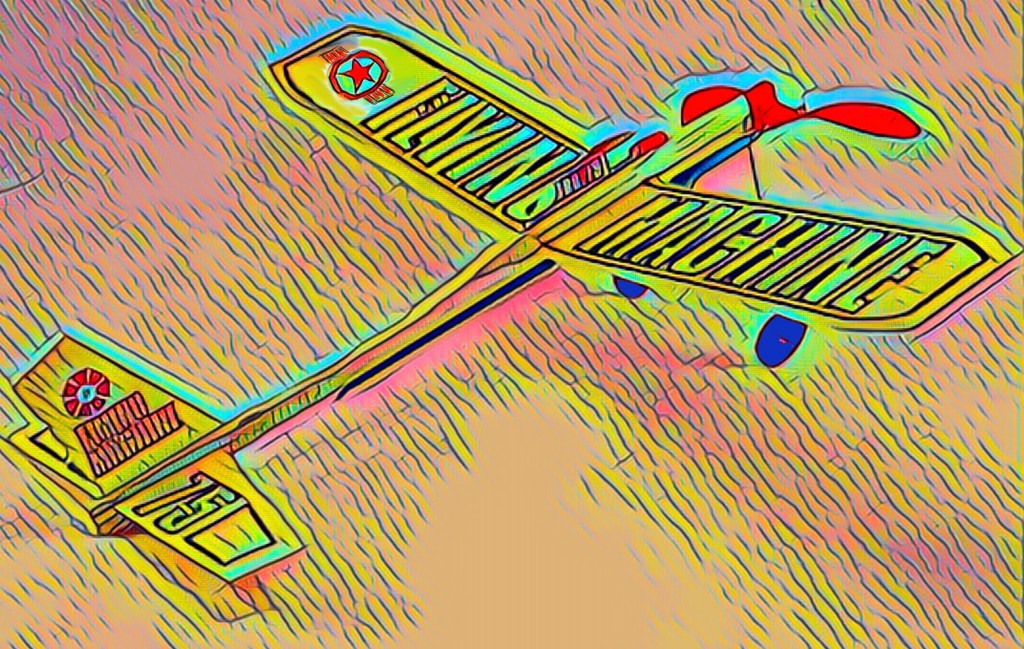
At the local Golden Rule Market there was the twice a week shopping trip with Mother. Naturally I spent some time on the aisles that featured toys. I had fixed my attention on a package that contained a balsa airplane. It was a long flat package with some red plastic parts, and some wooden balsa parts that had Air Force markings painted on the wings. It had a price tag of .50 cents.

Each succeeding week I asked my mother if she could buy it. Priorities required that hamburger, pork chops, bread, milk and vegetables were handled first. There wasn’t much left in the budget for tiny aviation.

Then one week, it suddenly appeared at the checkout, and I took it home! I carefully opened the package to take out the various parts. The plastic pieces needed to break loose from the plastic tree. The wooden pieces needed to be punched loose from the die cut balsa.

The directions were simple, it had a nose piece that slipped over the front of a foot long plank that acted as the planes fuselage, there were blue plastic pieces glued to the side of the plank were the wings were slid into a curved groove. The wings were maybe 8 inches long, with the Air Force symbols painted on, and the blue plastic clip made the wings curve slightly to create lift for flying.

There were more balsa pieces for the tail structure that were placed in tight fitting slots in the “fuselage”. There was also two black plastic wheels on wires that were fitted on a bracket beneath the wings as landing gear.

Finally the was the large red plastic propellor fitted to the nose piece and a rubber band hooked to the tail of the fuselage.

The secret was to wind the propellor in the right direction until the rubber band developed “knots”. Then keep winding until the knots went the complete distance. If you were brave, and the rubber band was new, you could get a triple row of knots for a longer flight time.

With a triple wound rubber band the plane could take off from the ground with a standing start. For even more excitement you could launch the plane while standing up with just a little arm motion. If thrown too hard you risked dislodging the balsa wings stuck in their slots.

I had a great hour or two flying the plane from different positions, in different directions. Then I had the idea of launching it from the porch of the apartment in order to get more height. The plane was triple knotted so it climbed quickly and did a slow banking turn to come back towards the apartment. Unfortunately it veered to the side and hit the very tall bush growing next to building, near the top.

It was a dense bush, impossible to climb, very thick, and it was only with difficulty that I could where it was. I knew it was there because upon landing the bush had dislodged a wing from the groove, and it was now laying on the ground in front of me.

This was a disaster, unreachable plane, no more fun. And I had to tell Mom.

There were many options of the best attitude to solve this problem. The attitude I choose was for Mother to immediately get ready to go to the Golden Rule Market to purchase another plane. I probably would have been wiser to use a pleading voice, but somehow it came out as a pouting demanding voice. My mother was not amused.

She did go out to see if she reach the plane, she couldn’t. Then she calmly said that I should have been more careful, and “I’m not buying another”. I repeated my demand several times, my mother continued cooking in the kitchen.

Finally I sat on the couch within her sight, holding the wing in my hands, thinking about my next move. Slowly I turned the wing over and over, then I snapped the tip off with my right hand. Maybe the sound alerted my mother, in any case, she turned her head from the stove to watch me snap another piece, to fall,on the floor in front of me. “Stop that, you are just doing that to make me mad.”

Snap, again and again. The mound of balsa at my feet was growing larger. “I’m not going to buy you another one.”, she repeated. I snapped the last few bits of the wing, then went out on to the front porch.

I wasn’t crying, I’m not sure what I felt, but it wasn’t normal. I looked over the neighborhood remember how wonderful it was to fly my plane. The wind took it higher than I had ever gone. Even now the wind hit my face to remind me of what it was like for my plane.

The bush was also hit by the wind, and it brushed on the building also like a broom sweeping. I noticed movement to my left. I saw the rest of my plane being dislodged, floatng to the ground, the propellor still turning from the last few knots in the rubber band. It lay there upright, on it’s landing gear, perfect… except missing a right wing.

That was 72 years ago, and I remember it like yesterday.

Posted in Commentary | Leave a comment